The President’s Government Abelardo De La Espriella settled the past October 29in the House of Representatives, the Economic Rescue Lawa project that proposes reducing public spending by about 15 percent. Furthermore, among the measures proposed is the change in health contributions of the workers.
If he Congress approves it as presented, who they earn more than two minimum wagesthat is, more than 3,501,810 pesos, would have an increase in the amount to contribute for this area starting in 2027.
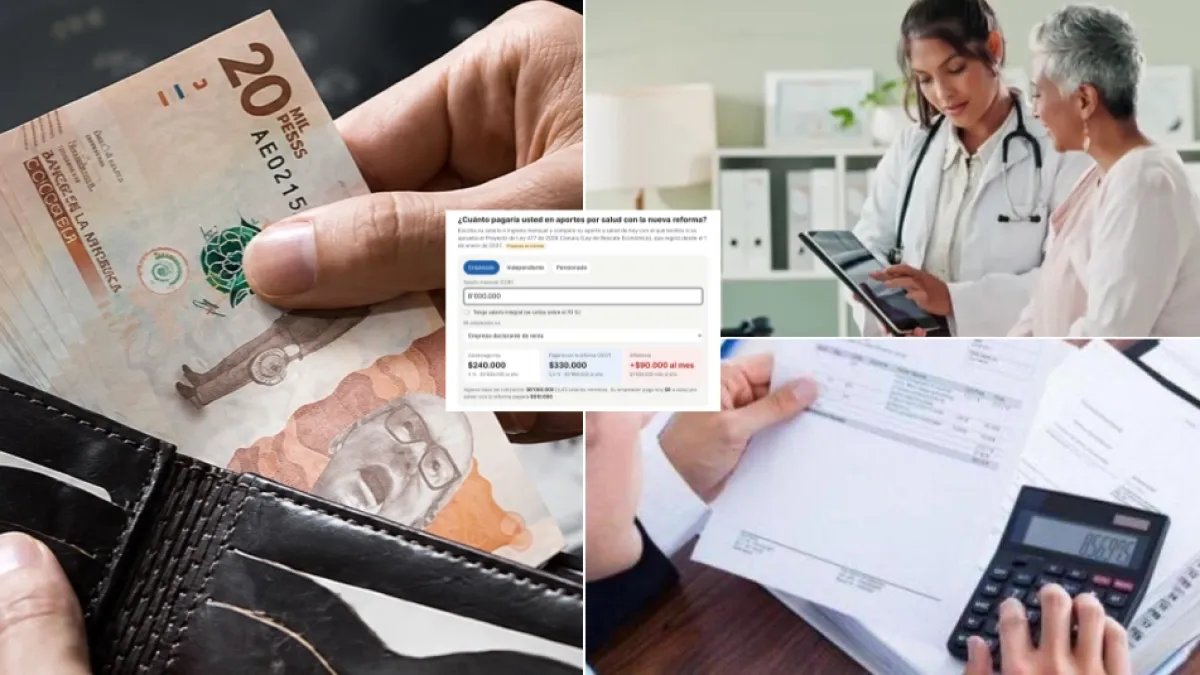
The EL TIEMPO Data Unit reviewed the filed text of Bill 477 of 2026 and designed a calculator to define how much each worker’s health contributions would be, according to their salary. According to the document, the employee contribution, as of today, is 12.5 percent, assumed four percent by the employee and 8.5 percent by the employer. With the proposal, the percentage borne by the worker could be up to eight percent.
These are the new contribution percentages for employees
The project maintains the contribution at 8.5 percent from the employer, but changes the worker’swhich today is four percent, regardless of salary. Instead, establishes a table of eight sections according to income, in which this percentage is preserved for those who earn up to two minimum wages —3,501,810 pesos.
Above that limit, the percentage would rise gradually. It would start at 5.5 percent for those who earn up to four minimum wages and would reach 8 percent for the highest salaries.
Thus, the increase grows with salary. An employee who earns 15 million pesos would pay 975,000 pesos per month, compared to the 600,000 pesos he contributes today. For those who contribute above the limit, the contribution would be doubledgoing from 1,751,000 to 3,501,900 pesos per month.
Since the percentage is applied to the entire salary, it is enough to barely exceed two minimum salaries to pay more. According to calculations by the Data Unit, whoever earns 1,000 pesos above that limit would go from contributing 140,200 to 192,700 pesos per month, that is, 52,500 pesos more.
In the explanatory statement, the Government argues that the contribution rate has not changed since 2007despite the increase in coverage and use of services. According to the document, with the current scheme, the resources of the General Budget of the Nation for health insurance could reach 3.1 percent of GDP towards 2037. With the change in workers’ contributions, calculates an additional collection of 0.2 percent of the GDP for the Administrator of the Resources of the General Health Social Security System (Adres) from 2027.
READ ALSO

The contributions from independent workers and pensioners
Independent workers pay the entire contribution todayof 12.5 percent, on a basis equivalent to 40 percent of their income, according to Law 2277 of 2022. With the project, that percentage would be maintained up to two minimum wages and would rise in sections to 15.5 percent.
With this, the project rises by at least 0.5 percentage points the contribution of independents with a contribution base greater than two minimum wages. Since this base corresponds to 40 percent of income, the change would apply to those who receive more of 8,754,525 pesos per month.
For example, an independent with an income of 12 million pesos, who today pays 600,000 pesos, I would pay 624,000 pesoswith a percentage of 13 percent. With revenues of 20 million, the contribution would go from 1,000,000 to 1,080,000 pesos. These calculations place each independent in a section according to their contribution base, as described in the project’s explanatory memorandum.
READ ALSO

The Government explains in the document that, with the current rules, an independent with an income of between three and six minimum wages pay 25 percent more for health than an employee with the same income.
For their part, the pensioners would not have changes. This is because article 21 of the project only modifies the first paragraph and the fourth paragraph of article 204 of Law 100. Thus, they would continue to contribute four percent from the allowance if they receive a minimum wage; Ten percent if they receive more than one and up to three minimum wages, and 12 percent if they exceed that amount.
That What happens with the exemption for companies
The project also modifies article 114-1 of the Tax Statute. Today, companies reporting income do not pay 8.5 percent of health or contributions to the National Learning Service (Sena) and the Colombian Institute of Family Welfare (ICBF) for workers who earn less than 10 minimum wages, an exemption that comes from Law 1607 of 2012.
With article 20 of the project, starting in 2027 the Total exemption would only apply to workers who earn up to two minimum wages. For those who earn more than two and even three, the companies would pay four percent of healthone percent to the Sena and one percent to the ICBF.
READ ALSO
Above three minimum wages, they would pay all the contributions again. That is to say, in the case of the employee who earns six million pesos, the company would go from not paying health contributions to paying 510 thousand pesos monthly.
According to calculations by the Ministry of Finance, with the change the full quote would apply again for around 618 thousand employees, with an average salary of 4.9 minimum wages, and another 549 thousand would be left with the reduced percentage of four percent. For their part, 84 percent of private sector employees, 6.4 million people, would maintain the total exoneration. Individuals who employ two to five workers would also keep it.
With this measure, the Government calculates an additional collection for the Adres equivalent to 0.38 percent of GDP in 2027. The project states that, with the exemption, contributions they went from representing 54 percent of health system revenue in 2011 to 37 percent in 2025.
How the calculator was made
The Data Unit calculator compares contribution monthly to health with the current rules and with those established in articles 20 and 21 of Bill 477 of 2026 Chamber. To make the calculation, you must choose whether you are an employee, self-employed or pensioner and write the salary, income or allowance.
In the case of the independentsthe calculator places each person in a bracket based on their base contribution income, which is equivalent to 40 percent of their income, as described in the project’s memorandum. The results are a simulation with the 2026 minimum wage. Furthermore, the percentages were applied as established in the text of article 21.
The calculations were made with Law 100 of 1993, article 114-1 of the Tax Statute and Law 2277 of 2022. The contribution base ranges from one to 25 minimum wages and the values are rounded as in the Integrated Contribution Settlement Form (PILA), according to Decree 1990 of 2016. All figures they use the 2026 minimum wageof 1,750,905 pesos, because that of 2027 has not yet been set.
The tool does not include pension contributionsto occupational risks or parafiscal ones. It also does not cover part-time contracts, special regimes or independent workers who deduct costs to calculate their base. Furthermore, the project is in process in committee and must still carry out its debates in the House and Senate, so the percentages could change.
DATA UNIT
SABRINA BASTIDAS IGUARAN