
The financial situation of the Principality is experiencing one of the best moments in history. The growth of GDP has been consolidated, the public debt has been progressively reduced since 2021 and the forecast for 2026 is that it will be only 28%, and access to the liquidity mechanism of European Central Bank (ECB) allows theFinancial Authority act as lender of last resort in extraordinary cases of need.
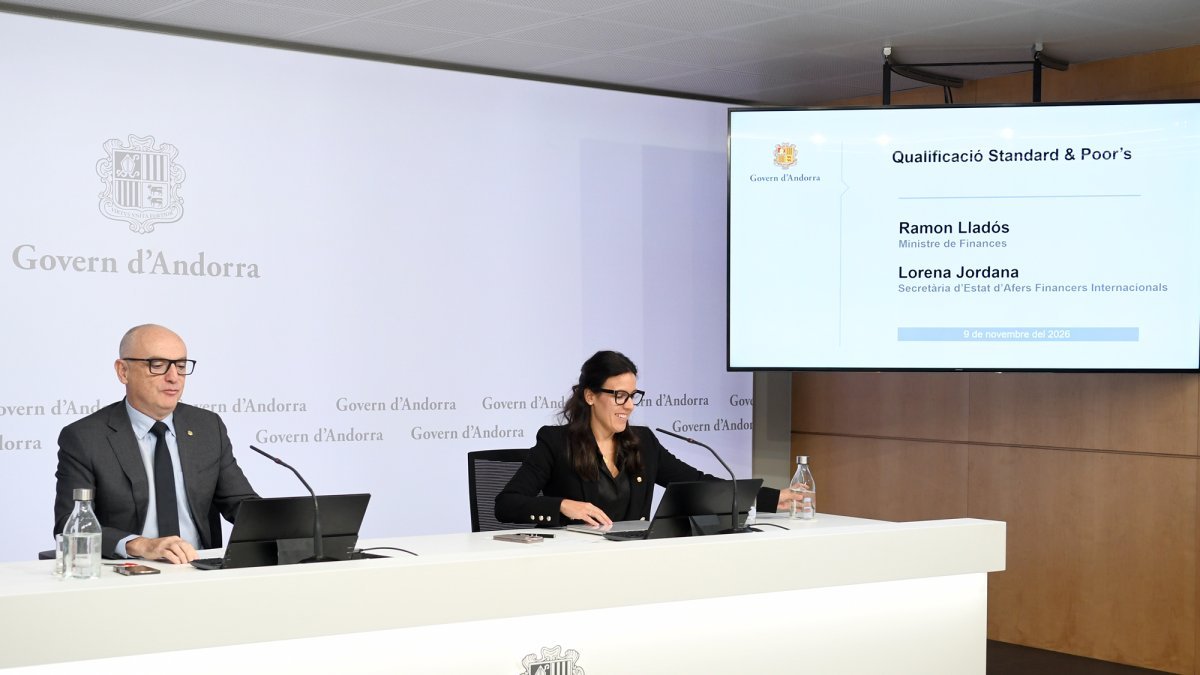
This is how thecredit rating agency Standard & Poor’s (S&P), that improves the Andorra’s position up to category Aconsidered remarkably reliable with a very low default risk. However, this actor also highlights that continuing with the positive line is closely linked to an eventual yes to theassociation agreement with Europe. The Minister of Finance, Ramon Lladósassured yesterday that the rejection of the pact “could be a risk factor for worsening the ranking”. In this sense, Standard & Poor’s put homework on principality for the next few years, one of which is to improve the economic diversification and increase productivitywhich is closely linked to the entry into force of the effects of the association agreement. The manager of the portfolio added that all the credit ratings look favorably on the country’s agreement with Europe.
“Investors who come to the country to develop a business read these reports”
The other main challenge that the country must face, according to this agency, is the reform of the pension system. “Obviously, we have it pending and I hope that in the next legislature sufficient consensus can be reached“, he acknowledged Lladós. On the other hand, the Secretary of State for International Financial Affairs, Lorena Jordanahe focused on the progress that means accessing the liquidity mechanism of the ECB. “It represents a significant reinforcement to prevent and deal with eventual episodes of financial stress”, he emphasized.
“The ECB’s liquidity mechanism is a reinforcement to deal with episodes of tension”
Andorra has improved five steps from the Standard & Poor’s ranking in the last ten years and is now in a position similar to that of neighboring states and above countries like Italybut still a hair away from the considered very strong economies, such as United States, Germany or Australia. Lladós he emphasized in this sense that “new entrepreneurs and investors who want to come to the country to develop their business look and read these reports”. the forecast ofS&P is that the Principality’s economy continues to grow in the coming years, with an annual average of 2.1% between 2026 and 2029, driven mainly by tourism, construction and public investment. It also provides that budget surpluses are maintained thanks to economic growth, expenditure management and the application of strict fiscal rules.