BAKU, Azerbaijan, November 10. The first eight
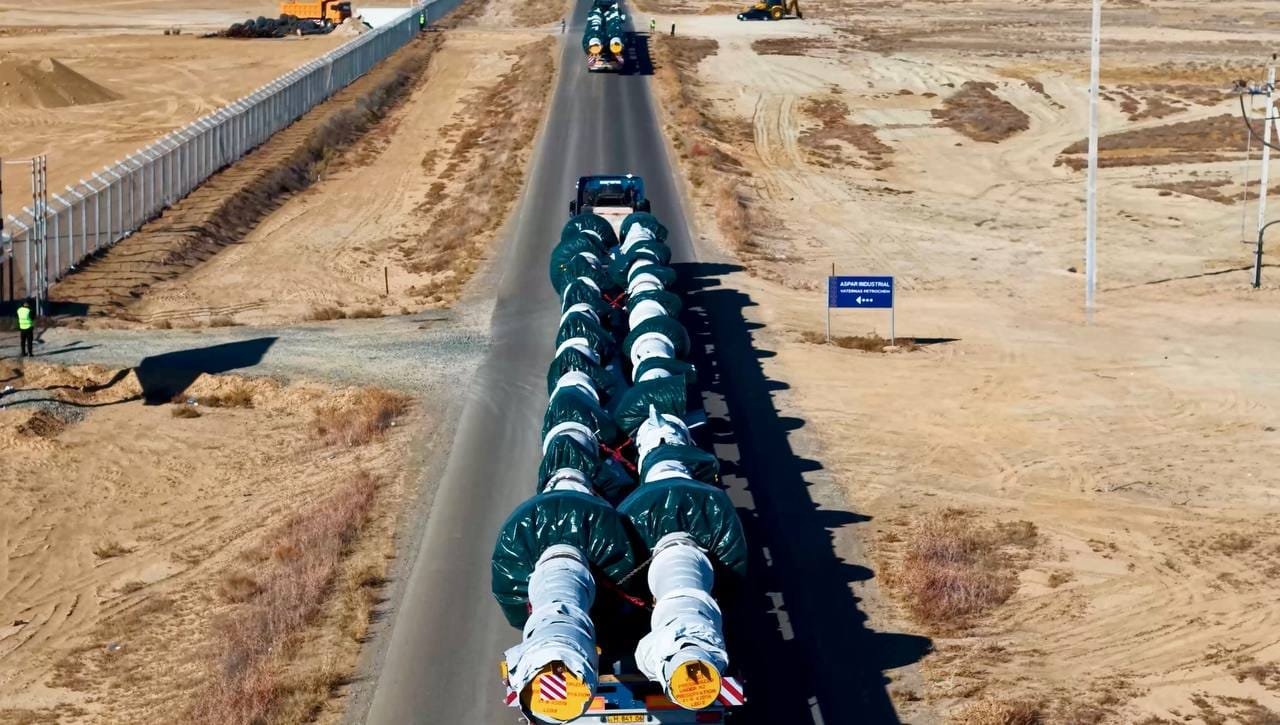
sections of loop reactors, key equipment for the polymerization
unit, have been delivered to the construction site of the Silleno
polyethylene plant in Kazakhstan’s Atyrau Region, the country’s
national oil and gas company KazMunayGas reported.
According to the report, each section is more than 67 meters
long and weighs up to 77 tons. The total weight of the delivered
equipment exceeds 600 tons.
The equipment was transported along a complex multimodal route
using international transport corridors. KazMunayGas described the
delivery as one of the project’s largest logistics operations.
The delivery marks an important stage in the implementation of
what the company describes as Kazakhstan’s largest petrochemical
project.
For reference, loop reactors are industrial units in which
ethylene is converted into polyethylene through a catalytic
polymerization process. In the slurry-loop method, ethylene, a
catalyst and other process components are fed into a closed
circulation system, where the mixture is continuously pumped at
high speed. The catalyst triggers the chemical reaction, causing
polyethylene to form as solid particles suspended in a liquid
medium.
Continuous circulation helps maintain uniform reaction
conditions and remove the heat generated during polymerization. The
resulting polymer slurry is then separated from the liquid medium,
dried and processed into polyethylene pellets.
The reactors are therefore at the heart of the production
process: they are where the main chemical transformation takes
place. Their design and operating conditions affect production
efficiency, product quality and the range of polyethylene grades
that can be manufactured.
Meanwhile, Silleno is one of Kazakhstan’s largest industrial
diversification projects, designed to shift part of the country’s
oil and gas industry from exporting raw hydrocarbons towards
producing higher-value petrochemicals.
Located in the Atyrau Region, the plant represents an investment
of approximately $7.4 billion and is designed to produce 1.25
million tons of polyethylene annually, with KazMunayGas, Russia’s
SIBUR and China’s Sinopec participating in the project. Its
feedstock will be ethane extracted from Tengiz gas at a dedicated
gas separation complex, linking the project directly to
Kazakhstan’s upstream oil and gas industry.
The plant is expected to produce more than 20 polyethylene
grades, around 40% of which will be premium products used in
packaging, construction materials, pipes, automotive components and
other industries. The project also has a significant trade
dimension: Kazakhstan currently imports polyethylene, while the new
facility is intended to replace part of these supplies with
domestic production.
According to KazMunayGas, around 20-24% of output is planned for
the domestic market, with the remainder destined for export,
including markets in the CIS, Europe, China and Türkiye. Beyond
reducing import dependence, the project is intended to expand
Kazakhstan’s non-resource exports, attract international investment
and strengthen industrial cooperation with Chinese and Russian
partners. It is expected to create around 8,000 jobs during
construction and approximately 800 permanent positions after
commissioning, currently scheduled for 2029.