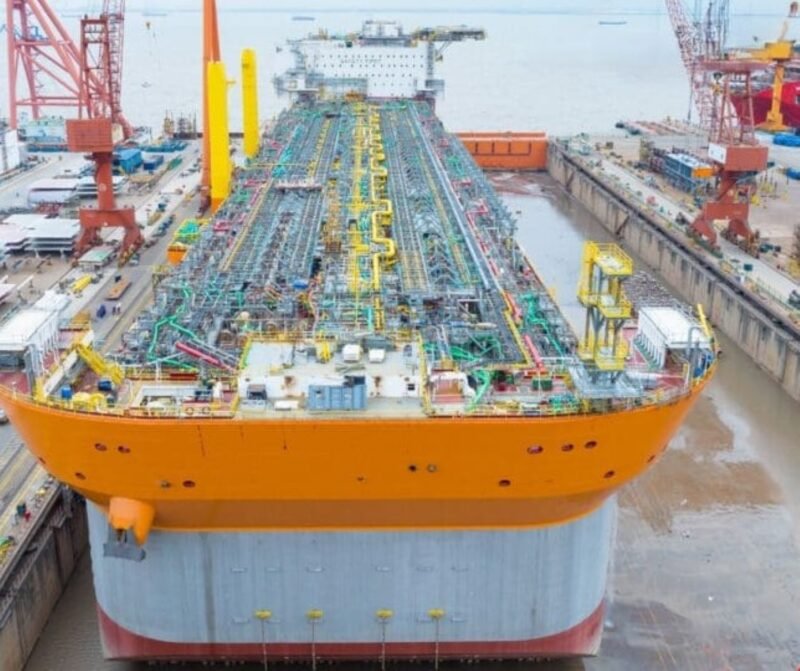
NANTONG – At the shipyard of China Merchants Heavy Industry (CMHI) in Nantong, a new step has been taken in the construction of the first floating production, storage and transshipment platform (FPSO) for Suriname, for which the Dutch SBM Offshore was commissioned by oil giant TotalEnergies two years ago. Last week, the hull of the GranMorgu – as the production platform is called – was completed and placed in a dry dock, so that the completion of the colossus can now begin.
According to client TotalEnergies, this is an important step in the construction of Suriname’s first offshore oil project, which should start in 2028. “The FPSO is the largest and most crucial part of our project,” the oil multinational emphasized. He added that it ‘functions as a floating industrial installation, allowing energy production to take place safely at sea.’ ‘Structural work and inspections’ will now take place in a ‘controlled basin’.
Important milestone
The placement in the dry dock is an important milestone in the construction, allowing the teams to complete the hull work before the next phase, which will see the FPSO transferred to the COSCO yard in Qidong, also China, for the installation of the upper parts, which have a total weight of around fifty tons. These systems will support offshore production and processing activities. This move marks GranMorgu’s final phase on land before the ship prepares for decades of offshore operations.
The FPSO will produce around 220,000 barrels of oil daily from the Sapakara South and Krabdagu discoveries in Block 58 of Suriname. These have now been renamed the GranMorgu project. Both fields are said to contain more than seven hundred million barrels of oil.
No flaring
According to TotalEnergies, the FPSO is designed as a all electricunit to minimize greenhouse gas emissions. There won’t be any routine flaring – so-called flaring – takes place; all associated gas is reused or injected back into the reservoirs.
After completion and commissioning in mid-2028, builder SBM Offshore will take over operations for the first few years, just as is the case with the five FPSOs in neighboring Guyana that have now been delivered to ExxonMobil.