The Intergovernmental Panel on Climate Change (IPCC) – the United Nations (UN) climate panel – is in deep crisis as member states argue over the publication of new reports and the budget. As a result, Suriname is in danger of being dragged along and held hostage in a geopolitical swamp where science has been relegated to political currency. As a result, Suriname could miss out on a lot of money, which it could claim in the future as a carbon-negative nation.
Text Armand Snijders
Image IPCC
Every year, the IPCC meeting precedes the Conference of the Parties, COP for short, where Suriname is usually also represented. The COP31 will take place in Antalya, Turkey, from November 9 to 20. All kinds of political leaders worldwide come together there to discuss the state of affairs on climate and the environment and to adopt a joint policy.
“The torpedoing of the IPCC by major powers such as Saudi Arabia artificially keeps the global oil market in the saddle”
At the IPCC meetings, the real preliminary work is normally done by scientists and experts. The IPCC reports have always been a gold standard: a ready-made, incontrovertible scientific dossier that diplomats could brandish on the world stage.
Major financial deficit
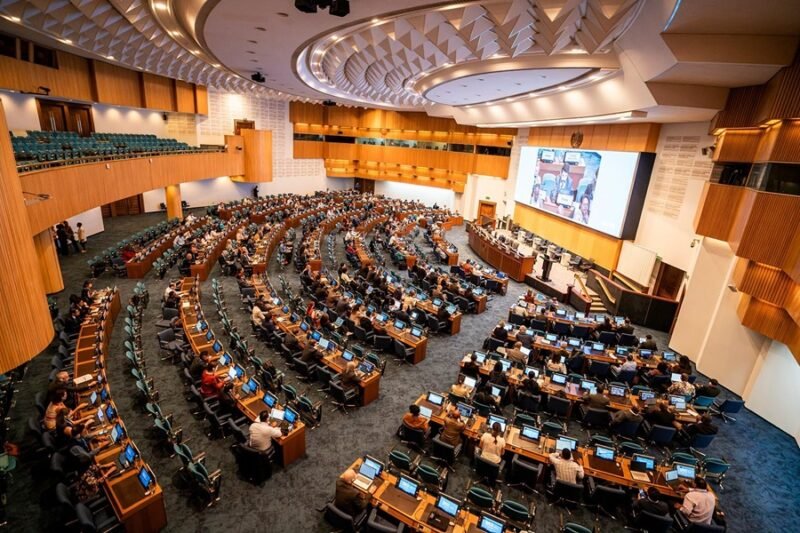
The recent flop of the crucial IPCC meeting in Ethiopia – which ended with no agreement on the scheduling of new reports and no budget for 2027 – is a huge fiasco, which experts say could derail the approach to the climate crisis underway in the world.
First of all, an agreement on the timeline could not be reached in Addis Ababa. It proved impossible to get everyone on the same page about the publication date of the new climate reports. Countries that want to speed up (such as those belonging to the European Union (EU) and small island states) collide hard with countries that want to slow things down (such as Saudi Arabia, India and Russia).
No agreement has also been reached on the budget for the IPCC fund. The panel is facing a major financial deficit and the refusal to approve the budget directly jeopardizes the progress of the working groups.
The meeting ran so far over the final day that the delegations from several small island states and least developed countries (such as Antigua and Barbuda and Nepal) simply had to leave to catch their flights. IPCC Chairman Jim Skea then officially suspended the meeting, because without these vulnerable countries, decision-making would no longer be inclusive.
(read more below the photo)

Political interests
The essence of the conflict is that different countries and especially political interests are opposed to each other. On the one hand is the bloc that demands that the latest scientific facts be on the table before the crucial Global Stocktake in 2028, the moment when the world balance of the Paris Agreement will be drawn up. This bloc, which realizes that time is running out, includes the European Union.
On the other side, a destructive delaying bloc is operating, led by oil giant Saudi Arabia, India and Russia. Formally, this bloc argues with the noble argument that developing countries need more time to position their own scientists. In practice it is pure obstruction. The longer science is held hostage, the longer the world will remain dependent on fossil fuels. As a result, the IPCC is actually simply torpedoed.
Tangible damage to Suriname
The damage is already noticeable. As a small developing country, Suriname simply does not have the official capacity or budgets to independently sift through thousands of specialist academic reports and translate them into practice.
When the IPCC panel is paralyzed by a lack of money and political intrigue, Suriname loses its most important ammunition. The claims about rising sea levels, the threatened salinization of the agricultural coastal strip and the need for adaptation money are worthless at international conferences without the independent stamp of the UN. Without up-to-date data, Suriname is left empty-handed in the face of the arrogance of the large industrial emitters.
Loss and Damage Fund
This failure hits Suriname directly in the wallet. Policymakers are happy to promote the country as one of the few carbon-negative countries in the world – a green lung that absorbs more CO2 than it emits. But that does not pay for the dikes in Commewijne or the flood defenses in Paramaribo. Suriname is dependent on international mechanisms such as the Green Climate Fund and the Loss and Damage Fund.
The crisis at the IPCC puts a bomb under the reliability of the entire UN climate architecture. If the scientific basis becomes politically contaminated, rich Western countries will no longer be willing to invest billions in these funds. This will further delay the allocation of adaptation money, which is of existential importance for Suriname to literally keep its head above water. Add to this that the United States under Donald Trump has turned its back on the IPCC and the climate treaty, and the disaster scenario is complete.
“Without current data, Suriname is left empty-handed in the face of the arrogance of the large industrial emitters”
Oil lobby delay tactics
The emerging crisis also exposes a painful dilemma for Surinamese policymakers. While Suriname is bearing the brunt of the oil lobby’s delaying tactics at the negotiating table, the inflow of billions from block 58 is also eagerly awaited. The large-scale oil and gas exploration off the coast forces Suriname into a difficult split, in which it is impossible to take a clear and, above all, tough position.
On the one hand, the country is begging for international climate justice because its coastal zone is drowning, but on the other hand, Suriname is praying that global demand for fossil fuels will continue for a while so that it can collect the petrodollars. The torpedoing of the IPCC by major powers such as Saudi Arabia artificially keeps the global oil market in the saddle. That may give the Surinamese treasury breathing space in the short term, but it will settle its ecological verdict in the long term.