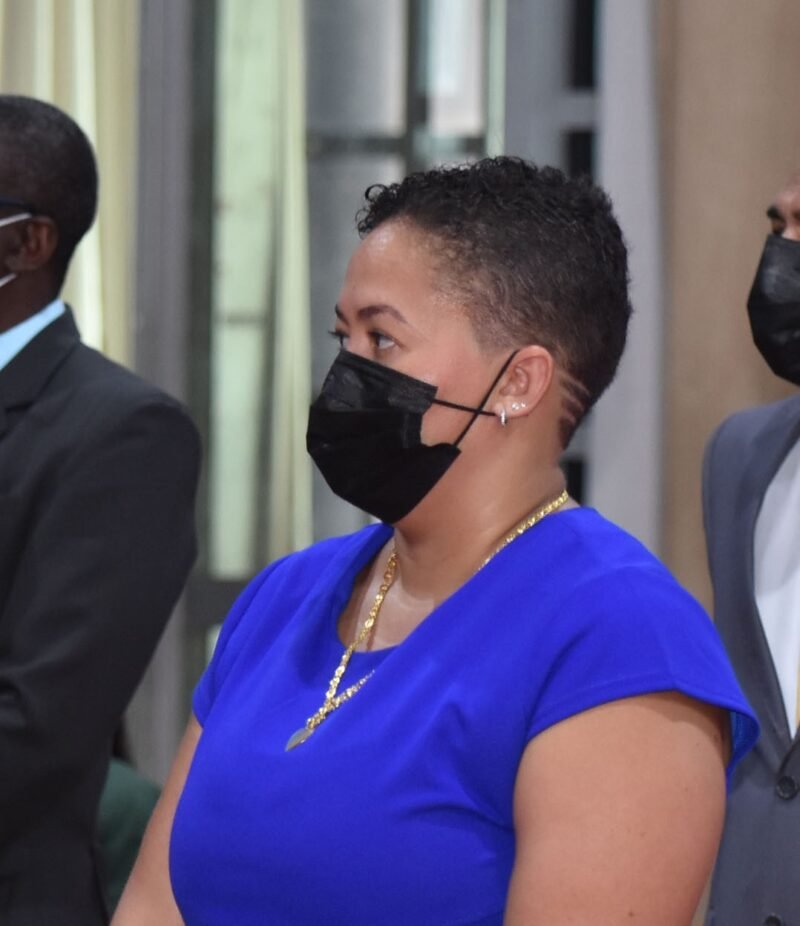
The administrative battle at the Telecommunications Authority of Suriname (TAS) has reached a point where the judge must determine who can be in charge for the time being. Director Wendy Jap-A-Joe and the supervisory board (SB) are diametrically opposed to each other. Even an attempt on Sunday to reach a settlement during the hearing of two summary proceedings failed. Both parties have refused. A verdict is expected on Monday (today). The conflict has not only seriously disrupted mutual relations, but has also raised questions about the functioning of government supervision and responsibility.
Text Ivan Cairo
Image dWT archive & CDS
The lawsuits are the preliminary conclusion of a months-long power struggle. What started with disagreements over financial management and supervision developed into a conflict over powers and ultimately over the question of who is allowed to manage TAS. A conflict that continued to fester.
“The question of why no sustainable solution was reached earlier remains. Why did the president let things take their course”
Welles-nietes game
The history goes back to changes within the Supervisory Board in October 2025. With the appointment of Emanuel Scheek as the new chairman of the supervisory board in May 2026, tensions between the management and the supervisory directors increased further.
The Supervisory Board stated that the financial accountability is insufficiently in order and required more insight into TAS’s expenditure and management. The lack of recent, approved annual accounts also prompted the council to ask questions. Jap-A-Joe disputed that it deliberately withheld information from its supervisors and in turn questioned their working methods.
An important point of contention became the financial investigation that the council wanted to have carried out. According to the available correspondence, the Supervisory Board had previously requested that an audit assignment for the 2024 and 2025 annual accounts not be further carried out or formalized for the time being. Shortly afterwards, the council decided to engage another agency for a financial and operational audit.
Jap-A-Joe requested an explanation about the council’s authority to issue that assignment, the costs and the protection of confidential information. Questions also arose about possible conflicts of interest between the new chief executive and the other company that would conduct the investigation. The Supervisory Board stood by its decision and requested cooperation.
Here it became visible how mutual distrust began to crowd out normal cooperation. A supervisory authority must be able to request financial information and conduct investigations within the limits of its powers. A director, in turn, may ask questions about the legality and implementation of such assignments. The problem arises when both parties start to judge each other’s actions mainly based on distrust. And that’s what happened.
The financial questions raised by the Supervisory Board deserve independent investigation. This applies, among other things, to expenses on business trips and other costs. However, as long as no verifiable findings are available, any irregularities should not be regarded as established.
Conversely, an appeal to positive results achieved under the Jap-A-Joe directorate cannot be a substitute for financial accountability. An institution may have performed well and at the same time be required to account accurately for the expenditure of its resources.
The Supervisory Board is also under a magnifying glass
It is remarkable that it is not only the performance of the director that raises questions. The decision-making regarding the composition and powers of the Supervisory Board also requires clarification. An overview of ministerial documents shows that there are two versions of a decision, both dated May 11, 2026, but with substantive differences.
The later version contains additional provisions on, among other things, the position of a previously appointed commissioner, compensation and the possibility of engaging external experts at the expense of TAS. The question is on what decisions these additions are based.
Without examining the original documents and the associated decision-making, it cannot be determined that anything unlawful has occurred. It is important that the responsible minister provides clarity about the differences.
The Supervisory Board rightly requires that the management can justify its decisions and expenditure. The same requirement of openness also applies to the council itself. After all, good supervision can only be credible if supervisors also use their powers carefully.
(Read more below the photo)

Battle over director position
Tensions took on a new dimension when Jap-A-Joe’s five-year term of office expired this month. She was appointed with effect from October 20, 2021. The Supervisory Board and the government state that its legal authority to lead TAS ended on October 20, 2026.
Jap-A-Joe disputes that she can only be set aside on that ground without further settlement of her legal position. She relies on an employment contract from 2021, which, according to her lawyers, still entails rights and obligations.
During the hearing of the summary proceedings, it became clear that the parties also have different views on the authority of the Supervisory Board to temporarily take over the management. It was argued on behalf of TAS and the state that the law provides for this when the director position is no longer filled. Jap-A-Joe’s lawyers dispute that the council is authorized to act on behalf of the organization in these circumstances.
There is also disagreement about the legal meaning and validity of the employment contract. According to the state, there are questions about how this was achieved at the time and the approval required. Jap-A-Joe maintains its validity.
The core of this discussion is relatively simple. An appointment as director and an employment contract are not necessarily the same. Tax lawyer Stanley Esajas and lawyer Jennifer van Dijk-Silos have separately pointed out that an employment contract does not automatically extend the legal authority to remain a director. This does not mean that any rights under an employment contract automatically lapse. Nor does it mean that every decision of the Supervisory Board is automatically lawful. These are separate questions that must each be assessed on their own merits.
The summary proceedings judge must now provide clarity about the immediate control within the TAS. However, the ruling will not necessarily end all other disputes between the parties.
Government role
At least as important as the legal dispute is the question of why the situation was able to escalate as it did. The government had known for months that the relationship between the director and the Supervisory Board had been seriously disturbed. President Jennifer Simons has consulted with both parties. The commissioners had asked for measures against Jap-A-Joe.
In August, the Council of Ministers found the grounds given were insufficient to suspend her. Those involved had to find a way to work together. That in itself was a defensible decision. After all, a suspension requires proper substantiation. But rejecting a suspension request does not automatically resolve a crisis of confidence.
“The summary judgment judge must now provide clarity about the immediate control within the TAS. However, the ruling will not necessarily end all other disputes between the parties”
The question is what concrete steps were subsequently taken to make the conflict manageable. The problems surrounding financial control had not yet been resolved and the director’s term of appointment was nearing the end. Moreover, the latter was not an unexpected event. The expiry date was already set when she was appointed.
However, in October there was again uncertainty about the transfer of management. The situation culminated in a physical confrontation in the TAS building on October 20. There are various explanations about the precise circumstances. In any case, the incident made visible how seriously mutual relations had been damaged.
Minister Raymond Landveld of Transport, Communications and Tourism and the president then came into the picture more emphatically. Simons confirmed that Jap-A-Joe’s statutory term of appointment has expired and that the Supervisory Board must be able to function in accordance with the law. At the same time, the need for research into the state of affairs remained. The question therefore remains why a sustainable solution was not achieved earlier. Why did the president let things take their course?
(Read more below the photo)

Politics makes conflict more complicated
The TAS issue has also exposed political divisions. Abop chairman and parliamentarian Ronnie Brunswijk has been critical of the way in which the Supervisory Board wanted to enforce the departure of Jap-A-Joe. He emphasized that her legal position should not simply be pushed aside.
NPS faction leader Jerrel Pawiroredjo chose a different approach. He stated that both the director and the commissioners have damaged confidence in their performance by their actions. The politician therefore believes that both parties must make way.
These views illustrate that the conflict is not only about interpretation of the law, but also about the question of whether the directors involved still have sufficient confidence to properly perform their duties. A distinction must be made between legal capacity and administrative suitability.
Someone can be legally within his rights, but still contribute to the deterioration of relations through his actions. Conversely, criticism of someone’s actions cannot be a reason to ignore legal rights and procedures.
Need more than a verdict
The TAS crisis mainly exposes how vulnerable an institution becomes when management, supervision and political responsibility are not properly aligned. A director must be accountable. A Supervisory Board must be able to supervise. And the government must ensure, within its powers, that a public institution continues to function properly. These responsibilities should not be seen in isolation from each other.
At TAS, a dispute over financial management and supervision gradually turned into a battle for control. The mutual accusations, legal proceedings and physical confrontation have increasingly diverted attention from the actual task of the organization. The situation degenerated into an ordinary game of musical chairs.
The summary judgment judge’s ruling may be a necessary first step to provide clarity about the management. But this does not yet answer the questions about financial management, the decisions of the Supervisory Board and the government’s approach. This requires a careful and independent investigation, in which none of the parties involved is exonerated or convicted in advance.
The most important lesson is that an administrative conflict does not disappear by itself when the government decides not to intervene for the time being. Timely and clear decisions are necessary, especially when cooperation between a director and her supervisors comes to a standstill. That solution was not forthcoming at TAS. The result is that the judge must now clarify a situation that the directors involved and the responsible authorities have not been able to resolve themselves.
*read also ‘Judge decides today on protracted administrative dispute at TAS’