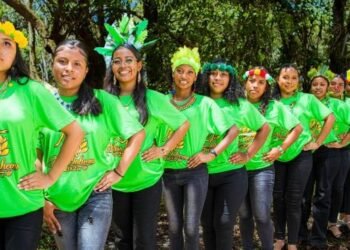
Fifteen years of investing in musical talent, knowledge development and professionalizing music education in Suriname. This is how Charmain Belfor, director of the Conservatory of Suriname, describes the significance of the institution’s fifteenth anniversary. The anniversary will be celebrated on November 11 in Theater Thalia with the special stage production ‘Hey skoro fu poku – A tori fu wi’.
Text Steven Seedo
Image Conservatory of Suriname & WSimons Photo & Video
Belfor is proud: “What particularly touches me is that Conservatorium Suriname has created a place over those years where musical talent can develop at a higher educational level, right here in Suriname.” At the same time, she emphasizes that fifteen years of existence does not mean that the institute is already where it wants to be. “We have built up a lot, but we also face important challenges in the areas of financing, facilities, quality assurance and further professionalization,” she admits frankly in conversation with the True Time.
“Music is not just entertainment. It is a form of education, cultural heritage, identity and economic activity”
director Charmain Belfor
For Belfor, the anniversary is not only a moment of celebration, but also of reflection. “’Who are we?’ “What did we mean?” And ‘what do we want to achieve in the next fifteen years?’ That is also the idea behind our anniversary production. We tell our own story, with the people who helped write that story.”
With the anniversary production, the audience gets more than a traditional anniversary concert. With live music, dance, theater and spoken word attendees will be taken on a journey through the history of the conservatory. The performance highlights the first dreams, the development of the institution, the talents of today and the ambitions for the future.
For Belfor, the anniversary is mainly about connection and appreciation. “We celebrate not only fifteen years of education, but fifteen years of people, stories, dreams, perseverance and music.”
Music education and culture
Conservatorium Suriname contributes to the development of professional musicians, music teachers and other creative professionals. Students and alumni are active in the Surinamese music world, education and cultural productions. But the institution also has a social function. “Music is not just entertainment. It is a form of education, cultural heritage, identity and economic activity.”
Belfor mentions as an important achievement the foundation that the Conservatory of Suriname has laid for professional music education at bachelor’s level in Suriname. Several generations of students have been trained over the past fifteen years. In addition, the institute has built up a network of national and international teachers and music professionals, giving students access to a wide range of knowledge and musical developments.
Belfor also sees the visibility of students and graduates during concerts, on stages and in cultural projects as an important result. The growing interest in the courses gives confidence, but at the same time requires further strengthening of the educational organization.
Ambitions for the next fifteen years
The conservatory now looks beyond music alone. “My personal ambition is that in fifteen years, Conservatory Suriname will not only be seen as a place where you can study music, but as an institute that demonstrably contributes to the development of the Surinamese art and culture sector,” says the director.
With preparatory courses for theater and dance, steps are being taken towards a broader range of vocational arts education. “Perhaps our greatest merit is that Conservatorium Suriname has continued to exist and develop for fifteen years, despite the many challenges that art education in Suriname faces,” says Belfor.
She calls this the result of the efforts of the founders, previous boards and management, teachers, students, graduates and partners. The anniversary is therefore a tribute to everyone who has contributed to the development of the institution.
In the coming years, Belfor wants to further develop the conservatory into a strong and future-proof institute for higher professional education in the performing arts. Education quality, accreditation, expansion of the training offering, cooperation with the professional field, sustainable financing and preservation of the Surinamese musical identity are central.
The institution wants to strengthen quality assurance and work specifically on the conditions for accreditation. She also wants to further develop theater and dance and provide scope for shorter, practice-oriented courses and certificate programs.
The connection between education and professional practice must also be strengthened. Students must gain experience with professional productions, entrepreneurship and collaboration within the creative sector during their education.
The director says that better facilities and sustainable financing are necessary for these ambitions. That is why Conservatorium Suriname wants to further expand the network of partners, sponsors and organizations that support the mission. The instrument fund is a concrete example of this. At the same time, the institute wants to pay more attention to documenting, researching, developing and transmitting Surinamese musical cultures.
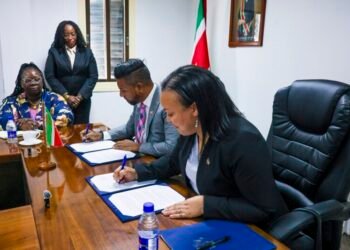
International cooperation should also contribute to the further development of the conservatory. It maintains contacts with various institutions for higher art education in the Netherlands, including Artez, the Utrecht University of the Arts and the Amsterdam University of the Arts. In addition, other collaboration options are being explored. “I strongly believe in internationalization and cooperation as important conditions for the further development of quality artistic education in Suriname,” Belfor makes clear.

Conservatory Suriname, also known as The Green Conservatory, was founded on November 11, 2011 by Albert Arens and Ramon Williams. Since then, 32 people have graduated. Belfor has been working there for almost thirteen years. She started as a speech therapy teacher. “I also held the position of Deputy Director of Training for five years under the leadership of then director Marcel Balsemhof.” She became acting director in November 2024 and has been official director since February 1, 2025.