
DISCAIMER: All views and claims expressed in this article belong solely to the author.
By Gabriel J Christian Esquire (c)
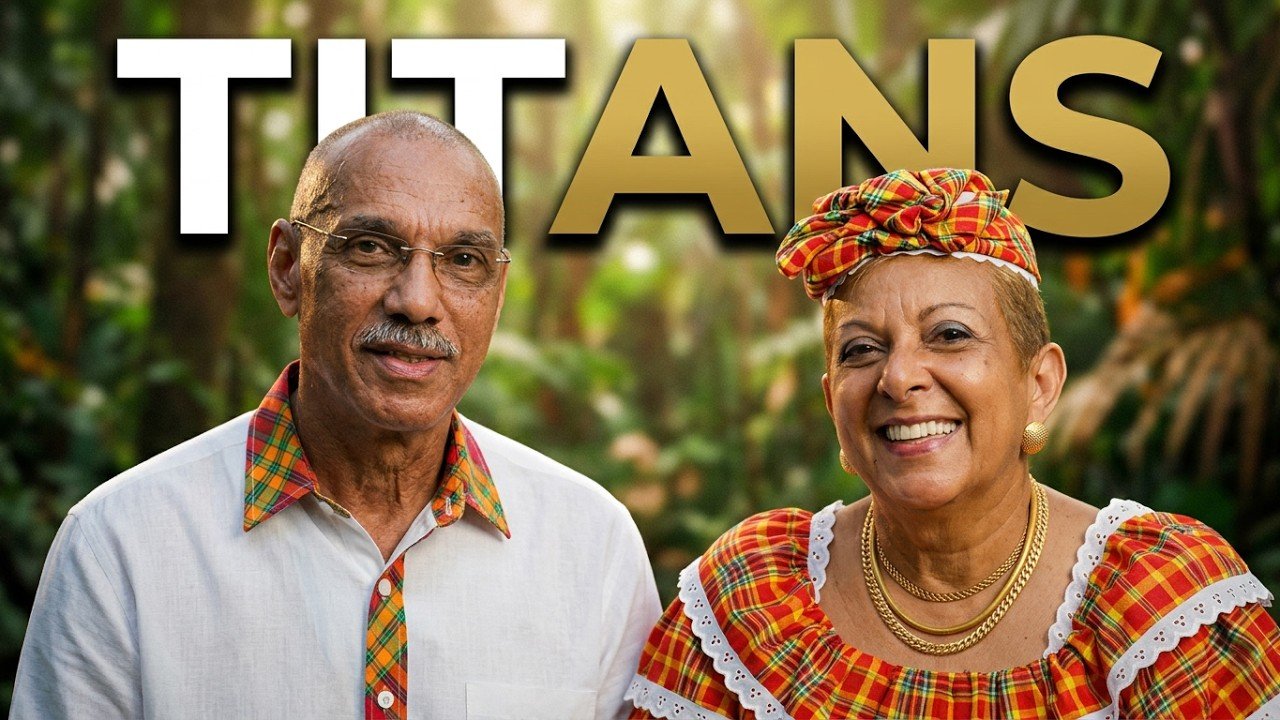
In the unfolding story of Dominica’s cultural awakening, few partnerships have so beautifully united intellectual achievement, artistic excellence, family devotion, and national service as that of Anita Astaphan Bully and her late husband, Dr. Alwin Bully, the celebrated playwright, artist, educator, cultural administrator, and designer of the national flag of the Commonwealth of Dominica.
Their lives intersected at a particularly important moment in our nation’s history, when Dominicans were awakening to the possibilities of political independence, cultural self-expression, and a distinctly Caribbean identity. Yet Anita’s remarkable journey deserves recognition in its own right, for hers is a story of scholarship, perseverance, enlightened mentorship, and an abiding commitment to the advancement of her beloved homeland.
A Remarkable Family Heritage: The Astaphan and Shillingford Connection
Born Anita Astaphan, she was the daughter of Raymond and Lucille Astaphan, whose marriage itself represented an important chapter in the social evolution of Dominican society.
Her mother, Lucille, belonged to the eminent Shillingford family, whose roots run deep in Dominica’s history. Her father, Raymond Astaphan, was of Lebanese descent, part of a community whose enterprise and industry would become integral to the commercial and social development of our island.
According to family recollections, theirs was the first marriage between a person of Lebanese descent and a native Dominican, a union that reportedly caused considerable excitement and even controversy in some social circles at the time.
What was then regarded as unusual, and perhaps even socially daring, has long since become commonplace in modern Dominica. Intermarriage across ethnic and cultural boundaries is now neither controversial nor particularly newsworthy. Indeed, the Astaphan-Shillingford union anticipated the growing integration of the various communities that together comprise our Dominican family.
Their marriage reminds us that the richness of our national identity derives from the meeting of different peoples, traditions, and experiences, bound together by common citizenship, shared aspirations, and love of country.
From that union came Anita and her siblings Joey, Reginald, Hugo, Albert, Louvain, Michael, Marianne, and Rosalind, members of a family whose story forms part of the wider tapestry of Dominican life.
From Roseau to the Universities of New York: A Triumph of Education
Anita’s educational journey offers a magnificent example of the transformative power of good teaching and enlightened mentorship.
While serving as an assistant teacher at Convent High School in Roseau, she encountered an extraordinary principal whom she fondly recalls as a “white American nun” who was also an atomic physicist.
That remarkable religious educator, combining scientific accomplishment with Christian service, recognized the mathematical promise of the young Dominican teacher and helped secure two scholarships that opened the doors of American higher education to her.
Anita subsequently earned a Bachelor of Science in Mathematics from Marymount Manhattan College and a Master of Science in Mathematics from the State University of New York at Stony Brook.
These were significant academic accomplishments, particularly for a young Caribbean woman pursuing advanced mathematical studies during an era when such opportunities were comparatively limited.
Her story also reminds us of the invaluable contributions of the religious sisters who educated generations of Dominican girls at Convent High School. Their work helped produce women of intellectual distinction, professional competence, and civic responsibility.
Anita’s achievements stand as testimony to what becomes possible when genuine talent meets inspired mentorship and the practical support necessary to turn aspiration into accomplishment.
Alwin Bully: The Artist Who Helped Shape a Nation’s Identity
The man whom Anita married in 1977 was himself destined to become one of the most consequential cultural figures in modern Dominican and Caribbean history.
Born and raised in Roseau, Alwin Bully attended Convent Preparatory School, the Dominica Grammar School, and St. Mary’s Academy before proceeding in 1967 to the University of the West Indies, Cave Hill Campus, in Barbados. There he pursued studies in English and French, graduating in 1972 with an honours degree in Modern Languages.
Even as a university student, his extraordinary artistic gifts were evident. He helped develop theatrical activity at Cave Hill, establishing creative relationships that would influence the emerging Caribbean theatre movement.
Returning to Dominica in 1972, Alwin taught at the Dominica Grammar School, where he also served as Acting Principal. Among his most enduring achievements was his leadership of the People’s Action Theatre, which he helped establish and directed during the remarkable cultural renaissance of the 1970s.
Through that institution, Alwin and a dedicated company of actors, playwrights, musicians, dancers, and other cultural workers brought theatre into the forefront of Dominican national life. Their productions entertained, educated, challenged social conventions, and encouraged our people to value their history, language, folklore, and cultural inheritance.
Alwin’s creative genius found expression across an astonishing range of disciplines. He wrote at least sixteen plays, including the widely acclaimed Good Morning Miss Millie, one of the classics of Caribbean theatre. His theatrical works included Streak, The Ruler, The Nite Box, and Pio-Pio, productions that helped bring Dominican dramatic expression to audiences across the Caribbean.
He was also a gifted director, painter, sculptor, Carnival costume designer, storyteller, and composer, credited with writing more than fifty songs. His artistic imagination embraced everything from the traditional rhythms and masquerade traditions of our people to the dramatic literature of the wider Caribbean.
Perhaps his most enduring gift to the nation came in 1978, when he designed the national flag of the Commonwealth of Dominica as our country prepared for independence.
At its center stands the magnificent Sisserou parrot, symbol of our unique natural inheritance, surrounded by colors and emblems expressing our history, environment, cultural heritage, and national aspirations.
Whenever our flag is raised, at home or abroad, we are reminded of Alwin Bully’s extraordinary contribution to the symbols and consciousness of Dominican nationhood.
In that same historic year, he established Dominica’s Department of Culture and became the nation’s first Chief Cultural Officer, helping to build the institutional foundation for the preservation and advancement of our creative traditions.
His service soon extended beyond Dominica. Beginning in 1987, he spent more than two decades based in Jamaica, where he served UNESCO in senior cultural positions, including as Caribbean Culture Advisor. Among his important achievements was his role in managing the production of UNESCO’s monumental six-volume General History of the Caribbean, a scholarly undertaking dedicated to documenting the history and civilization of our region.
In 2011, his alma mater, the University of the West Indies, conferred upon him an Honorary Doctorate of Letters, a fitting recognition of his immense contribution to Caribbean education, theatre, literature, and cultural development.
Anita and Alwin: A Partnership in Family and Cultural Nation-Building
Against this extraordinary backdrop of artistic creativity and national service, Anita and Alwin built their family and shared their commitment to Dominica.
Their marriage was blessed with three children, Brent Bully, Sade Bully-Bell, and the late Peron Bully.
In her biographical interview, Anita offers invaluable recollections of the glorious days of the People’s Action Theatre, when cultural expression became an instrument of enlightenment, community development, and national pride.
Those were the years when Dominica’s cultural workers helped awaken the consciousness of a people approaching independence, encouraging us to celebrate our African and Caribbean roots, our Creole traditions, and the dignity of our own artistic expression.
Anita’s recollections are particularly precious because they preserve the human story behind that cultural renaissance: the friendships, sacrifices, enthusiasm, creative partnerships, and shared patriotism of those who believed that a small island could make a great contribution to Caribbean civilization.
Her life also illustrates that the achievements of great cultural pioneers are sustained not merely by individual talent but by family affection, intellectual companionship, mutual encouragement, and the cooperative spirit of communities committed to a higher national purpose.
When Dr. Alwin Bully passed away on March 10, 2023, Dominica and the wider Caribbean lost a cultural giant whose magnificent legacy lives on in our national flag, our theatrical traditions, our literature, and the many artists and cultural workers inspired by his example.
Anita continues to embody an important part of that legacy, while maintaining her own distinguished place in our nation’s educational and cultural history.
The Continuing Call to Preserve Our Cultural Inheritance
Anita’s advocacy for greater investment in arts education carries particular significance. As an accomplished mathematician who benefited from exceptional educational opportunities, and as one intimately acquainted with the transforming power of the creative arts, she understands that scientific learning and artistic expression are complementary foundations of an enlightened civilization.
Her life’s journey, from the pioneering marriage of Raymond and Lucille Astaphan to the halls of American universities and the flowering of Dominican theatre, reflects the remarkable possibilities that arise when a people embrace education, cultural diversity, creativity, and service.
At a time when Dominica must invest more deliberately in its youth, educational institutions, and creative industries, the lives of Anita and Alwin Bully provide an enduring lesson: A nation cannot prosper by material development alone. It must also nurture the intellect, imagination, historical consciousness, and cultural confidence of its people.
Let us therefore join hands in saluting Anita and the late Dr. Alwin Bully, two outstanding contributors to Dominica’s cultural development, whose lives remind us that nation-building is not simply the work of governments and politicians. It is equally the work of teachers, scholars, artists, playwrights, parents, and all those who dedicate themselves to enlarging the horizons of their people.
May we honor Alwin’s immortal legacy and celebrate Anita’s continuing contribution by recommitting ourselves to the cooperative spirit that animated the cultural renaissance of the 1970s. Let us strengthen our schools, theatres, artistic associations, cultural institutions, and creative industries so that future generations may inherit not merely the symbols of nationhood but the intellectual confidence, cultural pride, and patriotic purpose necessary to advance our civilization.
We salute Anita Astaphan Bully, a distinguished daughter of Dominica, and remember with gratitude her beloved Alwin Bully, whose artistic genius gave our nation one of its most cherished symbols of sovereignty. Their lives and achievements represent a noble chapter in the continuing story of our Nature Isle.
May the work of these two worthy nation builders inspire us to preserve the best of our inheritance while cooperating to build an even more glorious future.
Dominica’s cultural heritage is a sacred trust. Let us prove ourselves worthy custodians of that inheritance.
🇩🇲 Long live the creative spirit of Dominica! 🇩🇲
Interview with Anita Bully