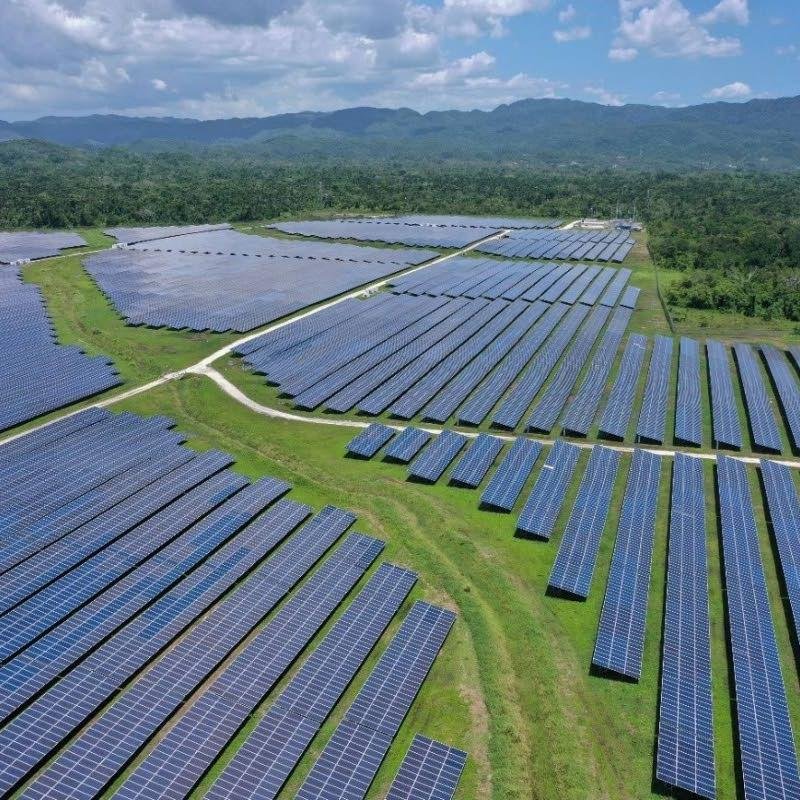
The Gleaner hopes that the Generation Procurement Entity (GPE), the government body that oversees the addition of new capacity to Jamaica’s electricity grid, will keep its promise to go to the market before year-end for 300 megawatts of renewable power.
At the same time, the government, and if possible, the Office of Utilities Regulation (OUR), must use their good offices to accelerate negotiations between the Jamaica Public Service (JPS), the monopoly transmission and distribution company, and Wigton Energy and SunTerra Ltd, on the terms on which the latter companies will supply solar-generated electricity to JPS. It is now just shy of two years since GPE awarded Wigton (49.93 MW) and SunTerra (50 MW) the right to generate and supply approximately 100 MW of solar power to the grid, at a base price substantially below that of the current cost for power generated from fossil fuels.
The average US$0.28 to US$0.35 Jamaicans pay for a kilowatt hour of electricity is significantly above the global average of around US$0.17 per kWh, and places the island in the mid-tier among regional peers.
There is a significant downside to the high energy costs in Jamaica: They are a drag on the economy. For instance, tourism, from which the island grosses over US$4 billion annually, is a significant consumer of electricity, whose high costs affect the industry’s competitiveness, as well as reduce the amount of its income that is retained in the domestic economy.
DISINCENTIVES
Additionally, high energy costs have been among the disincentives to the growth of manufacturing, contributing to the de-industrialisation of the 1990s and early 2000s as factories closed shop in favour of imports. Some relocated their operations to the southern Caribbean, including Trinidad and Tobago.
The energy-cost problem has been exacerbated by the US-Israeli war on Iran, followed by Tehran’s closure of the Strait of Hormuz, through which, before the conflict, a fifth of the world’s seaborne oil passed. The disruption of energy logistics since February has caused world oil prices to rocket close to US$100 per barrel, and sometimes higher.
In Jamaica’s case, the government in its 2026/27 budget had projected that the island would pay US$60 a barrel for West Texas Intermediate (WTI) crude, down from above US$70 the previous year. Now, WTI hovers at over US$90.
What that means is that the nearly US$1.7 billion Jamaica paid for 21.95 million barrels of oil equivalent in 2025 will be substantially higher this year.
However, renewables, especially solar, and, to a lesser extent wind, can make a difference to the electricity sector. The former is a commodity that Jamaica has in great abundance and can be harnessed relatively inexpensively compared to other energy sources, and without the planet-warming emissions that come with the burning of fossil fuels.
MOVE AGGRESSIVELY
At present, about 20 per cent of the island’s generating capacity for the national grid is from renewables, although they deliver about 13 per cent of electricity because of the variability of supply. However, the potential for doing so at substantially lower costs suggests that the government must move aggressively in delivering on its policy of having 50 per cent of electricity generated from renewables by 2030.
For example, when the GPE awarded the generating contracts to SunTerra and Wigton in November 2024, it did so on the basis that they would deliver electricity to JPS at an average tariff of 6.16 US cents per kilowatt hour; Wigton at 6.33 US cents per kWh and SunTerra at 5.99 US cents per kWh. Those tariffs are before JPS adds its operating and pass-through costs.
On the other hand, LNG, bought on the spot market and influenced by Henry Hub pricing, some analysts say, burns at between 10 and 12 US cents per kWh. LNG accounts for over 50 per cent of generation. When old, less-efficient plants that burn heavy fuel oil (HFO) are added to the mix, the average fuel cost could be up to a third higher, these experts say.
Which is why this newspaper insists on the urgency of bringing onstream 100 MW of solar from Wigton and SunTerra and that GPE keep to its timetable for issuing the requests for proposals for the 300 MW, including 150 MW of battery energy storage systems (BESS).
Proceeding with, and expanding, these initiatives are logical. Battery-storage technology has grown, and continues to grow, exponentially, enhancing capacity and lowering costs. This lessens the need to maintain fossil-fuel redundancies at the same level as in the past, with potential savings to the grid and consumers.
The government’s ongoing operating-licence negotiation with JPS has helped to complicate the transmission company’s separate negotiations with Wigton and SunTerra. But the delay has a cost. Funds, as they say, are fungible. The longer these companies take to access capital for their projects, the more expensive it is likely to be when they need it. That could imperil the projects or mean higher costs to consumers.
The government and the GPE must therefore get on with it.