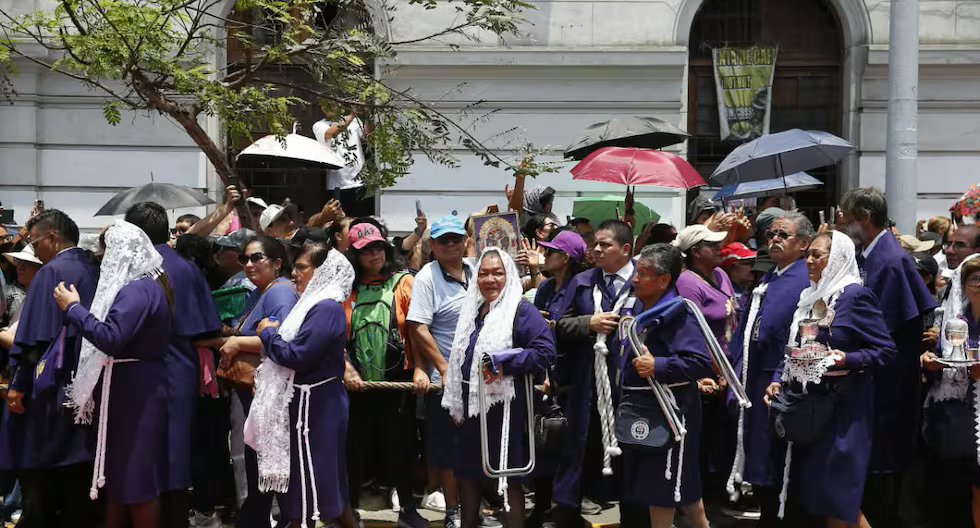
This Wednesday October 28during the fourth day of the tour of the Lord of Miracles through the streets of Lima was characterized by the fervor of the faithful of all ages who came as close as they could to accompany the march of the Christ Morenobut also because of the inclement heat that forced more than one to drink water, buy hats or look for shade to take shelter.
The faithful, as is tradition, accompanied at all times the 34 brothers who carry the 3.5-ton litter, who change shifts in various sections. However, the route represents challenges that the authorities have to avoid or solve in the best way, such as people with heat stroke, accidents and even the loss of people, especially children.
How does security work in the Lord of Miracles procession?
El Comercio followed the procession of the Lord of Miracles through the streets of the Historic Center of Lima and Breña, between Venezuela and Bolivia avenues, as in the Varela jirón. For this reason, as detailed by Mario Casaretto, Disaster Risk Management Manager of the Metropolitan Municipality of Lima (MML), various positions of the Unified Command were established to prevent and act in the event of potential incidents.

The fourth route of the Lord of Miracles included Venezuela, Bolivia and Varela avenues, all in Breña. (Photo: Cesar Campos/GEC)
This Command, made up of the National Police (PNP), the General Corps of Volunteer Firefighters, Civil Defense (Indeci) and the Brotherhood of the Lord of Miracles, are in charge of security during the procession. For this reason, along the route, in adjacent streets there were posts from the Ministry of Health (Minsa) or the DIRIS (Directorate of Integrated Health Networks) Lima Centro, with specialized personnel to care for people with decompensation, heat strokes, but also a tent from the San Bartolomé Mother-Child National Hospital on Alfonso Ugarte Avenue.
There was also the presence of vehicles from the MML rescue unit, ambulances from Essalud, the Minsa, the Samu, all placed at strategic points to have a quick response, while the members of the PNP are in charge of ordering the passage of the faithful to avoid excessive crowds near the walk of the Lord of Miracles.

Ambulances and rescue patrols, including firefighters, accompanied the journey of the Lord of Miracles. (Photo: Joel Dávila)
Heat, traffic and congestion
Senamhi predicted a temperature of 26 °C for Central Lima around noon. During the Cristo Moreno route, the heat was felt especially on Tacna Avenue, while the highest solar intensity was recorded between noon and 3 in the afternoon, when the procession advanced along Alfonso Ugarte and Venezuela avenues, in Breña.

The faithful who attended the procession had to endure temperatures of up to 26 degrees around noon until approximately 3 in the afternoon. (Photo: Cesar Campos/GEC)
As for traffic, on this day the Metropolitano service did not operate on its traditional route, causing problems for a no small number of people who were traveling, mainly, to their work centers, many of whom, in addition, could not take alternative routes, becoming trapped in the crowd.
The available accesses that people had were Plaza Dos de Mayo, but also Bolognesi Avenue which leads to Arica, Brasil and Paseo Colón avenues; However, this produced a series of traffic jams, slow mobility, including Bolivia Avenue which was open until the afternoon when it was closed by the PNP.

The procession was attended by many older adults, people with disabilities and parents with their children, despite the crowds and extreme heat. (Photo: Cesar Campos)
The work of the brigade members
Rescuers and brigade members play a vital role, because they are in charge of providing the first response to cases of heat stroke, decompensation, loss, and even people who become trapped in the middle of the crowd.
The Commerce spoke with Humberto Burgos, director of VOPRE (Voluntary Rescuers in First Response Operations in Emergencies and Disasters), who told us what function they perform during the procession: “we carry out joint actions with the Minsa and the Diris Lima Centro, attending to heat strokes, seizures, decompensation of older adults, mothers who have brought their youngest children who are trapped by the crowd.”
When these episodes happen, they mobilize the affected people to ventilated environments: “people are very devout, but they put aside their own safety. There needs to be more concern for one’s own integrity. Faith is strong in Peruvians and it is good to come, but always thinking about one’s own well-being.”

Humberto Burgos, General Director and Founder of VOPRE (Volunteer Rescuers in First Response Operations in Emergencies and Disasters). (Photo: Diego Aquino)
They are responsible for providing first aid, pre-hospital care for trauma, performing CPR, maintaining people’s temperature, search, rescue, and taking victims to advanced medical posts at various points along the route.
“People who suffer from bronchi, who are asthmatic, could suffocate. Older adults who no longer have the mobility of yesteryear, avoid crowds, could be crushed.”

The volunteers are the first response brigades to any incident that may arise during the procession. (Photo: Joel Dávila)
The devotion of the bearers of the Cristo Moreno platform
And in this journey, the crews in charge of carrying the Cristo Moreno walk throughout its entire journey are of vital importance, men who prepare themselves physically, mentally and spiritually to walk with the image of the Lord.
El Comercio spoke with Luis Perleche, foreman of the ninth gang of the Brotherhood of the Lord of Miracles: “we prepare all year, we have preparation with retirement masses, spiritual talks, everything to reach this month and entertain our patron saint in the streets of Lima,” he commented.

34 people carry the Lord of Miracles’ litter, whose weight is around 3.5 tons. (Photo: Cesar Campos)
Perleche also revealed his feelings when he is carrying Cristo Moreno: “it is something difficult to explain, we live it with great devotion, faith and fervor. We pray, we ask for those most in need, so that the country changes due to everything we are going through, we pray for our families, those who are alive and those who left us. But, mainly, we dedicate ourselves to getting along well with the Lord.”
The foreman of the ninth gang, with almost 40 years carrying the Lord of Miracles, explained that for them it is an additional complication to carry the litter with their clothing while in the inclement heat: “we have had heat shocks and we support each other. With the jacket, the tie, the habit, we end up wet”, in addition to adding that the Brotherhood, in times of social networks feels the pressure to do things well because they are seen by everyone thanks to the technology.

The bearers of the various groups prepare throughout the year physically and spiritually to carry the Cristo Moreno on their shoulders. (Photo: Cesar Campos/GEC)
Faith and commerce
The faithful have demonstrated their faith in different ways, such as the carpets that artists and groups make in the middle of the sidewalk where the Cristo Moreno will pass. The installation of stands with white and purple motifs, although the majority move on foot; Men, women, older adults with companions, parents with small children in their arms or on their shoulders, people in wheelchairs, stop when the walk stops and then continues.
The faithful cry with emotion when they see the image in front of them, the crowd raises their arms in a gesture of devotion, they applaud when the ringing of a bell rings. A particularly emotional moment was the admission of the Lord of Miracles for emergencies at the Arzobispo Loayza Hospital, where so many patients need additional motivation to recover.

Emotional faithful, they usually cry when they see the walk of the Lord of Miracles near them. (Photo: Cesar Campos)
All this accompanied by vendors who stand on the sides or behind the procession, either selling religious souvenirs or water to hydrate from the heat, but at high prices. The umbrellas for 8 soles and the rental of benches from 6 soles were very lucrative businesses, as well as the visors.
A seller of religious souvenirs told us: “It’s nice to come every year to accompany our Lord on his journey and, well, also earn a little money with these bracelets, keychains, prints, people really like them. The purple bracelets always sell well.”

Religious carpets are common in every Cristo Moreno procession. (Photo; Joel Dávila)
How was the journey of the Lord of Miracles?
Today, the Lord of Miracles, at 6:00 am the image left the Nazarenas church, to take the road along Tacna Avenue, then turn towards Nicolás de Piérola Avenue and head towards Jirón Cañete. At noon, Cristo Moreno arrived at Alfonso Ugarte Avenue where it made a stop near the Arzobispo Loayza Hospital, and then continued its journey towards Venezuela Avenue in Breña to the Oval of Faith; while in the afternoon, he entered through Jirón Varela, and then turned onto Bolivia Avenue where there was a stage with a Creole music group.
Late at night, the Lord of Miracles continued along Bolivia Avenue until he reached Garcilaso de la Vega Avenue, a straight path that will lead him, again, to Tacna Avenue and, finally, to the Nazarenas Church where he will rest until November 1, the last date of his journey.

This was the journey of the Lord of Miracles on Wednesday, October 28, 2026. (Photo: Diffusion)