The Minister of Energy and Mines, Guillermo Shinno, denied that the legal formula proposed by the Executive for the new Small Mining and Artisanal Mining Law (ASM Law) constitutes “an amplified Reinfo.” He insisted that the Comprehensive Registry of Mining Formalization (Reinfo) will conclude on December 31 and that the proposal contemplates a temporary “consolidation regime” of 18 months, so that informal miners who meet the conditions can advance towards formalization.
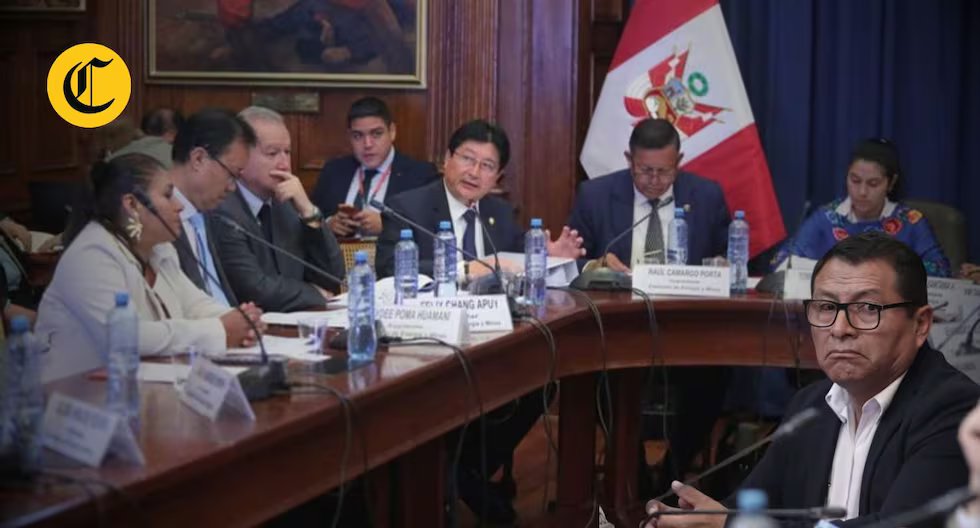
Shinno went this Tuesday, October 27, to the Energy and Mines Commission of the Chamber of Deputies to support the proposal sent by the Government, on the verge of the expiration of the last extension of the Reinfo in December and also the closing of the current legislature.
The session lasted for around three hours. After Shinno’s presentation, among others, a group of informal miners’ leaders convened by the president of the commission, Yenifer Paredes (Together for Peru), also attended, who flatly rejected the Government’s proposal.
Posture and contradictions
The head of Minem began his intervention by questioning the Executive and the previous Congress, pointing out that his sector had to prepare the ASM Law proposal in a limited period of two and a half months, after taking office on July 28. He maintained that, although everything can be perfected, the initiative on the table “is the alternative to simply the extension of a Reinfo”, whose last extension expires this December 31.
“In short, we know that the times do not help us, it is too short a time, but we could not fail to comply, as an Executive, with presenting an ASM bill, which was actually what had been expected for many years,” Shinno stated.

The Executive’s proposal contemplates two regimes, as well as the creation of a new body called FORMAPE. (Photo: Julio Reaño/@photo.gec)
He acknowledged that, after 15 years of attempts at formalization, “the results are not what were expected” and that the process, as it is, is “poorly structured.” He also maintained that those who are in the formalization process must be distinguished from those who “take advantage of Reinfo to carry out a totally illicit activity.”
The Executive’s proposal contemplates two regimes, as well as the creation of a new organization called FORMAPE (National Organization for the Strengthening of Artisanal Mining and Small Mining). According to Shinno, Reinfo “and everything it covers” will end on December 31 of this year, and from then on the proposal would have to come into force.
The first regime, called the “ordinary regime,” in the words of Shinno, “is the regime that has always existed, but we want to reinforce it.” This is governed by the logic of “first I obtain all my permits and then do my mining activity.”
As for the second, called “consolidation regime”, the minister explained that only those who, until December 31, maintain their “current” Reinfo status would enter. However, the formula sent to Congress also contemplates those who have suspended registration. This regime will take effect from January 1, 2027 and would be valid for 18 months, until June 30, 2028.
“We do consider that it is the exact deadline, because we are going to simplify the process, we are going to make it much more limited. And we consider that we can finish them in these 18 months to be able to formalize those who need to be helped in their formalization,” said the head of Minem.
As he explained, the formulation of an ASM Law is necessary to centralize everything in a single standard, establish clear conditions, articulate the different instances and strengthen the supervision and inspection capacity. He added that the proposal includes informal miners, but also the other actors in this chain, such as benefit plants, collectors, transporters and marketers.

Leaders of informal miners also attended Congress to participate in the session. (Photo: Julio Reaño/@photo.gec)
Although Shinno pointed out that the proposal does not repeal any law and that cultural heritage, national parks, indigenous peoples and prior consultation must be respected, he also announced new parameters for environmental instruments and explosives. Likewise, he proposed that the responsibility fall solely on the informal miner and not on the concessionaire, as an incentive for signing exploitation agreements.
He also insisted on the proposal to enable the Banco de la Nación to open current accounts for informal miners. He warned that “today private banks are closing the accounts” of this sector, which, he said, generates a “big problem” of traceability. This is one of the proposals that has generated questions from specialists.
“We understand the concern of private banks about the fact that perhaps some agents may be working illegally; and that leads to certain responsibilities. We understand that concern, but it does create a problem for us (in) traceability, because traceability is not only about the flow of the mineral, the flow of the inputs they need for production, but also economic traceability,” he expressed.
Objections to the project and rejection by informal miners
After Shinno’s presentation, the debate began. From the Good Government Party, deputy Milagros Santana questioned Minem and asked it to specify what would prevent the ASM Law from becoming another stage of temporary authorizations without results.
In the case of Together for Peru, some congressmen asked to call things by their “name”, along the lines that it was an extension of the Reinfo. Others questioned whether the proposal only strengthens control mechanisms. Representative Paredes herself maintained that, as president of the commission, she had the responsibility of studying the proposals sent by the Executive. “But also supervise what has been done and what has not been done; this commission is not a table of parts of Minem,” he said.
From Fuerza Popular, the deputies intervened to support the proposal, while, from Renovación Popular, deputy Frank Krklec warned that the deadlines would be insufficient and that it would not be possible to legislate on a technical and complex issue in such a short time in both chambers, as he pointed out to The Commerce in a previous report.
“It is not a prolonged Reinfo. Why don’t we consider it that way? Because although it is the continuation under a consolidation regime for 18 months of those that currently have the Reinfo in force, we are going to establish a much more simplified regime,” Shinno replied. He added that the conditions for formalization and technical assistance will be met.
However, he also maintained that among those asking for the expansion of Reinfo are, on the one hand, informal miners who want the continuity of their operations, but, on the other hand, he added, “there are also illegal miners who seek the expansion of Reinfo.”
“And it must be said in those words. Because today Reinfo has a legal umbrella that prohibits them from being reported; and that should not be the case. Anyone who carries out an activity in any economic sector, if we do things wrong, we depredate the environment, we pollute, we are subject to it and we must be sanctioned and investigated,” Shinno said.
“So we have to end that legal umbrella because it is what illegal mining is using to be able to carry out its clearly illicit activities and not only as illegal mining, but it is associated with other illicit activities such as human trafficking, child labor. And we must be very clear that illegal activities in the country are winning over formal economic activities, and it is something that is going to do a lot of damage to the country,” he said.
After Shinno’s presentation, representatives of informal miners’ unions also attended, such as Confemin, AMA Pataz, Macro Sur and Macro Norte. They agreed in rejecting the proposal made by the Executive to Congress and warned that it did not resolve the underlying problems.
Máximo Adolfo Franco Bequer, president of Confemin, maintained that the proposal “is more of the same” and that, within the proposed deadline, “we are not going to formalize it.” “Record it, we are not going to formalize it. Why? Because the formalization depends on an exploitation contract, and that contract has not been signed in 14 years. Nothing guarantees us that they will sign it in a year and a half. Therefore, that formalization is not going to happen, and in 2028 we will be in the same situation,” he asserted.
For her part, Jacqueline Villanueva Vargas, manager of the Mining Sector of the SNMPE (National Society of Mining, Petroleum and Energy), noted that they considered the proposal “to be a good starting point.” However, he maintained that some aspects were insufficient, such as traceability and even exemption from criminal liability, an issue that has already been resolved by the Constitutional Court.
“This consolidation regime (…) looks, at least in the text presented, like another extension of what we currently know as the Reinfo,” Villanueva asserted.
Amid tight deadlines, the session concluded without a clear date on when a proposed ruling would be available. It was only confirmed that this Wednesday the 28th — at 8:00 am — a public hearing will be held in Congress itself for, according to its title, “a real Mape Law.”