Madrid/Barely eight days after staging an act of repudiation against opponents and former political prisoners in the halls of the United Nations, Cuban diplomacy repeated the spectacle this Tuesday, now in full General Assemblyand less than 24 hours before the new vote on the United States embargo on the Island.
This time it was Foreign Minister Bruno Rodríguez himself, supported by six officials, who tried to sabotage the intervention of the American ambassador Mike Waltz while he was speaking before the organization.
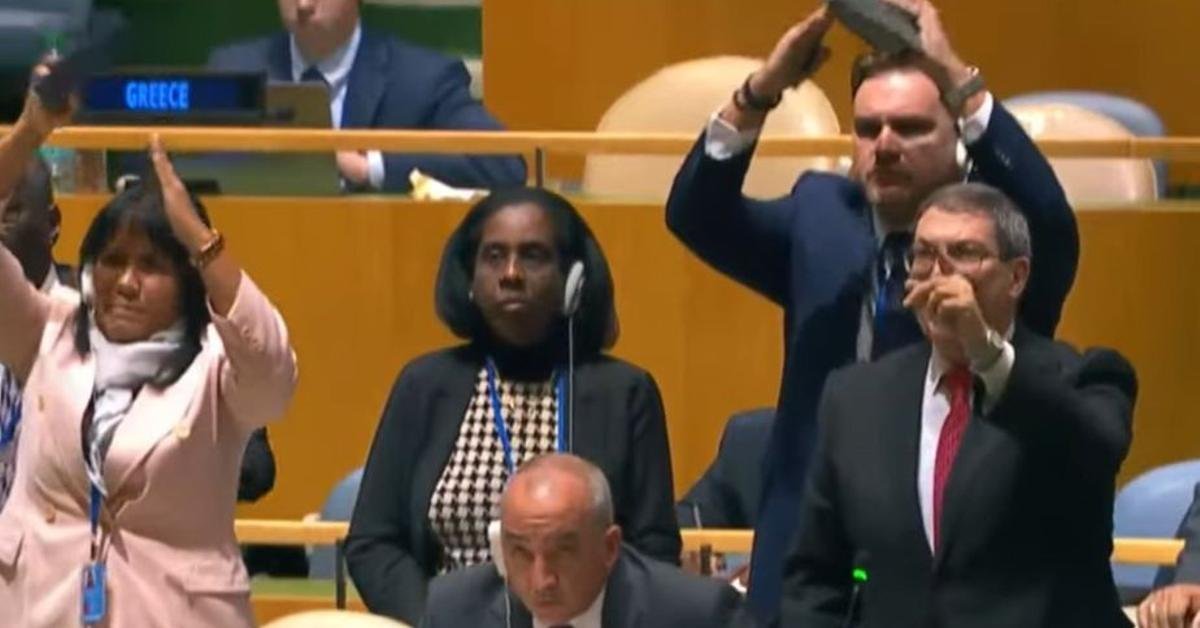
From their seats, Rodríguez and the officials accompanying him tried to interrupt Waltz with signs, shouts, and banging on the tables, almost from the beginning. One of the diplomats even took a Cuban flag out of her bag, ready to display it, but she put it away when another member of the delegation ordered her to stop.
From their seats, Rodríguez and the officials who accompanied him tried to interrupt Waltz with signs, shouts and bangs on the tables, almost from the beginning.
Accompanying him in the first row of the bench were Ernesto Soberón Guzmán, ambassador and permanent representative of Cuba to the UN, and Anayansi Rodríguez Camejo, vice minister of Foreign Affairs.
Their backs were protected by Alejandro González Behmaras, director of International Organizations of the Foreign Ministry, Pedro Luis Pedroso Cuesta, former ambassador to the UN – whose last documented administrative position is that of deputy director general of Multilateral Affairs and International Law, in 2024 – and Ileana Bárbara Núñez Mordoche, identified in September 2026 as director general of Multilateral Affairs and International Law, – although in June she was in charge of Latin America and the Caribbean.
The quartet was completed by a seventh official who could not be identified.
The protests intensified when Waltz criticized Fidel Castro’s repressive record and recalled the internment of homosexuals, religious people and other citizens in the Military Units to Aid Production (UMAP), forced labor camps established in Cuba during the 1960s.
Waltz also exhibited photographs to illustrate the privileges of the Castro family in the face of the hardships of the Cuban population: Fidel with Rolex watches, his grandson Sandro showing wads of bills and his son Antonio Tony Castro enjoying a luxurious yacht in the Mediterranean. To them he added images of the family properties in Cayo Piedra and of Miguel Díaz-Canel using luxurious accessories.
In his attempts to silence Waltz, Rodríguez Parrilla appealed to Article 71 of the General Assembly regulations, but the American reminded him that this provision allows intervention for procedural reasons, but not to discuss the content of a speech. “The reality is that he doesn’t like the substance of what he’s hearing. He doesn’t like hard truths,” he replied.
The Cuban foreign minister then stood up and advanced towards the rostrum from which Waltz was speaking, flanked by his subordinates. At times, they seemed ready to square ithow criminals operate when they surround their victims to beat them.

/ Video Capture/Live USA
“Back off, ambassador! Back off! This is not Havana,” the Washington representative snapped. He added that no one was going to intimidate him, as, according to him, the Cuban authorities do with political prisoners.
The president of the General Assembly, Khalilur Rahman, had to intervene to restore order and warned that he could suspend the session. Finally, he gave the floor to Rodríguez, who had to return to his seat. From there, he accused Waltz of “blatantly lying” and maintaining “an unworthy attitude.”
The presidency reminded the Cuban foreign minister that he should limit himself to the issue of procedure, and the American diplomat’s speech continued, although the Cuban officials, retreating to their bench, did not stop banging on the tables.
The Cuban offensive also featured operations on the flanks. Another official, later identified as Richard Tur de la Concepción, one of the first secretaries of Cuba’s Permanent Mission to the UN, attempted to pressure agency staff to cut off Waltz’s microphones, according to denounced the American ambassador in X.
When JP Freire, Waltz’s spokesman, began recording the scene with his phone, Tur confronted him and tried to swat his phone away and stop the filming. A gesture already immortalized in the annals of Cuban repression by the Minister of Culture Alpidio Alonso on January 27, 2021, against the independent Cuban journalist Mauricio Mendoza. The failed violence was recorded and broadcast by Waltz in X.
However, on September 22, during the general debate of the 81st session of the General Assembly, Bruno Rodríguez and his companions opted for a completely opposite strategy, in the face of Donald Trump’s intervention.
On September 22, Bruno Rodríguez and his companions opted for a completely opposite strategy, in response to Donald Trump’s intervention at the UN
The US president then described Cuba as an “absolutely failed state” and assured that his regime “will end up falling.” The island delegation got up and left the room in silent and discreet sign of protest.
Eight days later the Cuban representatives raised the tone, when Soberón led a act of repudiation against opponents and former political prisoners invited to the meeting Cuba Libre: The oppression that Havana hides, organized by the US permanent mission.
The aggressiveness of the Cuban side this Tuesday has further inflamed tempers in the midst of an intense diplomatic battle. Washington has multiplied his efforts to convince other governments to vote against the Cuban resolution or abstain. The Secretary of State, Marco Rubio, addressed the matter in a telephone conversation with the Salvadoran president, Nayib Bukele, as he had done with other heads of state in the previous days, while exile organizations asked European and Latin American democracies not to support an initiative that, in their opinion, Havana uses as a propaganda instrument.
The offensive has provoked an angry response from the Cuban Government. Rodríguez accused Rubio of pressuring and blackmailing foreign leaders, while Vice Minister Carlos Fernández de Cossío assured that Washington was resorting to intimidation and promises to modify the meaning of the votes. Havana thus tries to preserve the broad support that its resolution traditionally receives, despite the loss of support registered in recent years.
Waltz rejected these accusations and maintained that it is the Cuban Government that threatens other countries for their position regarding the vote. He also denied that there is a “blockade” in the strict sense and affirmed that US exports to Cuba exceeded 876 million dollars during the first eight months of the year, a figure that he presented as proof that trade between both countries continues.
The vote at the United Nations is no longer the triumphant walk of other years for Havana. In 2025, the resolution against the embargo gathered 165 votes in favor, seven against and twelve abstentions, the worst result obtained until then by the Island. This Wednesday’s scrutiny will show whether that loss of support was an isolated setback or the beginning of a trend.