SUBMITTED
Deepening military cooperation between Guyana and the United States is not a purely technical matter. Training, joint exercises, air surveillance and the fight against drug trafficking are presented as contributions to regional security. But in a region with extensive oil interests, the Essequibo conflict with Venezuela and the unresolved Tigri issue between Guyana and Suriname, every defense partnership also has geopolitical significance.
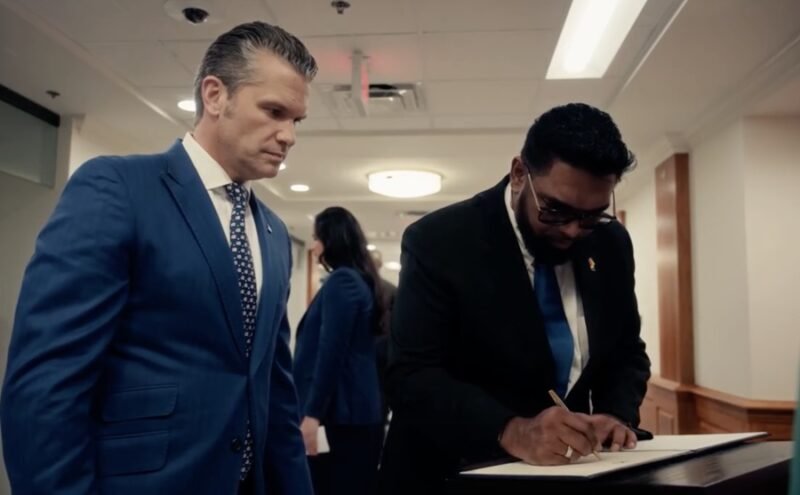
According to the report on Starnieuws, President Irfaan Ali and US Secretary of Defense Pete Hegseth have signed a joint statement. Washington says it wants to provide Guyana with long-term support with military expertise, training, exercises and enhanced airspace surveillance.
“Suriname can no longer content itself with silence and occasional protest notes”
However, the full text of the statement is not public. Specific amounts, implementation schedules and numbers of American soldiers have also not been disclosed. Therefore, caution is advised. There is no public evidence that the agreement is directly aimed at Suriname, but there is also no reason to downplay the possible consequences for Suriname.
Guyana is not necessarily naive. From his perspective, American support is understandable. The country feels threatened by Venezuela, which lays claim to Essequibo, while Guyanese oil revenues increase the strategic interest of major powers. U.S. training, intelligence and military technology can strengthen Guyana’s defense capabilities.
However, the danger is that protection gradually turns into dependence. A small state that ties its security to a major power may end up being used for interests that do not fully coincide with its own national interests.
The rhetoric of security and drug control can serve legitimate purposes, but it can also obscure a broader power strategy. Washington sees Guyana not only as a developing country, but also as an oil producer, Atlantic partner and possible link in the American security architecture of the Western Hemisphere.
Howard Zinn has shown in his critical history that American expansion was often accompanied by appeals to freedom, civilization, and national security, while simultaneously pursuing territorial, economic, and strategic interests. Noam Chomsky points out a similar contradiction between the American self-presentation as a defender of democracy and its support for interventions, military regimes and economic structures that can actually weaken democratic development elsewhere.
Moreover, current American attention to Guyana must be placed within the growing rivalry with China. Washington increasingly views Chinese investments in ports, infrastructure, energy and raw materials in Latin America and the Caribbean as a strategic threat.
China itself does not act selflessly; Beijing can also create economic dependence and geopolitical influence. But neither should the American response automatically be presented as a pure defense of democracy. It is also about markets, oil, military access and spheres of influence.
Guyana must therefore avoid becoming an advanced feature of American geopolitics. It must not allow itself to be drawn into military adventures determined by Washington. History shows that ordinary citizens ultimately pay the price when resources, power and militarism coincide.
The Tigri area is particularly important for Suriname. Guyana has exercised actual control over this since 1967, while Suriname has never definitively relinquished its claim. Yet Paramaribo has not developed a consistent strategy for decades. There were protests and diplomatic statements, but no strong international campaign, no fully prepared legal file and no sustained civilian presence in the border area.
Suriname has not gained or used time; it has mainly postponed. That procrastination is now working to its disadvantage. Guyana has been able to normalize its actual presence and has increasingly greater economic and military strength through oil revenues and American cooperation.
The new defense relationship does not automatically mean that Suriname has no legal chance. Territorial disputes are not decided solely by arms. Historical documents, maps, treaties, peaceful exercise of statehood, international law and diplomatic coalitions remain important. But Suriname can no longer content itself with silence and occasional protest notes.
Polarization works through us-them thinking and political fear. Suriname must prevent the border dispute from turning into blind nationalist escalation. At the same time, moderation should not be confused with passivity. The so-called middle group only has significance when it defends peace and justice.
The way forward is not a military confrontation. An arms race would be irresponsible and could actually provoke more foreign military involvement. Suriname must develop a national Tigri strategy, establish an independent legal team, organize historical sources and make its position internationally visible.
It should propose to Guyana a moratorium on new activities in the disputed territory, seek regional mediation and strengthen peaceful civilian presence. Paramaribo must also demand full transparency about the American-Guyanese defense agreements and explicitly ask whether they relate to the Tigri region.
Robert Greene’s analysis of power strategies is a reminder that dependence itself can become an instrument of power. Those who provide the resources, information and protection often gain influence over the agenda. Guyana must therefore be careful not to become Washington’s plaything or cannon fodder. Suriname must stop being a spectator to the erosion of its negotiating position.
Not militarism, but law; not silence, but international mobilization; not dependency, but strategic autonomy should be the starting point. Only in this way can the region prevent oil, power and foreign military interests from once again outweighing peace and justice.
Colvin Overdiep
The editorial staff of the True Time allows readers to submit articles for publication. In principle, all submitted articles will be included, unless the content is harmful, hurtful or insulting to third parties. Pieces posted do not necessarily reflect the views of the True Time. The editors reserve the right not to publish articles, or to shorten or edit them without taking them out of context.