The Dutch government, through then Prime Minister Mark Rutte, apologized on December 19, 2022 for the lucrative colonial slave trade and slavery in, among others, the former colony of Suriname. King Willem-Alexander, as head of state of the Kingdom of the Netherlands, also offered a personal apology on July 1, 2023, during the annual Ketikoti celebration in the Oosterpark in Amsterdam at the slavery monument. He even asked the descendants of slavery to forgive his family.
Text Carla Tuinfort
Image CDS
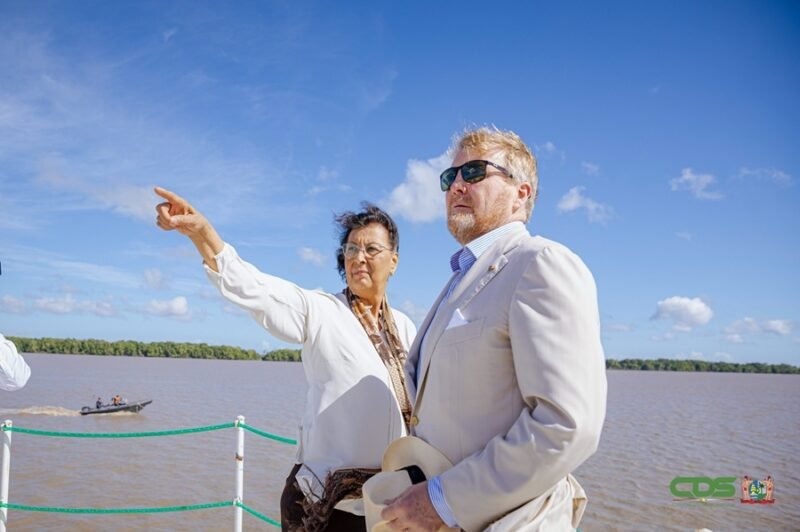
During his state visit to Suriname in December 2025 together with Queen Máxima, he repeated this in a private meeting with the traditional authority of the descendants of slavery. And the traditional authoritative representatives of slavery descendants, both red slaves (original indigenous people of Suriname) and black enslaved people (originally from Africa and sold to Europeans by African and Arab slavers) accepted his apology.
“All these children are now due to the president’s solo action, yes because that is what it is, the children are off the hook“
They granted the requested forgiveness with the help of the accompanying traditional spirituality of God, Tamushi, Anana Keduanman Keduanpon and the ancestral spirits. This is because without this forgiveness, an untenable stalemate would arise in order to continue living decently with each other. Descendants of slave traders and slave owners and descendants of enslaved people.
Formidable struggle and reparations
The ancestors of the enslaved fought a formidable battle against the European occupiers and so-called colonists in Suriname. Kaykusi and Priyari, among others, are well-known brave warriors among the natives, with whom peace was made after the Red War (1678-1686). The African fighters made the first lasting peace with the colonial administrative authority in the year 1760 under the leadership of the leaders Arabi and Basiton.
Prime Minister Rutte, at the instigation of alert slavery descendants, had said that the apology is merely a comma in the Dutch-Surinamese slavery history. That comma should be followed by measures and actions by ex-colonizer Netherlands to compensate for the deep aftereffects in damage and disadvantage and discrimination among the descendants of slavery. And King Willem-Alexander agreed.
The Surinamese economist Armand Zunder, himself a descendant of slavery, published the book ‘Reparations, the ‘Wiedergutmachung’ of the damage that Suriname and its people have suffered under Dutch colonialism’ in 2010. A valuable socio-economic study that showed that the Netherlands owes Suriname billions in unpaid slave labor and the psychological damage of dehumanization of the slave population with consequences that have occurred and have continued until now. And the resulting undeniable lag and dependence in the development of the country and its people.
UN Decades of African Heritage
The forced deportation of more than twelve million Africans in the transatlantic African slave trade and the forced labor in slavery that followed in the Americas and the Caribbean lasted from the sixteenth to the nineteenth century. And this was so horrific and degrading that the United Nations General Assembly (UNGA) declared the decade 2015 to 2024 the ‘Decade of African Heritage’.
However, this turned out to be insufficient for the gross impact of inequality compared to other peoples, so a second decade was added and declared, running from 2025 to 2034. In Suriname, for example, it is known that of the more than three hundred thousand imported Africans, only thirty thousand were left when slavery was abolished in 1863.
In March 2026, the United Nations declared that the transatlantic slave trade of kidnapped Africans was the worst crime against humanity and that inequality and exploitation persist. From a so-called ‘Slavery History Awareness Fund’ set up by the Netherlands in 2022, amounting to two hundred million euros, 66.6 million euros has been reserved for Suriname for government and civil society projects of non-governmental organizations (NGOs).
It is explicitly stated that this free Dutch slavery money does not in any way concern the expected reparations. It should also be noted that during the colonial slavery period a lot of money was earned from, among other things, the slave trade, cocoa, sugar, cotton and coffee for the benefit of Dutch wealth.
No investments were made in Suriname for the benefit of Surinamese wealth. When slavery was abolished in 1863, all slave owners received three hundred florins for each freed slave, while those freed slaves received no money, land or any other compensation.
Education for consciousness
Since March 2025, of the 66.6 million euros available for Suriname, half is available for policy interventions by the Surinamese government in this area. President Jennifer Geerlings-Simons and Prime Minister Rob Jetten of the Netherlands also spoke about this on September 24, 2026 in New York, where they were for the 81st UNGA.
Who can describe our surprise that the president informs the prime minister that he should prefer not to transfer that money, intended for policy interventions for the benefit of descendants of slavery, to Suriname, because she does not yet know how it should be spent. “Deployment of 33.3 million euros in slavery resources is delayed,” read the news on September 25, 2026.
But with 33.3 million euros, the entire Surinamese problem of the very important but tragically failing education sector of our country, from preschool to university, in one go for one and a half to two generations, has been thoroughly solved? Especially for the poor children of the interior and in the distant districts, where many children of the descendants of slavery live. Education as a basis for consciousness.
Dictatorial decision
I can already see it: finally, finally, quality education for them, with all the trimmings: well-founded and equipped air-cooled knowledge centers; adequate facilities with well-trained teachers; adequate and modern teaching resources; modern transport, housing, maintenance, electricity and water, safety, after-school care, recreation, radio and TV and internet; development of an adapted educational curriculum that trains young Surinamese to love Suriname and learn to embrace, keep clean and protect our country’s beautiful environment; to become diligent, disciplined, independent and critical citizens, with free visions and future prospects.
“It has been explicitly stated that this free Dutch slavery money does not in any way concern the expected reparations”
Complete with social workers, adequate health care and good salaries paid on time for everyone in the field and on the shop floor who is responsible for ensuring that everything runs smoothly. A conscious but also necessary investment in the Surinamese education system, full of training and education. There is still money left over from those 33.3 million euros.
Without asking or notifying the National Assembly or anyone else, President Geerlings-Simons tells Prime Minister Jetten that he must keep his money, free money for slavery descendants, for the benefit of modern awareness, through modern information and education. The Surinamese descendants of slavery and their children often live in the forest, under often appalling (school) conditions. All these children are now due to the president’s solo action, yes because that is what it is, the children are off the hook.