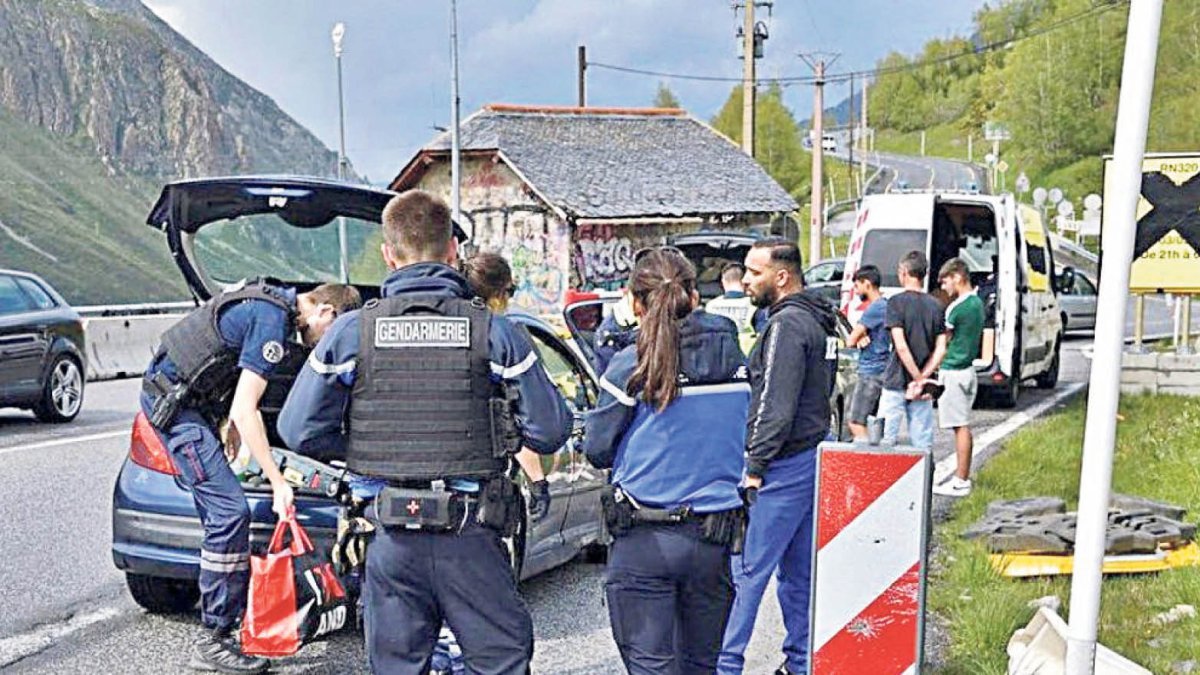

The European Union does not have a reliable estimate of the amount of tobacco that circulates on the illegal market or of the economic losses generated by this activity. It is one of the main conclusions of the last report of the European Court of Auditorswhich calls into question the effectiveness of the measures taken to combat smuggling and the clandestine manufacture of cigarettes. The warning is of particular relevance to Andorrawhere tobacco price differences with neighboring countries have historically made border control a sensitive issue.
The European supervisory body calculates, based on the estimates of the commissionthat the illicit tobacco trade causes annual losses of 13,000 million euros to the EU and member state budgets. However, he warns that this figure must be interpreted with caution because there is no independent and harmonized methodology that allows determining the real scope of the phenomenon. The available data comes mainly from the confiscations made by the authoritieswhich only reflect part of the clandestine activity.
Smuggling affects the EU and member state budgets
The report, approved last July, examines the actions carried out between 2023 and 2025 and concludes that the European response continues to be marked by the dispersion of responsibilities, legislative differences and insufficient cooperation. The auditors particularly analyzed the systems of Belgium, Spain, Poland and Romaniain addition to consulting the competent administrations of the other member states.
One of the shortcomings detected is the lack of a uniform system for sharing information. Europol, the European Anti-Fraud Office (OLAF) and the Community customs services they collect data through different procedures, without always having access to the same sources. This fragmentation makes it difficult to reconstruct smuggling routes, identify criminal organizations and coordinate investigations that affect several territories.
The Court denounces the lack of cooperation between EU countries
The situation is particularly significant in a business that constantly crosses borders. In a sample of ten seizures examined in each of the four countries audited, the researchers found evidence of international cooperation in only two, three, four and five cases, respectively. The court considers that these results evidence the limitations of current mechanisms and calls for faster, more comprehensive and systematic exchanges.
For the principalitythese conclusions offer a European context to a well-known problem. Andorra maintains a tax differential compared to France and Spain that can encourage the illegal transport of tobacco when the authorized limits are exceeded. The cross-border dimension of the phenomenon means that collaboration between administrations is decisive, even if the audit does not specifically examine the actions of the Andorran authorities or formulate any direct criticism of the country.
The document also notes that the underground market has undergone a profound transformation. If traditionally smuggling mainly consisted of transporting cigarettes between territories with different prices, nowadays illegal manufacturing within the same territory is gaining weight European Union. The authorities have located clandestine facilities in almost all member statesoften equipped with industrial machinery and organized by specialized criminal networks.
One of the examples collected is the dismantling, in 2025, ofa clandestine factory in Belgium which worked continuously and had four production lines. Each machine could make approximately one million cigarettes per hour. A Spainan operation coordinated with the support of theOLAF he allowed involving about three million counterfeit packages, valued at fifteen million euros, and about 31 tons of raw tobacco.
This change in model also requires a review of police and customs priorities. The auditors report that European rules do not uniformly regulate certain essential elements for making cigarettes, such as raw tobacco, industrial machines or some packaging materials. The differences between legislations facilitate that the criminal organizations take advantage of territories with less strict controls.
There is also no uniform punitive response. In some countries, smuggling is always a criminal offence, while in others it may only lead to administrative penalties depending on the value of the goods. The court warns that these differences can encourage the displacement of illicit activities to states where the legal consequences are less severe.
Another criticism concerns cooperation agreements with tobacco multinationals. According to the report, about half of the member states they maintain voluntary agreements with manufacturers, but many documents are not public. This lack of transparency makes it impossible to properly check whether commercial interests can influence the priorities of investigations.
The court claims to the European Commission a more coordinated strategy, with measurable objectives and defined responsibilities.