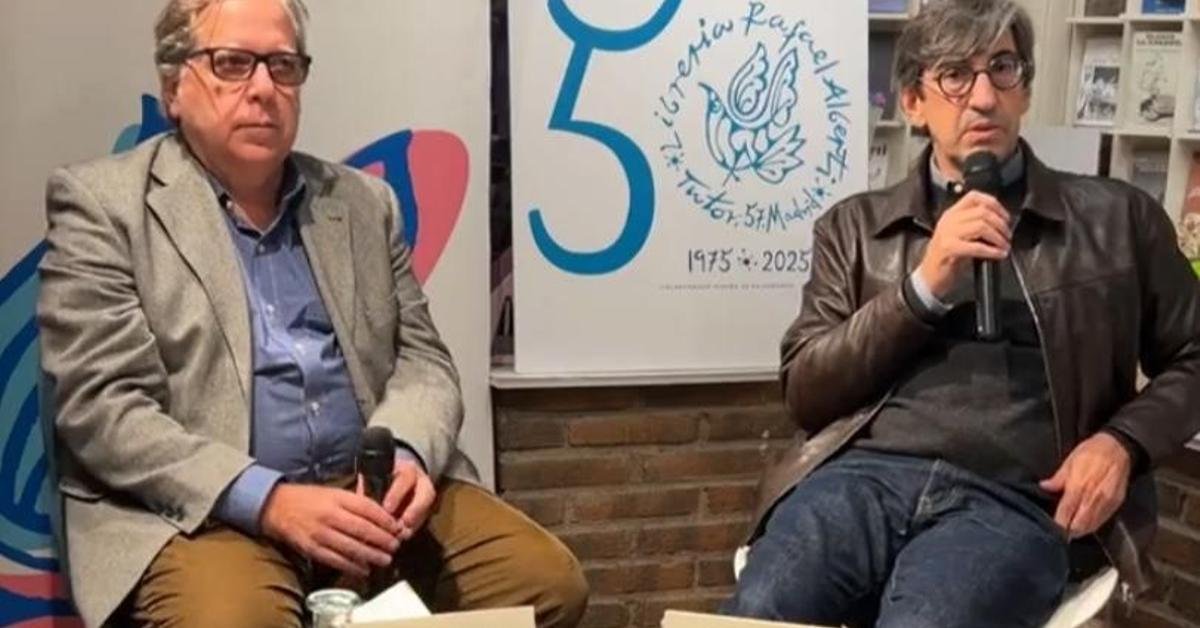
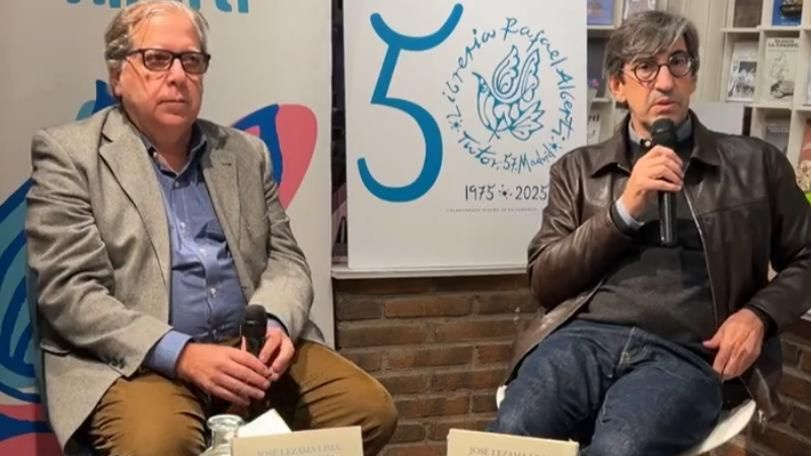
Madrid/How to build a biographical monument of a baroque, cryptic and difficult poet, whose existence took place almost entirely in the same domestic setting, Prado 9 and Trocadero 162? It is the first thing that the Mexican essayist Ricardo Cayuela Gally proposed. when presenting in Madrid José Lezama Lima’s biography of the Cuban writer Ernesto Hernandez Busto (Havana, 1968) and one of the reasons why he considers that the entire project – of which two volumes have already been published, Formative years (1910-1939) and Founding years (1939-1959)and the third is missing – is nothing other than “a cultural miracle.”
From that immobile geography, Cayuela noted, Lezama undertook one of the most ambitious explorations of literature in Spanish and became one of the most important poets of the language. But rebuilding such a life was not the only challenge that Hernández Busto faced throughout the twenty years of work that this work has taken him.
One of the things that most concerned the author while he was working, in that “long process,” was “to what extent I was making a book for Cubans or a book that could be read by people who, although they were interested in Lezama, did not have the burden that the figure of Lezama had for Cubans of my generation.” Therefore, to know if he was going for the right tone, Hernández Busto gave Cayuela fragments of the manuscript to read. “I did it with very few people, to be honest, because I was interested in keeping the entire project somewhat within that discretion, which I think is important,” he explained. “When you feel that you have something important in your hands, you try to take care of it, and although chapters were published, obviously reading the book as a whole offers another perspective and that was my idea.”
“I always say that ‘Paradiso’ is not so much an autobiographical novel as a genealogical novel”
One thing in particular, Hernández Busto was not willing to give up, when “some other” publisher to which he submitted it wanted him to cut pages. “I always refused,” asserts the poet and essayist, “because I always knew that this book like this, wordy and sometimes a little obsessive with certain details, was the one that I was interested in writing, was the one that responded to the project.”
Neat, meticulous, euphonious as usual, opening fans within fans, displayed in quotes, digressions and hundreds of footnotes, Hernández Busto reconstructs the world that made Lezama possible: the magazine Originsthe publishing houses, the friendships, the rivalries, that group of writers of which he was watchman and that would end up occupying a central place in the Cuban canon.
Cayuela brought out how one of the keys to the biography is in Lezama’s family genealogy. On the one hand, the maternal branch, the Lima, linked to the independence tradition, and on the other the paternal branch, which leads to a more uncomfortable military and political history, marked by conservatism, American influence and the racial prejudices of the time. In Lezama’s great novel, Hernández Busto finds a literary elaboration of both inheritances. “I always say that Paradise It is not so much an autobiographical novel as a genealogical novel,” he stated. “Lezama always tried to integrate his life and his family world into the fiction he wanted to put together. To do this, he tried to move two branches, which are two real branches of his life, of his genealogy.”
The father died when Lezama was eight years old. His absence was linked to the portrait that presided over the family home and the image of an unattainable ethical model. Hernández Busto pointed out that Lezama resolved this figure better “as absence than as presence.” Death thus acquired an almost mythical dimension. At the opposite extreme was the mother, Rosa Lima Rosado, whose “overpresence” conditioned her life. The biographer recalled an anecdote transmitted by Virgilio Piñera to Abilio Estévez: Lezama, now an adult, spread his flesh on a small bed, while his mother caressed his feet. Hernández Busto ventured that Paradisewith its intellectual and sexual freedoms, could hardly have been published while she was alive.
Faced with “a purely touristic concept of culture” or the “weight of North American influence”, for an intellectual like Lezama “the way out was Spain”
Another of the topics that Cayuela brought to the table was Lezama’s relationship with the Spanish writers who passed through Havana. Thus Federico García Lorca, who stayed three months on the Island instead of the planned month and who left a deep mark on him, or Juan Ramón Jiménez, who recognized an “exceptional interlocutor” in Lezama, María Zambrano, who was dazzled by his personality, or Manuel Altolaguirre, who helped him as an editor and patron. For Hernández Busto, that relationship cannot be reduced to the influence of an ancient metropolis on its colony. Faced with “a purely touristic concept of culture” or the “weight of North American influence,” for an intellectual like Lezama “the way out was Spain,” says the author. “Not as a metropolis, but as a culture, that is, the great world, the great themes that Spain gave to the culture of the language.”
The conversation between both essayists, who have known each other since the 90s, when the Cuban lived in Mexico, also addressed the limits of the universe of Origins. Cayuela asked about the distance between the Origenists and Afro-Cuban traditions. Hernández Busto recognized the racial prejudices present in Lezama’s family environment, but distinguished between these and the desire not to reduce national culture to the mestizo folklorism of the 1930s. The group’s ambition was different: to build a tradition capable of dialogue with universal literature. In the case of Lezama, this search privileged the baroque of New Spain societies, where a form inherited from Europe became an autonomous creation.
OriginsHernández Busto pointed out, occupied at the time a marginal position compared to the liberal and secular culture of the Republic, whose emblematic intellectual was Jorge Mañach, Hernández Busto also recalled. The controversy between the two over the intelligibility of poetry ended with Lezama’s withdrawal, but posterity altered those hierarchies. Hernández Busto recalled that his generation, that of the 80s, found in the magazine Origins an example of cultural resistance. “The case Origins “It is the perfect alibi for the marginalized,” he said. “It is a bit of confirmation that even in the worst social circumstances around there is a vote for posterity and there is confidence that certain words will be recognized.”
That “very obvious and more than proven sympathy,” explains the essayist, was a kind of “desperate departure from someone whom republican culture was already cornering in a terrible way.”
The essayist hesitates to subscribe to that today, “because the culture has changed a lot,” but in his youth he does remember “the emotion with which one could admire the ‘scratch on the stone’, as Lezama called it, not to say, fight against a hostile environment, with the absolute certainty that what you are doing is worth it and will be recognized in the future.”
Cayuela emphasized that Hernández Busto’s generation, that of Paideia, “in a certain sense tragic”: “A generation that went to the Soviet Union to see the communist model and what it discovered was Gorbachev, glasnost and perestroika. It arrived inflated with freedom to the Island, tried to apply that and found that the structures of the Revolution were not as permeable as the original model of which they were subsidiary and they faced persecution and exile.”
The “absolute certainty that he was on the route, that he knew what he wanted to say, that he had the global instruments to do it and therefore, he had that security to build his books,” pointed out by Cayuela, is a certainty, Hernández Busto added, “that gives desperation.” And that, he assures, explains “why Lezama sympathizes with the Revolution of ’59.” That “very obvious and more than proven sympathy,” explains the essayist, was a kind of “desperate departure from someone whom republican culture was already cornering in a terrible way.”
An irony collected in the second volume and brought up by Cayuela: at dinner on December 31, 1958, Lezama assured his friends that he had confidential information according to which “there was Batista for a while.” What comes next will be the subject of the third and final volume, “the juiciest” and which, the author announced, will be in the bookstore in a month and a half.
To conclude, the Mexican reflected on what reading the two published volumes teaches: “a very complex, rich, disputed country, where there are many options, even for the marginalized, with a very rich life.” A world, Cayuela adds, that “is going to be disappeared by the Saturnian whirlwind of the Revolution.” That is why in Hernández Busto’s book it is also “the story of a country that no longer exists.”