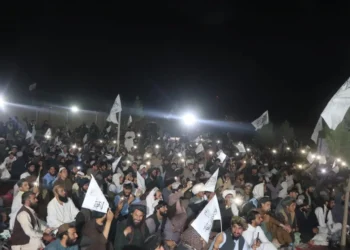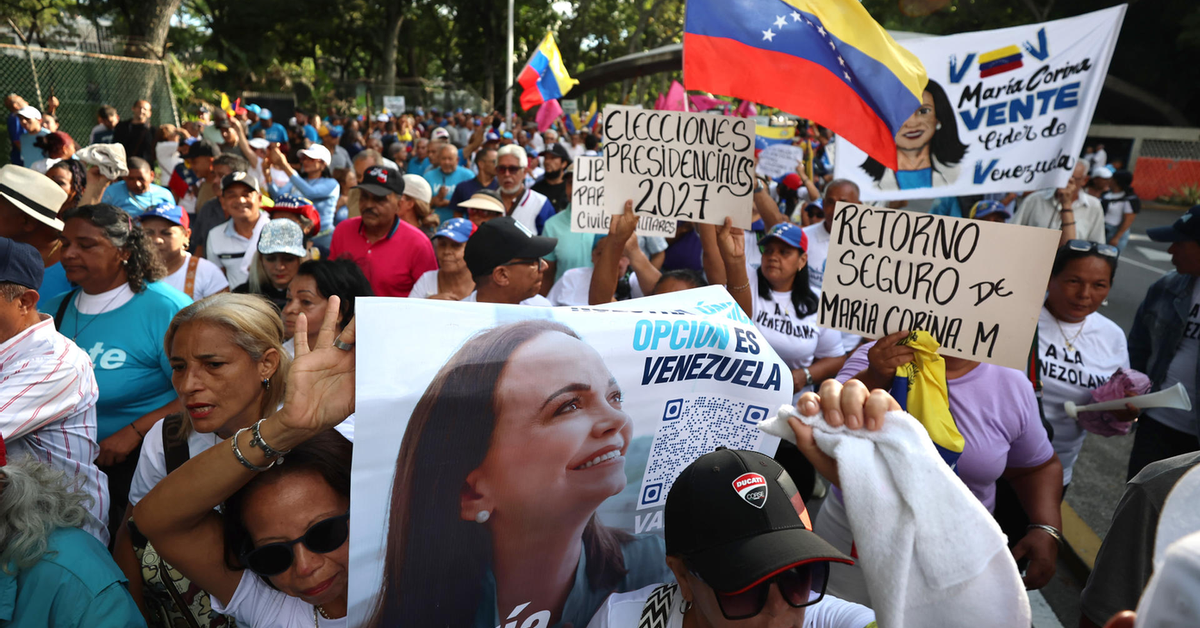
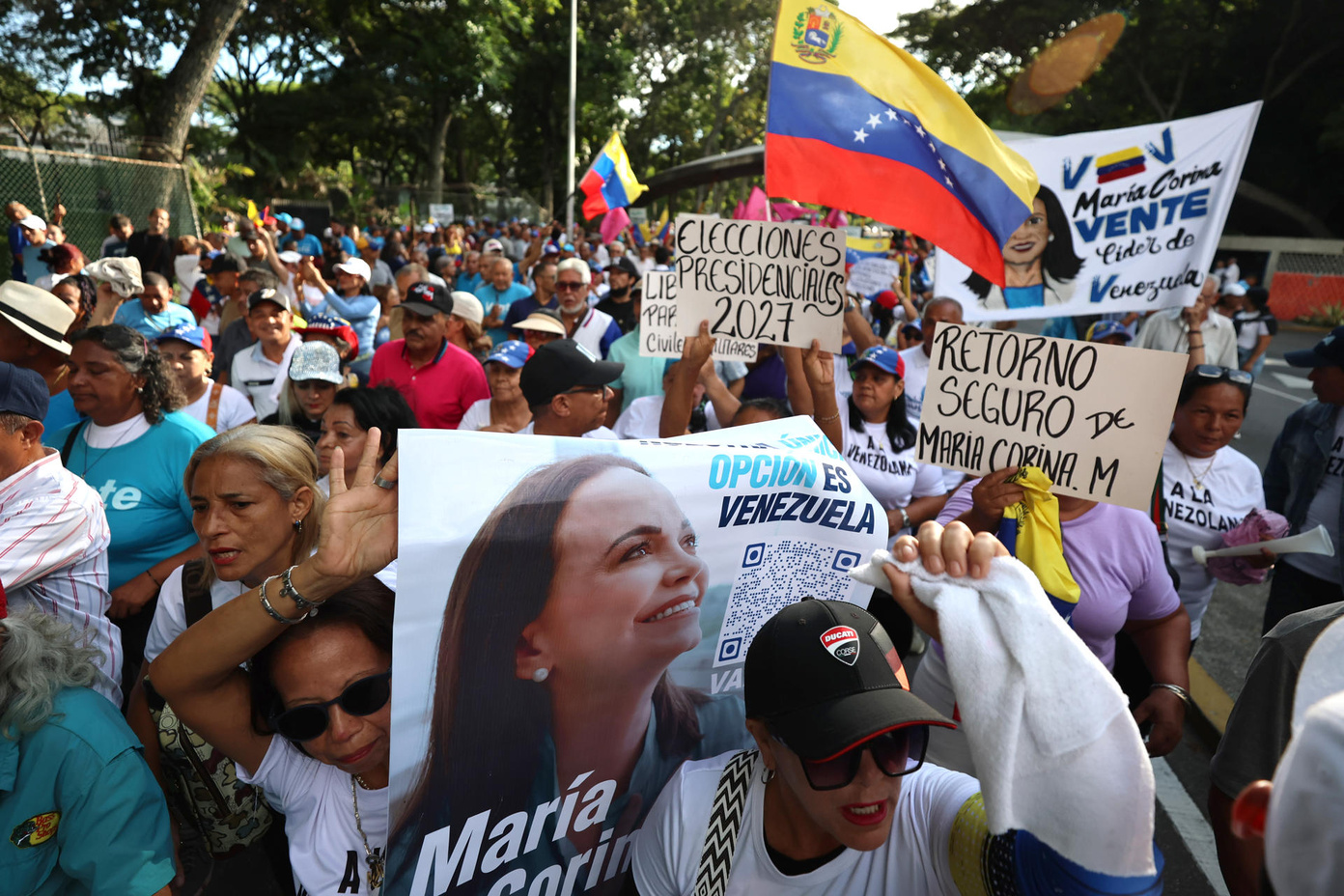
Caracas/The Venezuelan opposition led by María Corina Machado and Edmundo González Urrutia pressed this Thursday for the holding of presidential elections in 2027 during a march called throughout the country, a day after Chavismo and an opposition sector concluded their third cycle of dialogue.
From a point in western Caracas, protesters advanced shouting “elections now” and gathered in a city square, accompanied by leaders of various factions that make up the largest opposition coalition, the Democratic Unitary Platform, as well as human rights activists and leaders of Machado’s party, Vente Venezuela (VV).
VV activist Carlos Fernández anticipated that they are going to “vote out” the president in charge of Venezuela, Delcy Rodríguez, who took office after the United States captured Nicolás Maduro in Caracas last January.
At the end of this march, VV denounced the arrest of seven people who were “in charge of the sound trucks” used in the Caracas mobilization and requested their release.
At the end of this march, VV denounced the arrest of seven people who were “in charge of the sound trucks” used in the Caracas mobilization and requested their release.
This Thursday’s march also served to demand Machado’s return to Venezuela and to lead an eventual transition with her in the Presidency. The opposition member, who has been out of the country since last December, has tried to return up to seven times, according to her communications team recently, but she has been prevented from doing so.
On October 8, VV demanded that his leader be able to return to the country without the political disqualification that weighs against him, something that prevented him from competing in the 2024 presidential elections, despite having won the opposition primaries the previous year.
In parallel, Chavismo marched this Thursday in Caracas, after a rally in Plaza Venezuela, a central area of the capital. The general secretary of the ruling United Socialist Party of Venezuela, Diosdado Cabello, who usually calls marches when the opposition does so, assured that the demonstration was to support women in this month of the fight against breast cancer.
The day was also marked by Rodríguez’s meeting with the chief negotiators of Chavismo and the opposition in the dialogue, his brother Jorge Rodríguez, president of the National Assembly, and former deputy Dirorah Figuera.
The state channel broadcast images of the arrival of both at the Miraflores Palace, headquarters of the Venezuelan Executive in the Venezuelan capital, without giving more information about the meeting.
After the meeting, Delcy Rodríguez recognized what was achieved at the dialogue table to “advance in the field of political guarantees for all”
After the meeting, Delcy Rodríguez recognized what was achieved at the dialogue table to “advance in the area of political guarantees for all.” “Agreeing to endorse and follow these paths, in these different areas, is essential,” declared the president in charge in a video.
Figuera stated on Wednesday that Venezuela’s “great demand” is for a presidential election to be held, which he has proposed to be in 2027, and assured that he has the will to make this happen.
Neither Machado nor González Urrutia participate directly in these negotiations, but they have expressed their desire that these conversations achieve a “timely presidential electoral schedule.”
The Parliament of Venezuela also swore in this Thursday the 12 representatives of civil society who will make up, along with 11 deputies, the Judicial Nominations Committee, in charge of evaluating the profiles of the candidates for magistrates in the Supreme Court of Justice (TSJ), currently accused of being related to Chavismo, in response to what was agreed in the dialogue with the opposition.
According to an investigation by the NGO Transparencia Venezuela, two of these members have links with Chavismo, with which the Judicial Nominations Committee will have 10 profiles related to the ruling party, counting the eight deputies linked to the Government party.
The other nine citizens have no political ties and there is no information about one person, according to Transparency. They join the three opposition deputies who are also part of the committee.
The Judicial Nominations Committee will have 10 profiles related to the ruling party. The other nine citizens have no political ties and there is no information about one person, according to Transparency. They join the three opposition deputies who are also part of the committee.
The United States highlighted the progress of the third round of political dialogue in Venezuela and affirmed that more than 1,000 political prisoners have been released since last January, although it reiterated its demand that all political prisoners who remain detained be released. “We continue to urge the immediate release of all political prisoners,” the State Department said in a statement.
The text, signed by spokesman Tommy Pigott, highlighted that the reconciliation process seeks to “strengthen democratic institutions, expand political freedoms and lay the foundations for free, fair and credible elections.”
Among the results of the last round, the State Department indicated the commitment to review several laws that it considers “repressive” to expand political and social freedoms and guarantee the participation of all political actors.
The delegations also agreed to create a joint commission to manage the Venezuelan gold held in the Bank of England.
Washington also highlighted progress toward selecting the 32 new justices to rebuild an independent Supreme Court, regaining access to more than 70 previously blocked websites and efforts to reform the Hate Law.
However, an electoral agreement has not been reached as much of the opposition demands. The next meetings are scheduled between November 11 and 15, as announced by Jorge Rodríguez.