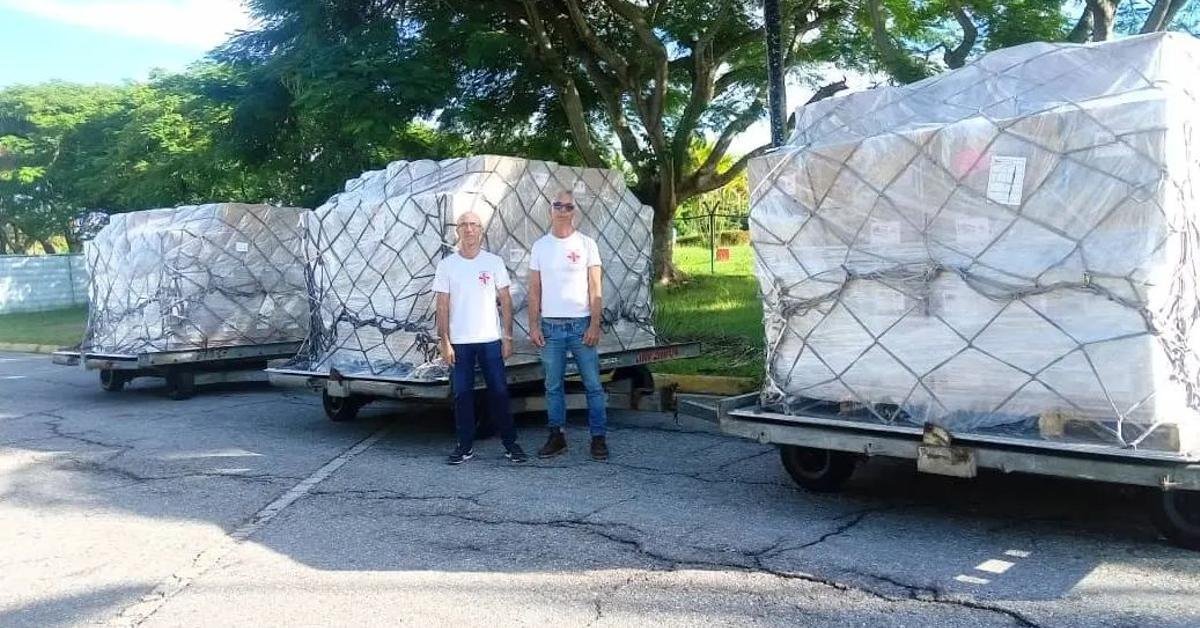
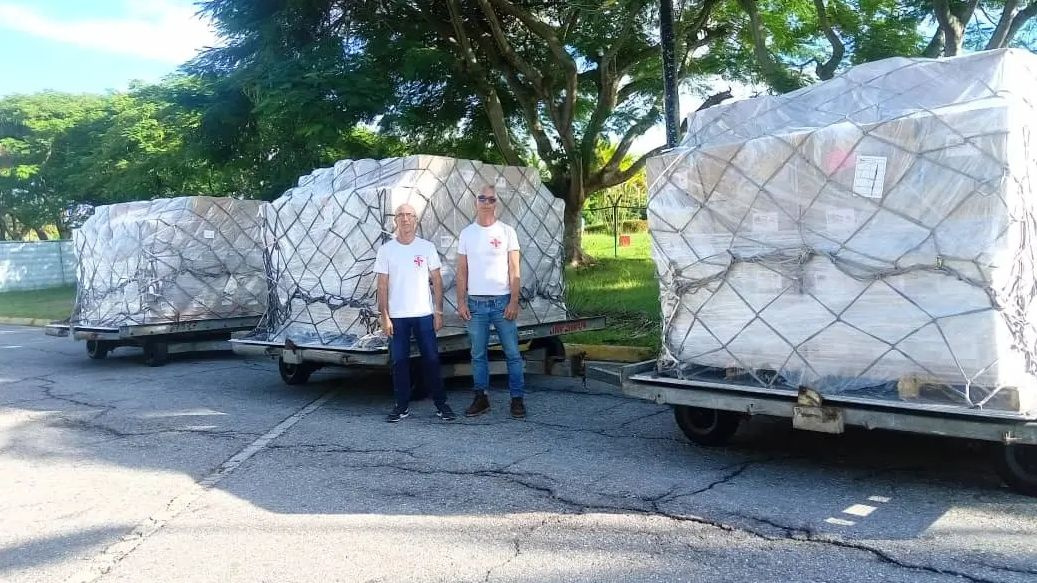
Havana/A second plane with humanitarian aid from the United States Government arrived this Thursday at the Juan Gualberto Gómez International Airport (Varadero), with 700 food kits and hygiene products destined for vulnerable families in Matanzas. The shipment will be distributed by the Catholic Church, through Cáritas Cuba, as part of the $100 million assistance program announced by Washington in May, which the Cuban Government initially described as a “fable.”
According to Caritas Matanzas reportedthe distribution will be made in Unión de Reyes, Bolondrón, Güira de Macurijes and other rural communities. “The volunteers from the Nuestra Señora de la Caridad parish, together with their parish priest, Enrique Peñate Galán, will carry out this path of mercy,” the organization notes.
“The volunteers of the Nuestra Señora de la Caridad parish, together with their parish priest, Enrique Peñate Galán, will carry out this path of mercy,” says Cáritas.
Caritas also highlighted that the first shipment arrived in Matanzas on October 14, also with supplies for 700 families from Alacranes and San Antonio de Cabezas, who began to receive food kits and hygiene products.
The organization initially identified 2,100 families, with priority for those over 60 years of age, people with disabilities, chronically ill people, pregnant women, nursing mothers and children under five years of age. Food insecurity and difficulties in accessing water are among the selection criteria.
Of the amount announced by the US Secretary of State, Marco Rubio, 60 million are channeled through the Catholic Church, with the participation of Cáritas Cuba and the US organization Catholic Relief Services, while the other 40 million correspond to other independent humanitarian entities.
60 million of US aid is channeled through the Catholic Church, with the participation of Cáritas Cuba and Catholic Relief Services
The history of these donations began with a dispute between both governments. On May 8, after Rubio’s announcement, Cuban Foreign Minister Bruno Rodríguez accused him of trying to deceive Cubans and Americans.
Five days later, the State Department publicly formalized the offer and Bruno Rodríguez changed his tone. “We are willing to listen to the characteristics of the offer and the way in which it would materialize,” declared the chancellor, although he demanded that it be free of “political maneuvers” and questioned Washington’s motivations.
He first shipment of the new program arrived in Julywith 18 tons of food and hygiene products. Afterwards, deliveries began in other provinces, including Villa Clara, Cienfuegos, Camagüey, Ciego de Ávila and Pinar del Río. The modules include rice, beans, oil, sugar, pasta, preserves, toiletries, water purification tablets and rechargeable lamps.
The United States established that supplies would reach the population directly through the Church and other independent organizations, as a guarantee against corruption and possible interference by the Island’s Government in the destination of the assistance.
The United States established that supplies would reach the population directly through the Church and other independent organizations.
The conditions were not completely new. After the passage of Hurricane Melissa, in October 2025, the United States had announced three million dollars in aid for the victims, an amount that was later increased by another six million. The shipments were also channeled through Cáritas and Catholic Relief Services.
American distrust has precedents in complaints about the fate of many other donations received by Cuba. In March of this year, Food Monitor Program denounced the alleged marketing in state stores that charge in dollars of food products from shipments sent free of charge by Mexico.
A month later, the organization revealed that the Mexican Agency for International Development Cooperation had reserved for five years, at the request of the Cuban Government, information on the management and destination of 3,125 tons of food and medicine sent in four shipments. The measure prevents public knowledge of inventories, distribution routes and final recipients.
The withholdings have also affected religious organizations. In July 2024, the Cuban authorities held in the port of Mariel a container sent from the United Kingdom by the International Aid Trust for an evangelical church in Havana. It included wheelchairs, mattresses, clothing, food and toys. Its director, the Reverend Bernard Cocker, denounced that the Government intended to appropriate the cargo. Authorities alleged problems with some items and with the sender’s activities in Ukraine.
Havana accuses the United States of using humanitarian assistance for political purposes
Havana, for its part, accuses the United States of using humanitarian assistance for political purposes while maintaining sanctions that aggravate the island’s economic and energy crisis.
The deliveries arrive in a country where the Government itself admits that a large part of the vulnerable population is not covered by its social assistance programs. In July, the vice minister of Labor and Social Security, Ariel Fonseca Quezada, recognized that there were 1,004,000 vulnerable households, where approximately 1,365,000 people lived. However, social assistance programs protected about 177,000 households, with around 300,000 beneficiaries.
The Vice Minister of Labor and Social Security, Ariel Fonseca Quezada, recognized that there were 1,004,000 vulnerable households in Cuba
Independent measurements present an even more serious situation. He Cuban Observatory of Human Rightsbased on a survey of 1,318 people between June and July, estimated that 94% of Cubans were at the extreme poverty threshold if remittances were excluded. Eight out of ten respondents had stopped eating a meal due to lack of money or food, a proportion that increased to nine out of ten among those over 61 years of age.
At the beginning of October, the prime minister, Manuel Marrero, promised to distribute monthly five pounds of rice, one of sugar and one of grains to 883,000 Cubans considered especially vulnerable, until January 2027. He did not specify when deliveries would begin.