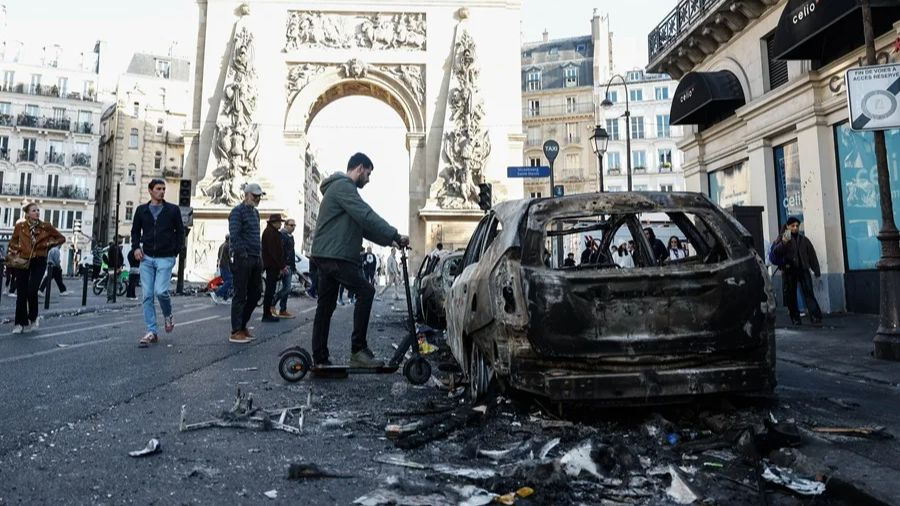
Paris/The French Government announced this Monday the first nightly curfews for the nights of Monday and Tuesday in the department of Nord, which will affect the cities of Lille, Douai, Wattignies and Denain, while Italy observes with concern the wave of protests and riots in France and other European countries are currently following the situation from afar.
This confirms the announcement made today by the Prime Minister, Sébastien Lecornu, to implement partial curfews to try to stop the wave of violence unleashed over the weekend in protests against the rising cost of life and the degradation of education and health, after almost 10 years of President Emmanuel Macron’s mandate.
The prefecture (government delegation) of the North specified that these curfews will affect specific areas of the four cities, with the agreement of their mayors.
The North Prefecture specified that these curfews will affect specific areas of Lille, Douai, Wattignies and Denain.
The Government is expected to publish the map of all the municipalities concerned before the end of the day.
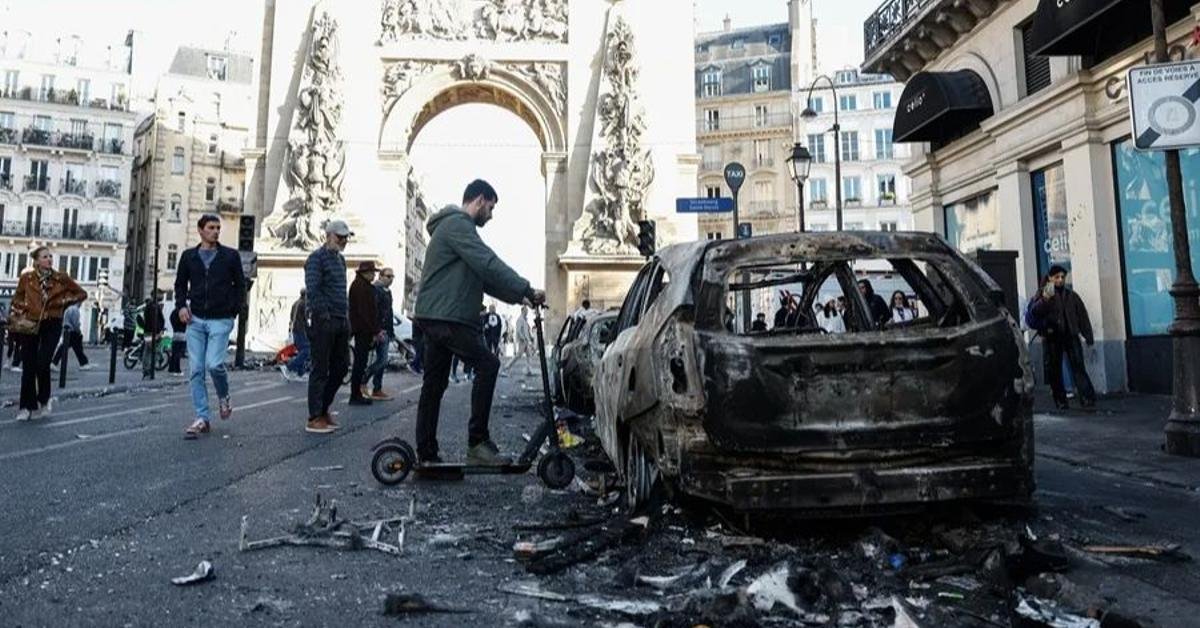
The measure aims to protect businesses after the looting that has impacted some 3,000 establishments and the episodes of great violence recorded in many French cities on the day of protests last Saturday and which continued in some of them also on Sunday, especially in Paris.
The curfews are temporary, according to Lecornu, and prior to an eventual decree declaring a state of emergency, which grants more powers to law enforcement.
“It is a curfew by territory, partial, it seems to me that, at this moment, it is a more adapted instrument than decreeing a state of emergency,” declared Lecornu, who did not rule it out.
“It is a curfew by territory, partial, it seems to me that, at this moment, it is a more adapted instrument than decreeing a state of emergency,” declared the French prime minister.
Several mayors of affected cities have criticized police action, considering it inadequate.
Faced with measures to support the workers of businesses affected by the riots, Lecornu has slipped a political interpretation of the incidents, of which he accuses the ultra-left and which would aim to “question the calendar and holding of the presidential elections”, scheduled for six months from now.
As of 8:00 a.m. on Monday, 2,331 people remained in police custody due to the riots and looting, according to the Ministry of Justice, which noted that 70% were of legal age and that the Prosecutor’s Office requested preventive detention in more than 80% of the cases.
The coordination of the so-called ‘yellow vests’ that participated in last Saturday’s protests in France has announced a second day of mobilization for next October 24, with dozens of actions planned throughout the country.
The Italian Prime Minister, Giorgia Meloni, brought together her ministers and leaders of other institutions this Monday to analyze the situation of public order, after the weekend riots in Milan (north) and in the midst of protests over rising fuel prices in the south of the country.
Milan and other nearby cities such as Turin or Bologna, have experienced violent demonstrations this weekend against the rising cost of life
Milan, the economic capital of northern Italy, as well as other nearby cities such as Turin or Bologna, have experienced demonstrations this weekend against the rising cost of living that have led to violent scenes of urban guerrilla warfare and looting in city center stores.
On the other hand, discontent has also reached the south of the country, which has been shaken since last Friday by the protest of transporters due to the increase in the price of fuel that is already beginning to be scarce in some places.
The German Government, however, rules out a European contagion of violence.
“Of course, the images that we have all seen, both in Paris and in Limoges, fill us with great concern,” Foreign Ministry spokesperson Kathrin Deschauer said in a regular press conference, rejecting the violence in the streets.
The European Commission expressed the same line, which today described the violent acts recorded in France as “unacceptable” and, although it defended the fundamental right to demonstrate peacefully, it supported the efforts of the French authorities to guarantee security.
The European Commission today described the violent acts recorded in France as “unacceptable”
In Albania, this Sunday marked six days of student protests against the Government of socialist Edi Rama, who refuses to resign and assures that the actions are endangering Albania’s access to the European Union.
Activists complain about the poor conditions at the country’s universities and the high cost of living for university students. Since the beginning of the protests last Tuesday, more than 270 people have been injured, including about 170 police officers, while 167 people were arrested, according to official data.
Calm is the tone in the peaceful encampments in Lisbon and Porto against the housing crisis, where young people want to extend their protests to the union movement and promote an “Iberian general strike” on November 11, coinciding with the strike called in Spain also due to the problem of access to housing.
The General Confederation of Portuguese Workers (CGTP), the main trade union center in the country, appears as a fundamental interlocutor for a possible call, although at the moment it is not known that it has taken up the proposal.