In 2019, 27 law
students at the University of the South Pacific had an idea that
sounded almost impossibly ambitious: they should take the issue
of climate change to the International Court of Justice.
Six years later,
in 2025, the Court delivered its opinion on the
obligations of States in respect of climate change. On
20 May 2026, the General Assembly adopted a resolution
welcoming it.
That path, from a
student-led campaign to a landmark legal opinion and a UN
resolution, was led by the Pacific. Young Pacific climate
advocates started the process, and Vanuatu was the country that
carried it through to the UN General Assembly.
This left our
Embassy pondering what happens after this ICJ Advisory Opinion
has been adopted and what exactly comes next for states
obligations in regard to climate change?
reflections on the panel.

On the morning of
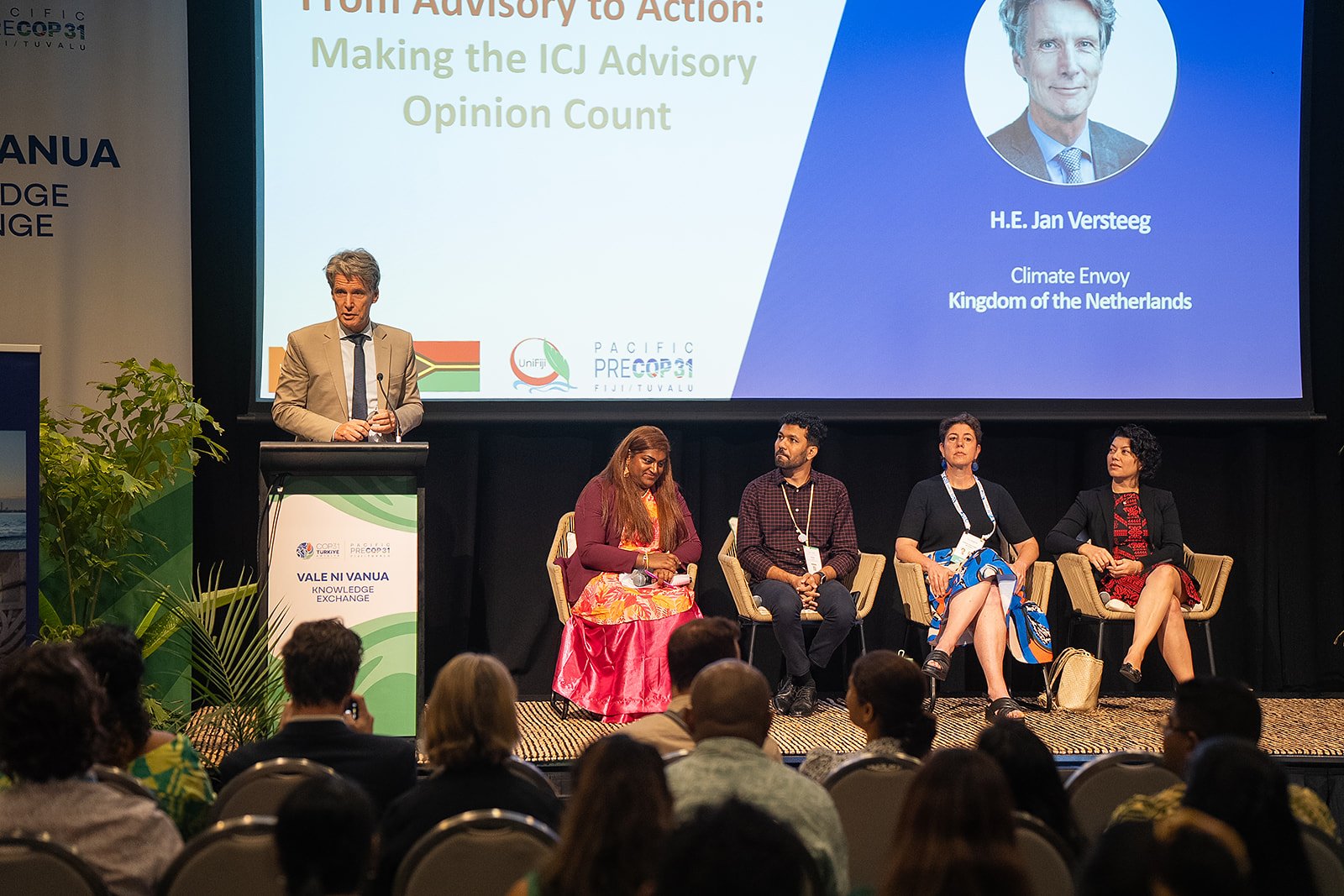
Wednesday 7 October, we put that question to a panel. “From
Advisory to Action: Making the ICJ Advisory Opinion Count”
was co-hosted with the Government of Vanuatu and the University
of Fiji.
The Kingdom of
the Netherlands has a particular reason to care about
this issue. We joined the core group that drafted the
General Assembly resolution alongside Barbados, Burkina
Faso, Jamaica, Kenya, the Marshall Islands, the
Federated States of Micronesia, Palau, the Philippines,
Singapore and Sierra Leone. We also have Caribbean parts
of the Kingdom whose climate vulnerabilities echo those of
Pacific states.
The aim of our
event was simple. A legal opinion only matters if it changes
what governments do, so we wanted to create a platform where
Vanuatu and other Pacific Small Island Developing States (SIDS)
could tell their own story and set out practical next steps,
with the Netherlands in a supporting role.
Our event was
kicked off with keynotes from two different sides of the
narrative. EU Commissioner Wopke Hoekstra, responsible for
climate, net zero and clean growth, gave the view from the
European Commission and Hon. Ralph Regenvanu, Vanuatu’s Minister
for Climate Change and the Pacific Ministerial Champion for Loss
and Damage, gave Vanuatu’s perspective. Both speakers emphasized
the need for the ICJ Advisory Opinion to support meaningful and
tangible climate action.
Commissioner
Hoekstra kickstarted the event with passionate commentary – “We
commend the strength, the courage and the leadership of the
islands and the ICJ case is an example of where we can support
and amplify these efforts.” He said the EU would keep backing
Pacific led climate action and resilience.
Minister
Reganvanu built upon this message and emphasized that
“Our measure of success must be the difference an
outcome makes – not simply that we secured an outcome.”
An important message to keep in mind as we approach COP
31 in Türkiye in November.
After these
keynotes, we kicked off our main panel discussion. The panel was
moderated by Patricia Chand of the University of Fiji and
brought together:
- Lee-Anne
Sackett, Vanuatu’s Special Envoy for Climate Justice and its
lead negotiator on the 2026 UN General Assembly
resolution. - Dr. Siobhan
McDonnell, of the Australian National University, a lead
climate negotiator for Pacific governments since
2019. - Vishal Prasad,
Campaign Director of Pacific Islands Students Fighting
Climate Change, who addressed the judges at The Hague in
December 2024.
A key take away
from the conversation was that we all have to normalize this
conversation outside of the diplomatic and legal circles in
which it is commonly discussed. We all need to become champions
of the advisory opinion and find ways for us to bring it to the
forefront in our own professional circles. As Minister Reganvanu
said, “As we prepare for COP31, we should ask where our
collective effort can deliver the strongest action, and how each
process can reinforce the others.”
The Netherlands
remains committed to working with Pacific countries to bring the
issue of climate change higher on the international agenda, deal
with the impacts of the climate crisis in the region and find
ways to strengthen their autonomy and resilience.
and what comes next.

Importantly, we wouldn’t have been
able to organise such an interesting and insightful panel discussion
without the support of the University of Fiji. Their support,
knowledge and help with logistics was invaluable and their staff were
a pleasure to collaborate with.
Netherlands’
Contribution to Pacific Resilience Facility (PRF):
Another highlight
from Pre-COP was that we had an opportunity to announce
something we’ve been quietly working on for a while now. As a
country with 26% of its land surface below sea level, the
Netherlands feels a strong solidarity with the Pacific island
countries and their struggle with sea-level rise. That’s why at
the Pacific Pre-COP in Fiji, the Netherlands Climate Envoy H.E.
Jan Versteeg pledged a EUR 1 million contribution to the Pacific
Resilience Facility.
The PRF is a
Pacific-led fund designed to support small-scale resilience and
adaptation projects at the community level. This complements the
important work of larger institutions such as the Green Climate
Fund and the Asian Development Bank (ADB), of which the
Netherlands is also a founding member.
At one of the
meetings in Fiji, the PRF was compared to a breadfruit tree:
strongly rooted and continuing to provide nourishment over many
years. In much the same way, the PRF is rooted in the Pacific
and aims to provide lasting benefits to communities across the
region.
The Netherlands
congratulates the Pacific Islands Forum on launching its very
own international financial institution, and we look forward
to many meaningful community projects coming to
fruition.
University of Fiji