How on earth is it possible that the SLM has been able to survive for years and get planes in the air despite all the losses and scandals due to mismanagement? The answer is as simple as it is shocking: thanks to trickery and deceit at the top level, both within the company and politicians. In three episodes the True Time how the people have been deliberately fooled for years by shrewd figures, including the current government. This last part clearly explains why the plan of Minister Adelien Wijnerman of Finance and Planning to convert the disguised subsidies into a loan is doomed to failure in advance. And they and president Jennifer Geerlings-Simons know that all too well.
Text Armand Snijders
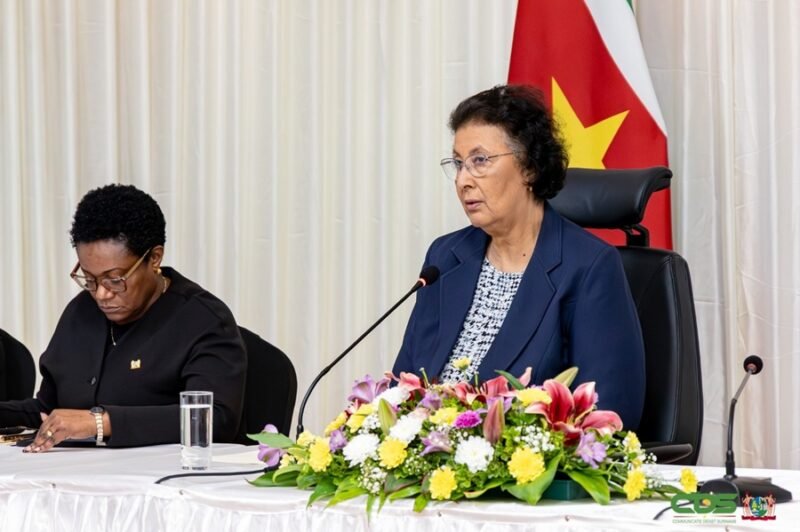
Image CDS
Then-president Chandrikapersad Santokhi (2020-2025) had actually already thrown in the towel regarding the Surinamese Airlines (SLM), whose situation was hopeless, partly thanks to his failed approach. His government repeatedly claimed that society no longer needed state support, while in reality a lot of money went to it. These mainly came from other state-owned enterprises, such as Staatsolie, Havenbeheer and Grassalco.
“So the state provides an unsecured loan to a technically bankrupt company”
IMF was silent
This was contrary to the conditions that the International Monetary Fund (IMF) had set for the years of financial support to keep the Surinamese economy afloat. This was common knowledge in society. Although the Surinamese side has always been very secretive about this, it must undoubtedly have also come to the attention of the IMF, which kept silent.
It should not be surprising if the IMF pretended to bleed its nose for political or strategic reasons. After all, tolerance within the margins of a financial program is not an unknown mechanism internationally. The conclusion that the government had cunningly deceived the IMF may well be premature.
During technical missions and evaluations of the IMF, analysts combed the entire government treasury. Large monthly cash flows (such as the millions for the SLM) that run outside the regular budget are immediately noticeable in the monetary data of the Central Bank of Suriname. It could therefore hardly have escaped the attention of the IMF that this money actually functions as state aid.
Legally closed
If so, there may be three plausible reasons why the fund accepts what is now called a specific ‘loan structure’. Firstly, a strictly legal one: as long as the Surinamese government properly sealed the construction as a loan agreement, the country formally complied with the agreements. The IMF has long been satisfied that it has the necessary documents to demonstrate in Washington that the rules on paper are being respected.
It is also conceivable that larger macroeconomic goals were much more important to the IMF, such as controlling inflation, stabilizing the exchange rate and reducing the total government debt ratio. Then blowing up an entire aid program over a relatively minor misstep at a national state-owned company is like shooting a mosquito with a cannon.
The IMF may also have understood the Surinamese reality. The abrupt collapse of the national airline could have led to social unrest and political instability. That would be the last thing the IMF wants in a country that has just undergone a tough reform process.
Tacit compromise
It is conceivable that in these types of situations the IMF would choose to tolerate the construction during the ongoing reviews, but to call the government out on it afterwards in formal reports. In its official evaluations, the IMF consistently warns the Surinamese authorities that financial supervision of loss-making state-owned companies must be urgently strengthened to limit risks to the state treasury.
Viewed in this way, the loan construction was a tacit compromise: the government could keep the SLM afloat and the IMF could continue to report that Suriname was formally adhering to the reform agreements. So the Santokhi government got away with it, but left the SLM in 2025 even worse than it had found it five years earlier.
Debt or loan?
And now it is the headache of the government of Jennifer Geerlings-Simons. In this hornet’s nest – in which fellow party members and so-called experts are trying to sting her from all sides – she must try to get order out of the chaos and cope with the debt of more than a hundred million US dollars.
By the way, Minister Wijnerman does not consider the forty million US dollars that he has ‘received’ from Grassalco as a debt, but as “a loan to recover the money”. This makes SLM less bad on paper, but in fact it is a waste of scrap; the money must be refunded.
When Wijnerman states that the subsidies will now be converted into a loan, she repeats an internationally proven political strategy. However, from a financial and technical point of view it is virtually impossible. A company that has no money and is short of two million US dollars per month on operating costs (fuel, lease and salaries) has no capacity to pay interest or principal.
“Viewed in this way, the loan construction was a tacit compromise: the government could keep the SLM afloat and the IMF could continue to report that Suriname was formally adhering to the reform agreements.”
Never ever healthy
If the government formally places these loans on the balance sheet, they are seen as ‘subordinated debts’ by external private creditors or lease manufacturers. This will make it even more difficult and expensive for SLM to lease commercial aircraft on the open market. Moreover, the SLM hardly owns any hard assets (such as its own fleet of modern aircraft or valuable real estate portfolios) that can serve as collateral. The state therefore provides an unsecured loan to a technically bankrupt company.
These are all signals that indicate that the SLM can never become healthy in the current situation. It is not without reason that many experts say that closing down and starting over is the only option. And Geerlings-Simons and Wijnerman know that too. For the time being, they also want to continue throwing taxpayers’ money into the bottomless SLM pit.