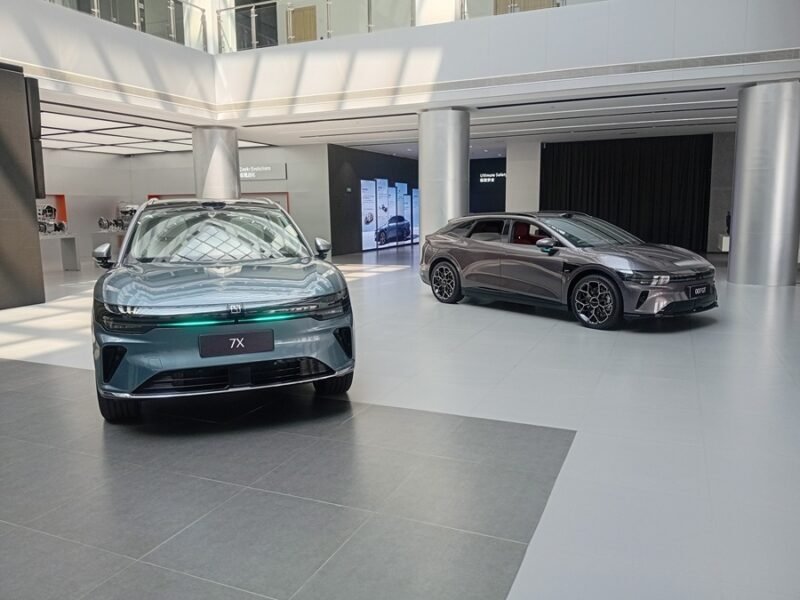
At the Zeekr factory in Ningbo, it’s all about pace. Robots weld the aluminum bottom plates of the Zeekr 007 and Zeekr 7X together, while AGVs – unmanned carts – silently find their way between the assembly lines. Certain parts are assembled by workers. No oil smell, no rattling engines: just the hum of power tools and the rhythmic clicking of battery packs disappearing into the ground. There is a dashboard on the floor with real-time data on output, quality and energy consumption. Elsewhere, new electric cars are rolling off the production line every minute. The production cycle is high. And the ambition is even higher: this is how Chinese premium EVs want to conquer Europe.
Text and image Ivan Cairo
This was what a group of foreign journalists saw during a visit to the Zeekr car factory in Meishan, in the Chinese province of Zhejiang. Along the way, there was enthusiastic discussion on the bus about what the reporters hoped to see: the production process up close.
“Behind the impressive numbers, an important question remains: at what cost will that pace be sustained?”
However, disappointment followed upon arrival. Filming and photography in the factory is prohibited. Cameras were only allowed to be used in the showroom, where three models were displayed, while the assembly hall had the greatest interest among visitors. The disappointment was noticeable, but did not stop them from exploring the factory with great curiosity.
Photos are being taken furiously in the showroom. The group then goes to the production hall, where a representative explains the manufacturing process. The tour is regularly interrupted by questions.
The assembly hall covers no less than 120,000 square meters. It is warm there and almost everything revolves around automation. People and machines work side by side, but move along strictly separate routes. Yellow lines on the floor indicate where visitors and employees are allowed to walk. This prevents dangerous situations with robots and unmanned carts that continuously transport parts to the workstations.
Robots are taking over
The factory becomes one ‘dark factory’ named. This does not mean that everyone works in the dark, but that certain production lines can function without lighting because human intervention is hardly necessary. According to the information provided, several workshops are fully automated.
The welding workshop in particular appeals to the imagination. There, 823 robots perform the welding work without human intervention. The machines perform their work with great precision and in a fixed rhythm.
Yet automation does not mean that people have become redundant. The factory has approximately 2,500 employees. They carry out, among other things, assembly work and inspections. Along the production line, workers are busy connecting parts and checking vehicles. The self-driving transport carts ensure that materials end up in the right place.
The heat in the enormous hall is noticeable. While the machines perform their work, the employees remain focused on their tasks. The visitors barely attract their attention. In a factory where production runs according to a precise schedule, there is little room for interruptions and distractions.
A car every 89 seconds
The production rate is impressive. A complete car leaves the assembly line every 89 seconds. By the way, that doesn’t mean that a vehicle is built in a minute and a half. The number indicates the interval at which a finished car comes off the production line.
The factory has been operating at full capacity since September 2025 and, according to the data provided, operates in two twelve-hour shifts. Nearly a thousand vehicles are produced every day. The annual production capacity is three hundred thousand cars.
Various models are built in Meishan, including the Zeekr 007, 007 GT, 7X, 9X and Mix. The factory plays an important role in the international delivery of the 7X. On September 8 this year, the two hundred thousandth copy of this model rolled off the production line, approximately two years after its introduction.
The high production speed is partly possible due to close cooperation with suppliers. More than 60 percent of the supply chain is organized locally. Chairs come from Jifeng and injection molding machines from Haitian, among others. The average response time between the factory and suppliers is only 2.3 hours, according to company information. A required mold can be delivered within half an hour.
The nearby port of Ningbo-Zhoushan is also strategically important for the supply of raw materials and the export of vehicles. The factory supplies to more than fifty countries and regions.
(read more below the photo)

Downside of the pace
The extensive automation also raises questions about working conditions. Employees are deployed in two twelve-hour shifts, with three to four rest days per month. In busy production periods, significant overtime may also be required.
The basic salary for production employees amounts to approximately four hundred euros per month. Due to overtime and allowances, the total income can amount to seven hundred to eleven hundred euros. However, these data do not necessarily provide a complete picture of the employment conditions of all employees.
Workload is a broader discussion point in the Chinese auto industry. Manufacturers are developing new models in increasingly shorter times. Development processes that previously took approximately 54 months have been reduced to 24 months or less for some manufacturers. This places high demands on both staff and suppliers.
Working conditions are also becoming increasingly important for manufacturers with international ambitions. The European Union has adopted legislation that must ban products made with forced labor from the European market from the end of 2027. This does not mean that long working hours are automatically classified as forced labor, but companies will have to be able to demonstrate that their supply chains comply with the rules.
Competition with Europe
The technological progress in Meishan is impressive, but European car manufacturers are not standing still either. Volkswagen has converted its factory in Zwickau, Germany, to produce electric vehicles. In bodywork construction, the degree of automation is almost 90 percent and 1,625 robots are used.
Approximately 1,050 vehicles are produced daily at Stellantis in Sochaux, France, slightly more than at Zeekr in Meishan. The difference is that the French factory also builds conventional and hybrid cars, while Meishan is specifically designed for the production of new energy vehicles.
This is an important competitive advantage of Chinese producers. Many modern factories have been designed from the ground up around electric propulsion, automated production and a tightly integrated supply chain. European manufacturers often have to make major adjustments to existing factories.
Zeekr has now built up a strong position in the Chinese premium segment. In 2025, the brand sold 224,133 vehicles. December was the strongest month of that year with 30,267 deliveries.
The luxurious Zeekr 9X in particular has attracted attention. According to recent sales data, the model achieved a strong position in the segment of large SUVs above 500,000 yuan, equivalent to approximately 65,000 euros. The Chinese brand is thus firmly entering the territory of established European premium manufacturers.
(read more below the photo)

International ambitions
However, international expansion is not without obstacles. The European Union has imposed additional import duties on electric cars from China. Geely, Zeekr’s parent company, is subject to a compensatory duty of 20 percent on top of the regular import duty of 10 percent. According to Brussels, these measures should compensate for the consequences of Chinese government subsidies. For Zeekr they mean higher costs and a more difficult competitive position on the European market.
The American market poses an even greater challenge. In addition to high import tariffs, there are strict restrictions on Chinese technology in vehicles. Zeekr therefore focuses mainly on other international sales markets, including Europe and the Middle East.
The Chinese government has encouraged the development of electric vehicles for years with subsidies, tax breaks and industrial policies. The Meishan factory is also considered a national green factory. The sustainability facilities mentioned include solar energy, heat recovery and rainwater recycling.
For Zeekr, Meishan is more than a production location. The factory shows how China is trying to expand its position on the international car market with automation, economies of scale and a strongly interwoven network of suppliers.
“Employees are deployed in two twelve-hour shifts, with three to four rest days per month. In addition, significant overtime may be required during busy production periods.”
At the end of the morning the journalists return outside. The cameras can still be used there to capture the factory facade. Inside, visitors got an impression of the enormous scale, automation and high production pace.
But behind the impressive numbers, an important question remains: at what cost will that pace be maintained? The machines in Meishan don’t need a break. The people who work there do.