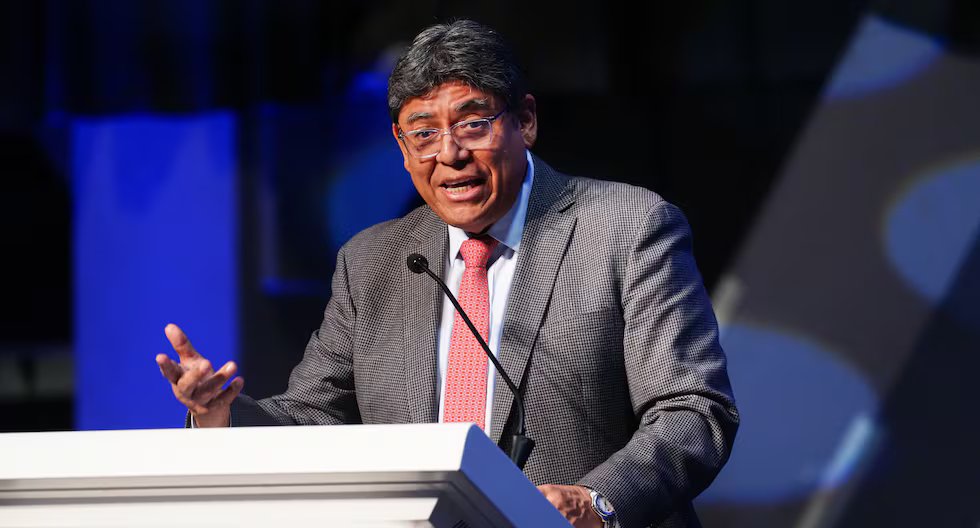

In a scenario marked by the risks associated with the El Niño phenomenon, the oil supply shocks derived from the geopolitical crisis and the solidity of the Peruvian economy, the Minister of Economy and Finance, Elmer Cuba, assured that his portfolio will work to prevent the country from losing its current economic dynamism.
“We have a Ministry of Economy that will respond so that the economy does not cool down and that is very important to have employment, to be able to sell, especially for microbusinesses that are very sensitive to economic cycles,” he mentioned.
As part of these measures, Cuba announced that next week it will present changes in fiscal matters that its sector has been fine-tuning together with the President of the Republic, Keiko Fujimori.
“In the Ministry of Economy and Finance, we are designing a very powerful countercyclical fiscal policy. I cannot give details now because we are going to fine-tune it with the president and we are going to announce it next Thursday,” he said.
The announcement was made during the opening speech of the second edition of Peru Business Fest 2026. And although he did not provide further details about the measures, the minister acknowledged that the “State does not do its job well”, alluding to municipal obstacles that, in some cases, make it difficult for businesses to operate and can even cause them to close.
“A large company could face the opposition of a mayor, a scrupulous mayor (…), and that is already expensive for a large company and can be corrosive for a small company, because it cannot overcome that bureaucratic barrier created by the municipalities,” he said.
Under this line, he announced that they will work in coordination with Indecopi and its Commission for the Elimination of Bureaucratic Barriers, emphasizing that the State itself must comply with its resolutions instead of challenging them.
Economic dynamism
According to Cuba, the initiatives seek to sustain the economic dynamism and business confidence achieved by the current government. Among the positive indicators, he highlighted that business expectations about decisions within companies and the sectors in which they operate have reached historical highs, according to the Central Reserve Bank (BCR) survey.
“The country risk, for example, is at historic lows of 100 basis points, but also in the Peruvian private sector (…) we have never had so many reserves in the Central Bank, so much fiscal space, so much access to financing and it is time to respond so that the economy does not cool down and those expectations of the private sector that are at the top in hiring and investment continue,” he noted.
However, the minister acknowledged that this favorable scenario coexists with three supply shocks that he described as temporary. Among them he mentioned the El Niño phenomenon and the oil crisis, whose effects would be transferred to prices.
Added to these factors is the shock derived from the rise in international interest rates, driven by the response of the central banks of different economies to contain inflation. This increase makes credit in foreign currency more expensive and raises the yields required for bonds in all maturities.