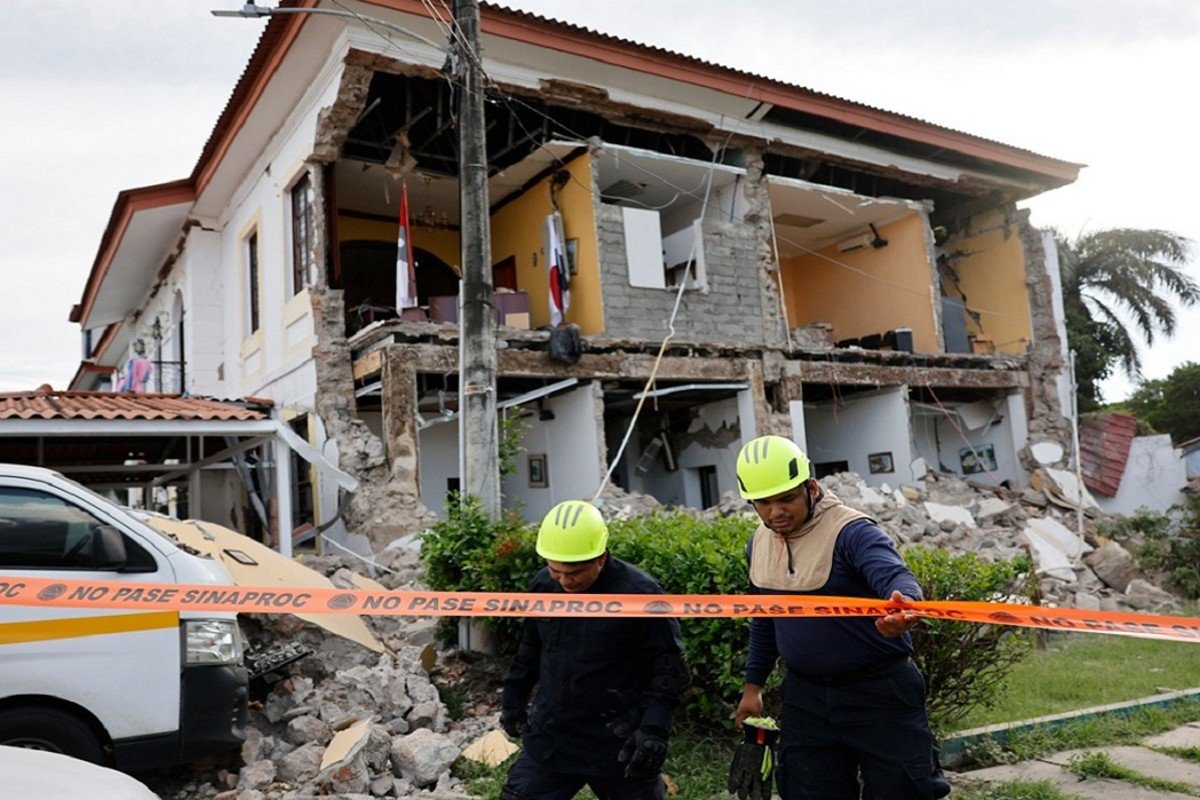
Although the earthquakes in Venezuela and Panama They had similar magnitudes, they produced significantly different damages. This is due to the terrain, the distance to the epicenter, the rupture of the fault and the vulnerability of the buildings.
In Venezuela, two earthquakes of magnitudes 7.2 and 7.5 were recorded in a densely populated area. The earthquakes of June 24 left 14,239 homes with moderate damage and 11,000 with serious damage. On the other hand, Panama experienced a single magnitude 7.7 earthquake this Friday, October 9, in a non-urban area, with 188 structures damaged and no fatalities reported. The event was followed by more than 100 aftershocks.
These disparities were analyzed by engineers and researchers Óscar Ramírez and Ramiro Vargas in the forum ‘Engineering and Seismic Risk: Building a Resilient Panama’, organized by the Technological University of Panama, a month before the Panamanian earthquake.
Ramírez explained, as reported Infobaethat the magnitude and distance to the epicenter are not sufficient to anticipate the damage of an earthquake. The depth of the focus, the way in which a fault breaks, the propagation of the waves, the type of soil and the properties of each building intervene in the perceived intensity and damage.
For his part, Vargas distinguished between threat and vulnerability. The first depends on the seismic activity; the second, the propensity of a structure to suffer damage. The latter can be reduced with engineering intervention.
The land and buildings
Seismic waves travel through rock and pass through soil deposits before reaching a building. The properties of these materials can modify the movement received by the structure.
For his part, Ramírez compared sectors such as Paitilla and Punta Pacifica, where the rock is close to the surface, and Costa del Este and Santa María, settled on compressible clay deposits. The same structural solution does not necessarily work in the same way on both types of terrain.
They also indicated that soil classification is not enough. It all depends on how it interacts with the mass, stiffness and damping capacity of each building. This suggests that two buildings located in the same place can move differently.
Additionally, people can also experience earthquakes differently depending on what floor they are on. Each structure has its own vibration characteristics and that condition can coincide with that of the terrain.
The Argentine media pointed out that this phenomenon is known as resonance, and occurs when the vibrations of the ground and the building approach each other, increasing the displacement.
“When you mount a flexible structure on soft ground, the structure is going to amplify its displacement, but substantially,” Ramírez described.
The height of a construction does not define its vulnerability. A low-rise building can register higher accelerations than a tower; However, a tall and flexible structure can suffer significant displacements under certain ground conditions.
The tallest buildings in Panama were built on rock using piles or deep excavations. These foundations are calculated to support the vertical loads (such as the structure’s own weight and use loads) and the lateral forces caused by an earthquake.
The earthquake-resistant design does not seek for the construction to remain intact in the event of an earthquake. The purpose is that it can deform, dissipate energy and retain its stability.