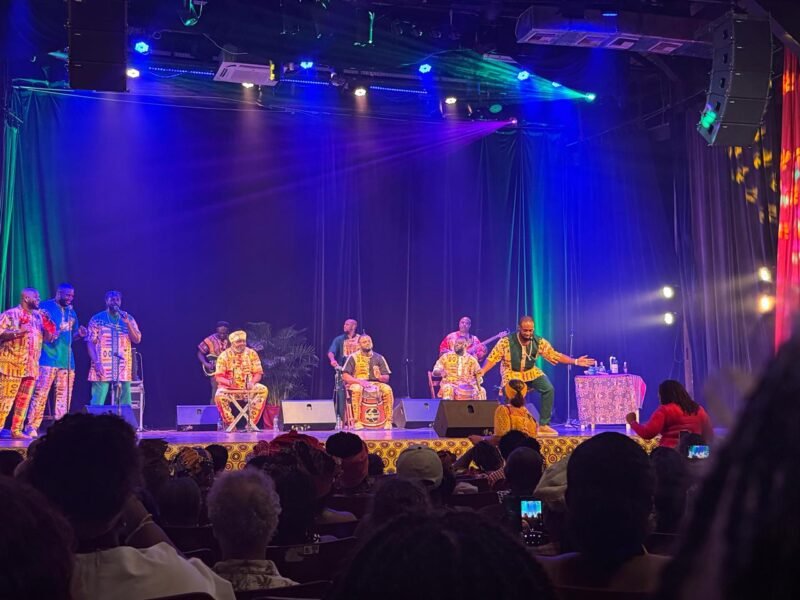
Black Harmony had a firm musical grip on the audience during its anniversary concerts in Theater Thalia on Saturday and Sunday October. One visitor clapped enthusiastically, while the other moved their head to the rhythm. People sang along, swayed on chairs and as soon as the members of the male group invited the audience to stand, they didn’t have to say it a second time. The legs started moving automatically.
Text and image Shanavon Arsomedjo
It was much more than a party. With the anniversary concerts, the Afro-Surinamese music group celebrated twenty years of music, brotherhood and solidarity. The men took the audience on a journey through tradition, memories, love and spirituality, with room for fun and exuberance. It was an evening where different musical worlds came together and the band showed how much color and energy has grown in twenty years of Black Harmony.
“Black Harmony not only celebrated an anniversary, but also brought to life the versatility of its musical identity”
Recognizable rhythms
From the first notes it was clear that the group did not intend to stick to a quiet evening of listening. The music invited movement, but at the same time brought the audience into contact with the cultural and spiritual roots that form an important part of Black Harmony’s repertoire. During the concert, anyone who wanted to follow the group’s musical development got a good impression of the journey Black Harmony has taken in twenty years.
The journey took us back to the early days, when the gentlemen mainly focused on English-language music. From that basis the group developed further, with more and more room for Afro-Surinamese music, recognizable rhythms and songs that are close to their own culture. This development was not only noticeable in the music, but also in the audience’s reactions. Especially with the Afro-Surinamese hits and the winsti pokus, the audience seemed to become even more energetic. The rhythms were recognizable to many and the songs evoked something that was difficult to limit to just listening.
Multiple voices, one harmony
While some sang along to the songs word for word, others let their hands do the work. There was clapping, nodding and careful swaying. As soon as the invitation came to stand up, the hall effortlessly transformed into a place where the music was also experienced with the body. The alternation between the different styles gave the concert its own dynamic. One moment the emphasis was on the spiritual charge of the music, the next moment the festive spirit dominated. It was precisely that combination that made the evening special: Black Harmony not only celebrated an anniversary, but also brought the versatility of its musical identity to life.
Band leader Orlando ‘Nana’ Ceder took care of an important part of the vocals, but he was not alone in the spotlight. Jamal Bijnoe and Jurmen Macnack also regularly took the lead and thus gave their own color to the performance. Derillio Alexander also showed that he has good singing qualities, while Stephano Banel did not leave his vocal talents unused. Together with musicians Ulrich Entingh, Louis Bean, Wendel Triesie, Morenzo Bruma and Bjorn Plak, they formed the musical basis on which the evening could sparkle. The accompaniment gave the voices space to come into their own and contributed to the alternation between the more spiritual moments and the songs that invited the audience to move along.
The singers were given the space to make themselves heard, while the group as a whole retained the cohesion that belongs to Black Harmony. It was an interplay in which individual qualities and the collective sound complemented each other. During the concert, the name of the group seemed more than just a name. The voices and instruments found each other in the music and the men radiated the pleasure of musicians who have been working together for years.
“The men brought the music, but the audience gave it an extra layer with its reactions. Every invitation to participate was received with enthusiasm”
Recognition and own work
The repertoire also offered sufficient moments of recognition. Well-known songs such as ‘Puwema’ and ‘Kankantrie’ were given a place in the musical journey, in addition to own compositions such as ‘Mi Nana’, ‘Wi Kabra’ and ‘Liba Tori’. In doing so, Black Harmony showed that the group not only builds on music that the audience already knows and cherishes, but also makes its own contribution to the Afro-Surinamese musical landscape. The own compositions were in line with the cultural and spiritual theme of the evening. At the same time, the well-known songs provided a direct connection with the audience.
The audience did not have to think long about what to do with the music: singing along, clapping or moving was often enough. The power of the concert was not exclusively in the songs themselves, but in the interaction between the musicians and the audience. The men brought the music, but the audience added an extra layer to it with their reactions. Every invitation to participate was received with enthusiasm.
Twenty years and beyond
With the anniversary concerts in Theater Thalia, Black Harmony underlined that the group still has plenty of life left in it after twenty years. The music got people moving, evoked memories and offered space for spirituality and cultural recognition. It was a celebration in which past and present met, without the festive character disappearing into the background.
Twenty years of Black Harmony means twenty years of making music together, but also twenty years of building a brotherhood that became audible in the singing and palpable in the audience. And if the audience’s reactions are any indication, the love for the group and its music is far from over.