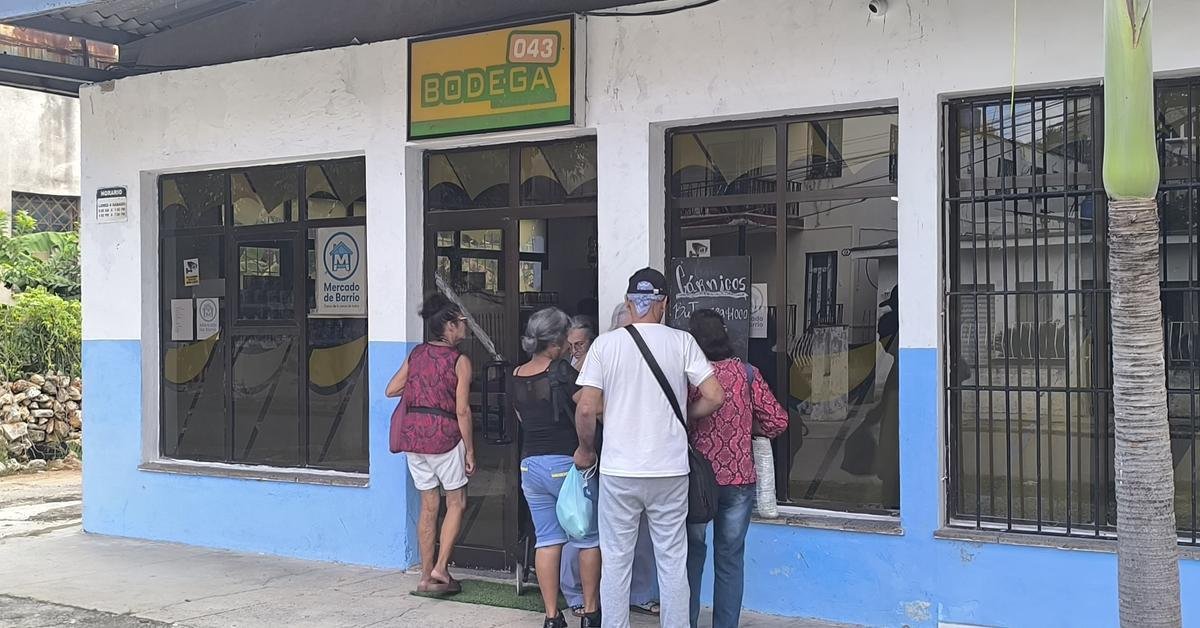
Havana/In the new Neighborhood Market on Ermita Street, between Conill and Tulipán, in the Havana municipality of Plaza de la Revolución, inaugurated just this Saturday, there are certainly no lines. At its doors, this Monday, a woman who seemed to be the administrator encouraged people to come in while promoting some products.
At his call, a retiree entered and went straight to the counter that had a sign above it that said “regulated products,” a legacy of the old state business that was in the same place, Bodega 043, which is now managed by the El Titán de Tulipán MSME. “What are the regulated products?” asked the woman. The manager responded: “Remember that we transformed this, that belonged to the winery and must be deleted, here we do not sell regulated products.”
On the contrary, the store appears stocked as it has been in decades without being a state warehouse. For sale there is not only food, packaged and fresh, but also toiletries, perfumes, small appliances and even air conditioners. The prices, as explained by the authorities when they announced the opening of this type of businessesin alliance with the State, are only between 10% and 15% cheaper than the rest of the private ones.

/ 14ymedio
The small difference can be seen in the “released products” table, which not only shows the sale price but also the “reference price.” Thus, for example, a kilogram of rice is 900 pesos (the reference price is 1,050); black beans, at 950 (from 1,250); the 250 gram package of coffee, at 2,600 pesos (from 2,800), and the carton of eggs, at 4,200 (from 4,800). As for meat, you can find sausage at 1,000 pesos, pork loin at 2,150 pesos per pound or chicken mince at 700 pesos per pound.
In the perfumery area, a young woman lamented the poor quality of the fragrances, cheap imitations of other brands, for 3,000 pesos. “So expensive, and they last just as long as you put them on,” the girl said.
An old man, for his part, looked at the appliances with longing eyes: rice cookers at 24,000 pesos, Silver Crest mixers at 32,000, water pumps at 40,000, splits at 220,000 pesos.
Rice cookers at 24,000 pesos, Silver Crest mixers at 32,000, water pumps at 40,000, splits at 220,000 pesos
“No one comes here because people have already realized that these are not neighborhood markets or the head of a guanajo,” protested a woman, who left the premises, perfectly air-conditioned and illuminated, as well as monitored with several security cameras, without buying anything. One of the clients who came in this Monday to ask about tobacco, stated: “This is a pure and simple MSME, and the price difference is minimal.” In this regard, he gave the example of Reloba tobacco“the bad one,” at 135 pesos, when individuals have it at 150. “I don’t understand why it is so expensive, because that is produced in Cuba.”
/ 14ymedio
In the midst of a chronic shortage and inflation that does not subside, and as part of the new economic measures, the Government issued regulations at the beginning of August to include private companies in a mixed trade modelwhich put an end to the state monopoly in wineries and wholesale markets. This included the creation of supply markets, such as the one in Sancti Spíritus just openedand also Neighborhood Marketswith the promise of a better assortment and cheaper prices.
However, the slight price difference has sparked enormous criticism, including in the state press. This same Sunday, an article on the Matanzas radio station Radio 26 attacked: “If the name were honest, they would not be called Neighborhood Markets. They would be called Barrio Alto Markets, Exclusive Zone Markets, Private Urbanization Markets or, simply, Barrio Pudiente Markets. Because an establishment whose prices the neighborhood cannot pay does not belong to the neighborhood: it belongs to another stratum, to another social geography, to that parallel country where inflation is not measured in anguish, but in comfort.”
“An establishment whose prices the neighborhood cannot afford does not belong to the neighborhood”
In the text, its author, the notorious pro-government journalist José Miguel Solís, recalls the “promise” of making available to consumers “20 basic products with prices up to 15% lower than those of other private businesses.” And he continues: “Reality, however, crashes into the pockets of retirees and workers.” Likewise, he denounces scarcity and “inequality” that “is sold as competition.”
“The paradox is evident: a state system that, with all its insufficiencies, guaranteed at least a regulated quota is dismantled and is replaced by a commercial network whose prices depend exclusively on the ability to pay,” Solís asserts. And he adds: “The notebook did not solve the lack of food, but its disappearance has not brought abundance either.”
/ 14ymedio
Meanwhile, he protests, “the managers of these markets receive 5% bonuses on sales tax, tax exemptions for those who wholesale with entities of the Internal Trade system, and up to two years of free lease of state premises, extendable if they invest.” This causes, he says, a “contrast that is difficult to ignore”: “the State gives up income, but that renunciation does not reach the consumer’s pocket. The supposed reduction falls by the wayside.”