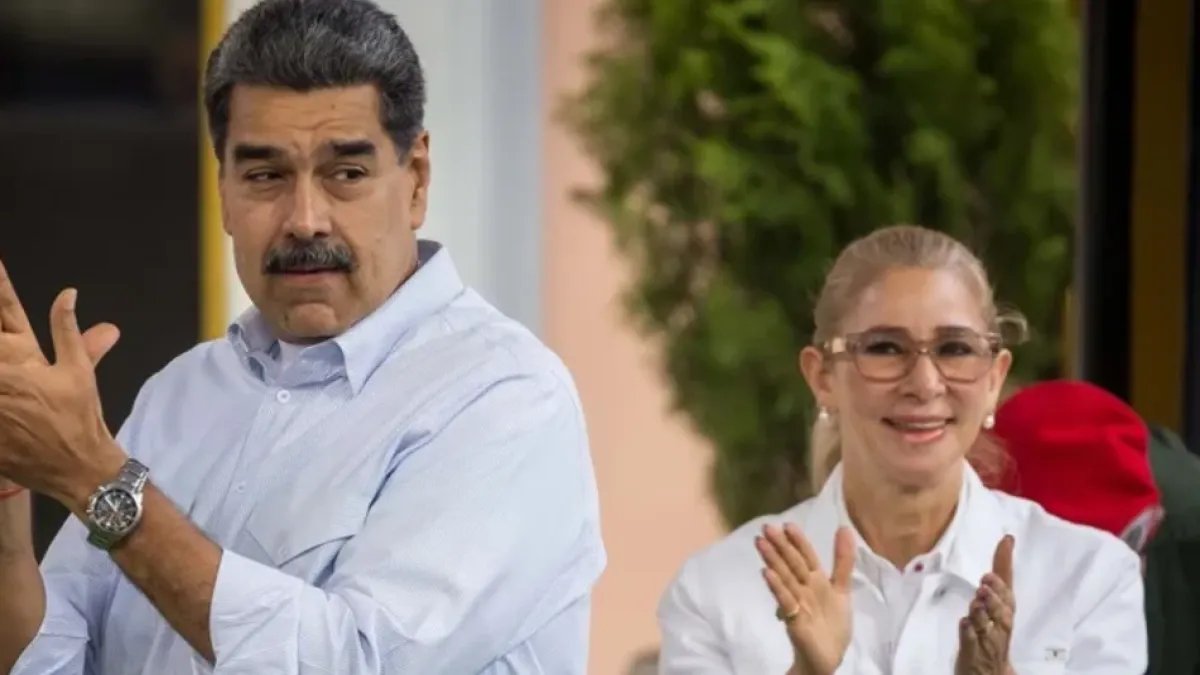
The new file presented by the United States justice system against Nicolás Maduro and Cilia Flores contains serious allegations about their alleged relations with the FARC and the ELN. The Prosecutor’s Office maintains that the Venezuelan leader negotiated explosives with the former guerrilla leadership to settle debts for drug trafficking, allowed exchange operations of weapons for cocaine and ordered the transfer of a soldier to a FARC camp in Colombia, where would have been tortured.
The accusation against the former president and the former first lady, which They were captured in Caracas the past January 3talks about an alleged meeting they held with three of the main leaders of the former FARC, held shortly after the death of Hugo Chávez, in 2013. This is one of the most delicate sections of the new accusation.
The meeting, according to the US Prosecutor’s Office, had a purpose: to resolve a financial debt derived from an alleged association for drug trafficking that would have ended in an agreement to supply explosives to the Colombian guerrilla. The protagonists of that meeting, according to the file, were Rodrigo Londono Echeverrialias Timochenko; Luciano Marin Arangoknown as Iván Márquez, and Seuxis Pausias Hernández Solartealias Jesús Santrich.
Nicolás Maduro and a PDVSA plant. Photo:Courtesy
The three are mentioned in the 30-page document presented yesterday before the Federal Court for the Southern District of New Yorkin which more than two decades are rebuilt of alleged drug trafficking operations, corruption and repression related to Maduro and his circle of power. The accusation points out that guerrilla leaders met with Maduro and Flores to discuss “the money that Maduro owed to the FARC in relation to his drug trafficking association.”
And he adds that, “to pay at least part of the debt, Maduro agreed to sell explosives of the Army reserves to the FARC.” US prosecutors go further and maintain that the then president was aware of the consequences that this operation would have: “Maduro recognized that It would also increase the capacity of the FARC to wage war against Colombia“The accusations appear in the accusation and are part of the thesis of the Prosecutor’s Office, but They do not constitute judicially proven facts.
Nicolás Maduro, during the extraction by United States security forces. Photo:United States Department of Justice
The moment in which the meeting would have been held is especially relevant. In 2013, the government of Juan Manuel Santos advanced peace negotiations with the FARC in Havana, while Maduro assumed the Presidency after the death of Chávez.
The Prosecutor’s Office does not establish the amount of the debt or specify where the meeting took place. It also does not determine how many explosives were delivered. However, he maintains that operations related to the supply of weapons were prolonged. In this sense, it is stated that “mine sales continued until approximately 2015”, a period in which Maduro would have facilitated “the sale of mines manufactured in Cuba, among other weapons, to terrorist groups.”
Rodrigo Londoño, the first in line, is named in the document. Photo:Isabel Valdes. J.E.P.
‘Nexus’ with armed men.
The file maintains that the links with Colombian guerrilla organizations transcended the agreements between their leaders and regime officials. In another section, they describe the alleged participation of members of the General Directorate of Military Counterintelligence of Venezuela (DGCIM) in drug trafficking and arms transfer operations. “Around 2016, a senior Venezuelan official, identified as ‘CC-1’, gave instructions to members of that organization to coordinate drug movements,” the document reads.
And he points out that the official ordered DGCIM officers“assigned to an elite unit, which coordinate the movement of cargo of drugs.” The file specifies that “‘CC-1’ I got those shipments of the FARC”, a group that they identify as part of the drug trafficking networks that had relations with the Venezuelan power. According to the accusation, “the military officers used cargo trucks that normally transported fuel” to take the weapons to “a Venezuelan port, from where They would be sent outside of Venezuela”.
Nicolás Maduro. Photo:EFE
The researchers consider that these episodes They were part of a larger structure of corruption that allowed sectors of the Venezuelan Government to enrich themselves with drug trafficking. The alleged links between the Venezuelan Government and the Colombian guerrillas also they would have reached the judicial system.
The accusation maintains that, in the Chávez administration, officials close to power promoted judicial decisions that favored members of the FARC investigated for crimes committed in Venezuela. The document assures that, under the direction of ‘CC-1’ and other collaborators, “the judges they regularly designed the dismissal of cases against members of the FARC.” The above in order to “guarantee that the FARC could continue operating in Venezuela without obstacles.” The file does not relate the processes that were filed nor does it identify the judges. However, presents these performances as part of an institutional practice.
Likewise, it points out that Colombian armed groups, such as the FARC and the ELN, they obtained resources for control of illicit activities in Venezuela: “They collected ‘taxes’ through extortion in the areas they controlled in Venezuela.” According to the accusation, these activities were carried out within a system of corruption that allowed military officials and police profit from illegal businesses and guarantee protection to certain organizations.
mature collage Photo:EFE / AFP / Illustration made with AI / EL TIEMPO
The relationships described were not limited to the former FARC. The ELN also appears in several sections of the file, particularly in the events linked to the circulation of cocaine across the Colombian-Venezuelan border. One of the most recent accusations corresponds to the period between 2022 and June 2024. During those years, according to the Prosecutor’s Office, the official identified as ‘CC-3’ “ordered members of the DGCIM to hide narcotics in scrap metal shipments” that a local businessman had been forced to sell at a lower price.
The investigators maintain that, in that same period, the official “traveled regularly to controlled destinations by the ELN near the border between Colombia and Venezuela to ensure continuous passage and safe from cocaine.”
The accusation thus places members of Venezuelan military counterintelligence in contact with ELN structures that exercised control in the border areas. The shipments, they indicate, were later mobilized by sea and air routes. “From these entry points, cocaine It was shipped out of Venezuela both on vessels approved by Venezuelan military officials and on clandestine flights designed to avoid detection“, it reads.
The file adds that contacts with organizations dedicated to drug trafficking in Colombia would have continued after June 2024. It is stated that “representatives of ‘CC-1’ They continued arguing with drug traffickers Colombians plans to traffic cocaine through Venezuela at least until August 2025.” Military torture. Another chapter of the accusation describes an episode that occurred in November 2013 in Colombia. According to the document, Maduro ordered to arrest a military officer Venezuelan identified as ‘Victim-2’, suspected of maintaining contacts with a former senior government official who had opposed Chávez and Maduro.
The Prosecutor’s Office affirms that, “by order of Maduro, members of the DGCIM They arrested Victim-2 and the transported to a camp in Colombia, near the Colombian-Venezuelan border, controlled by the FARC.”
The accusation says that the officer was there “in inhuman conditions,” under the custody of the Venezuelan guerrilla and military intelligence. According to prosecutors, “members of the DGCIM they tortured Victim-2 during interrogations (of an alleged plan to overthrow Maduro) that lasted approximately two days“. The file indicates that was punchedbeatings with a belt and attacks with objects that looked like tubes. Also would have been forced to stay lying on a mattress that only contained metal springs and He was suspended by his hands and feet for several minutes, until lose consciousness.
READ ALSO
The accusation describes that the torturers “they submerged their nose and mouth of Victim-2 underwater, simulating drowning, approximately 30 times.” While they subjected him to these practices, the agents they threatened to kill and it accused of participating in a conspiracy against Maduro. The file adds that the soldier also received threats against his family. After about two weeks of captivity, the detainee was forced to record a confession false and finally was released near the border. But the accusation is not limited to attributing the facts to members of military intelligence.
Prosecutors maintain that Maduro I was aware of the conditions in which the officer was detained and “approved” the treatment he received. The document does not identify the Colombian department where the camp operated nor does it establish which guerrilla commander would have authorized the operation. Nor does it indicate that Colombian authorities would have been aware of the facts.
Justice Editorial
Justicia@eltiempo.com