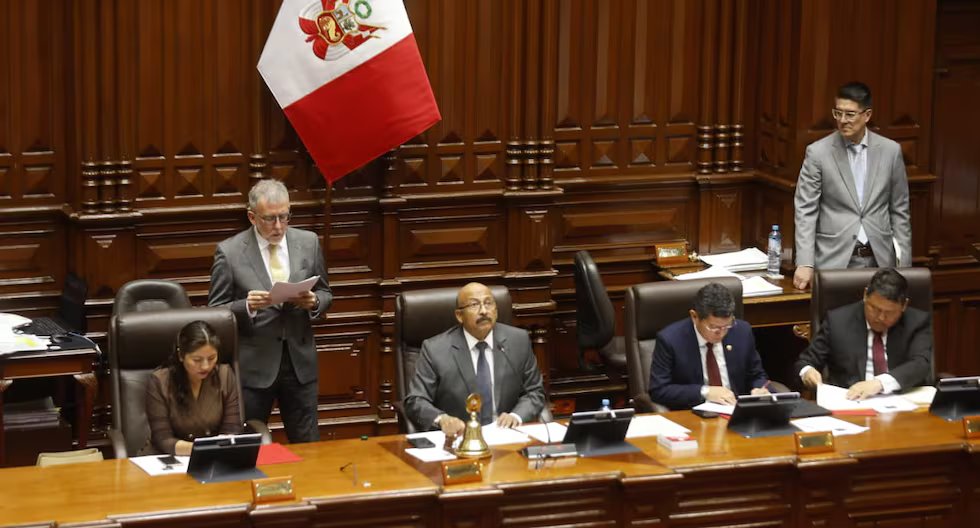
In a day marked by suspensions of the plenary session, emergency meetings of the Board of Spokespersons and successive changes in the opinions, the Chamber of Deputies approved granting legislative powers to the Executive for 90 days, in matters of citizen security and to address the El Niño phenomenon. The decision will be sent to the Senate for evaluation.
The proposal received 66 votes in favor, 34 against and 24 abstentions last Tuesday the 6th. The session began at 10 in the morning and ended after 11 at night.
THIS WAS THE VOTING ON THE MAJORITY OPINION:
| BENCH | No. | IN FAVOR | AGAINST | IN ABSTENTION |
|---|---|---|---|---|
| Popular Force | 41 | 34 | 0 | 7 |
| Together for Peru | 32 | 0 | 30 | 1 |
| Good Government Party | 18 | 0 | 0 | 16 |
| Popular Renewal | 15 | 15 | 0 | 0 |
| Civic Party Works | 14 | 12 | 0 | 0 |
| Now Nation | 10 | 5 | 4 | 0 |
| TOTAL | 130 | 66 | 34 | 24 |

This is how each deputy voted. The image does not show the vote against Svieta Fernández, from Together for Peru.
The day was dominated by chaos and entrapment, mainly based on the positions assumed by the Together for Peru and Fuerza Popular benches, as well as the decisions adopted by the president of the Chamber, Óscar Reto.
During the day, Fuerza Popular, which had initially presented a minority opinion with 50 of the 66 powers requested by Keiko Fujimori’s government, modified its proposal twice.
In the afternoon, he proposed reducing them to 30 and, in the evening, he presented a new text that incorporated 20 points from the majority opinion of the Constitution Commission and another nine additional points.
Meanwhile, Together for Peru appealed to previous questions and various readings of the regulations to avoid the approval of the powers.
After 10 pm, the plenary session rejected the first minority opinion presented by Fuerza Popular, which contemplated 50 powers for the Executive. The proposal obtained 64 votes against, four abstentions and no votes in favor. The Fuerza Popular deputies abstained from participating in the vote, maintaining that this ruling had already been replaced by substitute texts.
Then, the plenary session rejected the minority opinion presented by Together for Peru, which proposed not granting any legislative power to the Executive. The proposal obtained 49 votes in favor and 75 against, with no abstentions.
Hours before, the majority opinion, promoted by Renovación Popular, Obras, Ahora Nación and Partido del Buen Gobierno, was rejected with 49 votes in favor, 73 against and two abstentions.
Fuerza Popular and Together for Peru opposed it. Both groups defended their own minority opinions with different proposals.
However, at the end of the day they approved putting that opinion to a vote again, which finally achieved support. This will be referred to the Senate.
Throughout the session, Fuerza Popular sought to deliver more powers to the Executive, while Together for Peru proposed rejecting them in their entirety.
During the debate, deputy Nery Fernández, from the Good Government Party, questioned: “The extremes, those who wanted everything and those who wanted nothing, end up preventing an agreement for Peru.”
“A democratic agreement cannot be replaced by any imposition from the extremes,” he added.
In the morning, the session was charged with an atmosphere of tension. The climate escalated to the point that the president of the Constitution Commission, Giannina Avendaño, of Together for Peru, tried to frustrate the debate with the request to put the majority opinion to a vote – quickly.
However, Reto arranged a fourth intermission to try to unblock the session.
It all began at 10:23 am with a bell that began the plenary session. First, he became aware of the entry of two minority opinions, those of Fuerza Popular and Together for Peru.

Approval of faculties.
The first, as El Comercio announced in its Sunday edition, proposed 50 faculties; while the second requested to archive the Executive’s request.
Almost all legislators, from their seats, listened to the arguments that supported the proposals. In principle, Giannina Avendaño supported the majority opinion and reminded the plenary session that it was born from a “consensus text” between the members of Popular Renewal, Now Nation, Good Government and Works in the Constitution Commission.
The proposal allowed the delegation of powers to get out of the trap generated in that working group.
By then, the Constitution Commission had received three alternative formulas and a prediction promoted by Avendaño herself, which proposed outright rejecting all the powers requested by the Executive. The latter, however, was rejected with the support of 15 legislators.
Once the support was resumed, continued Arturo Alegría, from Fuerza Popular, who argued in favor of his minority opinion, which proposed 50 powers, and saluted the Renovación Popular bench for having previously promoted the “consensus text.”
Shortly after, Analí Marquez, from Together for Peru, spoke and proposed not approving the delegation of powers.
He explained that what was proposed by the Executive is “unconstitutional”, because it implied granting the Government powers that, by nature, correspond to the functions of Congress.
“Delivering very broad, general powers, do you know what consequences it brings? It first weakens the balance of powers. (…) When the balance of powers is broken, the State becomes fragile. And when it becomes fragile, perverse dictatorships appear. We all know what dark stage I am referring to,” he said.
Once the debate began, Nery Fernández, from Good Government, made his position clear by pointing out that many issues in the Fuerza Popular minority opinion may be important, but “they are not urgent.” “What do you want to deceive? What do you want to go under?” he added.
Pier Figari, from Fuerza Popular, was more critical of Together for Peru when he “regretted” that the left-wing party “is on the side of the paralysis of the State and not of the solutions that are needed.”
In turn, Gian Marco Quezada, from Fuerza Popular, questioned the left-wing sectors: “Ignorance is daring. Stating that the delegation of powers is a cut precisely in the powers of this Parliament is pure ignorance.”
In the midst of the tensions, a voice in the debate tried to calm things down. Representative Verónica Yonz, from Renovación Popular, asked the benches to stop focusing on who is leading or who is currently governing and “let’s think a little more about what we can do to be able to let this Executive work.”

Approval of faculties.
However, Ernesto Zunini, from Together for Peru, continued the confrontation. When he took the floor, he tacitly questioned Fuerza Popular by accusing them of seeking to “take away the powers of the Chamber of Deputies.”
“Should we trust a bench that says it will guarantee and that asks to speak to terruque us? Do they want us to collaborate? How to collaborate?”, he criticized.
Along the same lines, representative Giannina Avendaño spoke before concluding the session. She put her representation of Together for Peru above her work as president of the Constitution Commission, pointing out that she listens to her voters, who tell her that “there is no confidence in Fujimorism” and that, therefore, “the delegation of powers should not be granted.”
“That is the position of Together for Peru and it is the defense that we make. However, there are four benches in the Constitution Commission that have decided to grant confidence to Fujimorism. (…) Let’s move on to the vote on this consensus proposal,” he said.
Once Avendaño’s oral presentation was over, Oscar Reto arranged for an intermission to “articulate the necessary consensus that the country demands.”
Then more “intermediate quarters” arrived, and after comings and goings, after 11 pm. The opinion was approved by a majority.