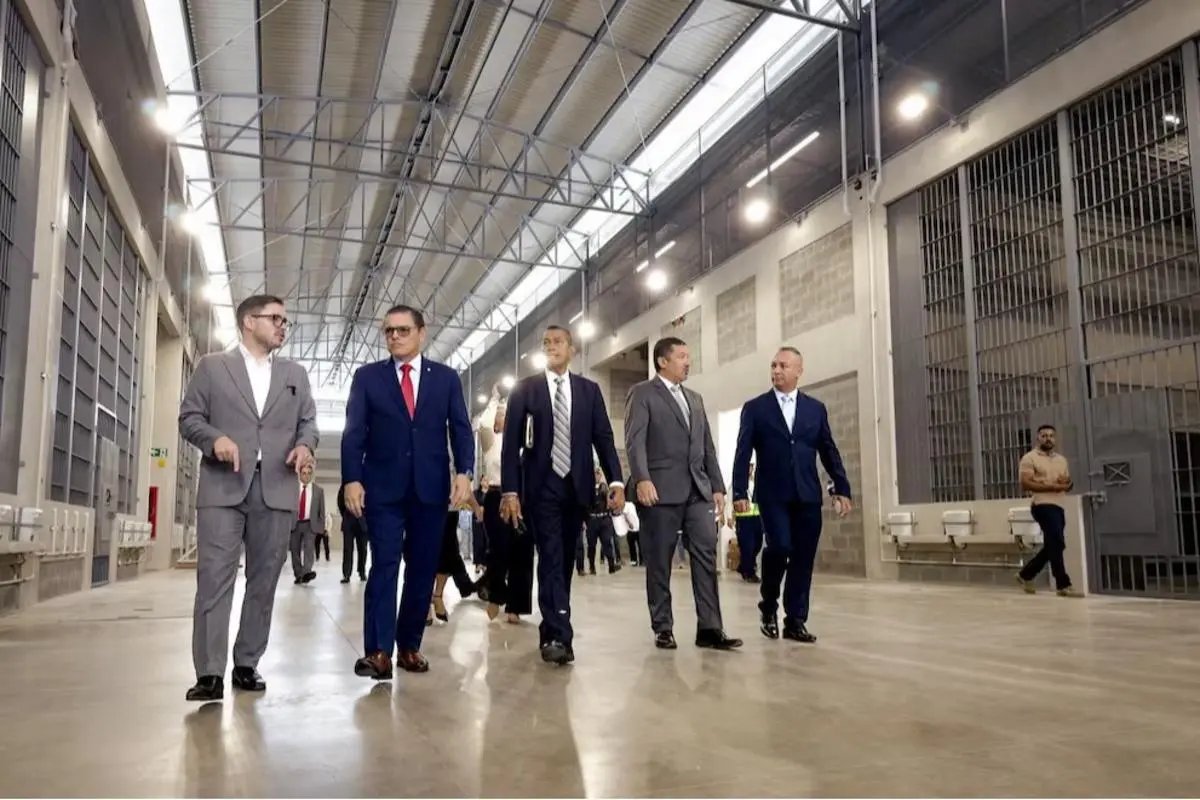
The Minister of Public Security, Frank Ábregovisited Costa Rica on High Containment Center for Organized Crime (Cacco)with the purpose of knowing its operation and evaluating the possibility of implementing a similar model in Panamanian territory.
The visit, carried out in San Rafael, Alajuela, was announced this October 2, and occurred while Costa Rica is preparing to put into operation the new penitentiary center in the administration of President Laura Fernández.
Ábrego toured the facilities accompanied by the Minister of Justice and Peace of Costa Rica, Gabriel Aguilarhighlighted the website Infobae.
According to the report of Infobaethe Panamanian official showed interest in the characteristics of the Cacco and in the possibility of replicating the experience in Panama.
So far, no details of a specific project have been announced, such as an eventual location, capacity or schedule to build a facility of this type in the country, the Argentina-based media highlighted.
The Cacco was conceived to house people deprived of liberty linked to organized crime structures and considered highly dangerous.
The center will have capacity for more than 5,000 people deprived of liberty, according to information released by Costa Rican media.
Its design and protocols take as reference the El Salvador Terrorist Confinement Center, which was created during the administration of President Nayib Bukele.
The Costa Rican penitentiary model is structured around the principles of order, control, discipline and zero tolerance against corruption, in accordance with the strategy presented by the Ministry of Justice and Peace of Costa Rica.
The Costa Rican Minister of Justice and Peace, Gabriel Aguilar, He later explained that part of the knowledge obtained during that visit would be incorporated into the new Costa Rican center.
Among the measures planned for the Cacco is the mandatory use of orange uniforms for detained people and restrictions on receiving clothing from outside.
In addition, during 2026 the Ministry of Justice of Costa Rica applied other measures in the prison system, including the removal of 187 television screens from cells in seven prisons and a reinforcement of security controls and visits.
In the month of June The Star of Panama reported that Panama was advancing a project for a maximum security prison with a Public Private Partnership (PPP) model.
At the end of May, the PPP Governing Body authorized continuing with the next phase of analysis and structuring of the project.
The Minister of the Presidency, Juan Carlos Orillac, explained that the facility would have capacity for about 2,000 people deprived of liberty and highlighted that the PPP scheme will allow long-term maintenance and operation to be incorporated into the contract.
Furthermore, the Panamanian Executive considers that this new infrastructure will contribute to improving the classification of inmates and strengthening security controls.