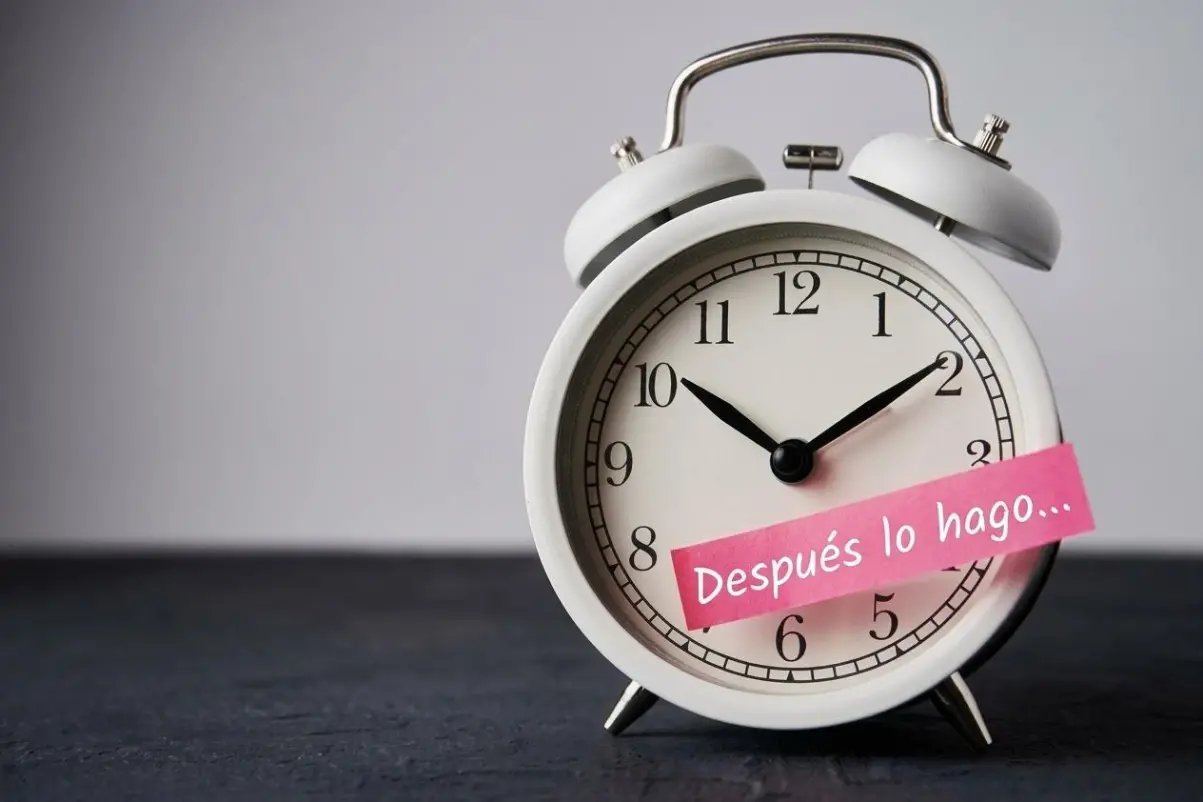
“I’ll do it later.” The phrase can appear in front of a room that needs order, an unanswered message, a pending bill, an exercise routine or a task that you simply don’t want to start. Sometimes a few minutes pass; others, hours or even days. The activity remains pending, while the phone, a series, a conversation or any other distraction wins the battle for attention.
Although procrastination is usually associated with a lack of discipline or organization, the behavior is more complex. Research published in the European Journal of Personality found that this is a widespread behavior among adults studied in the Netherlands. Of the 1,835 participants who responded to the first phase of the study, 95.6% indicated that they procrastinated at least occasionally and 35.2% indicated that they did so regularly or very frequently.
The study, led by Edwin AJ van Hooft, sought to identify which tasks and situations typically lead people to procrastinate. Domestic activities topped the list, with 29.5% of responses, followed by jobs in and around the home, social activities, administrative procedures, work or academic tasks, personal care and leisure, and shopping.
The data shows that procrastination does not only occur in the face of a university assignment or a job responsibility. It can appear in everyday activities such as cleaning, paying a bill, making a call or making an appointment.
It is not always a lack of discipline
For psychologist Katherine De León, reducing procrastination to a discipline problem leaves out other factors that may be behind the behavior. In his experience, fatigue and the fast pace of daily life can influence the tendency to procrastinate.
“I think that life goes so fast that it’s exhausting,” says De León, who believes that each person can procrastinate for different reasons. From their perspective, the brain also seeks moments of pause and can be influenced by the reward system, especially in an environment where mobile devices offer constant stimuli.
The specialist suggests that procrastination can appear when the alert system remains active and the person needs to regulate themselves in the face of certain demands. Therefore, it is important to recognize when an excessive amount of obligations is accumulating and give space to rest.
Procrastination research has also explored this relationship with emotion regulation. A conceptual review by Fuschia Sirois suggests that, when faced with difficult or unpleasant tasks, procrastination can function as a way to temporarily avoid the negative emotions associated with the activity. In other words, the person gets immediate relief, even though the task remains pending.
This helps explain why someone can know they have something important to do and still choose another activity at that moment. The problem is not necessarily in ignoring responsibility, but in the difficulty of facing what is less attractive or generates discomfort.
The telephone and the immediate reward
In this scenario another everyday element appears: the cell phone. For Danissa Mendoza, professor, the digital environment makes it easier for people to constantly find alternatives to entertain and inform themselves.
Mendoza notes that the need to stay connected can become a difficult habit to break. In addition, it highlights the role of algorithms, which select content according to the interests and behaviors of each user and can maintain their attention for long periods.
Scientific research has also found a relationship between problematic phone use and procrastination. A meta-analysis published in 2024, which reviewed studies on students, found a correlation between smartphone addiction and procrastination, although the authors warn that the relationship may vary depending on factors such as the year of study and the quality of the research analyzed.
Another study published in Scientific Reports in 2026 analyzed digital disconnection as a self-regulation strategy. In a sample of 237 young adults and more than 12,000 observations, the researchers found that moments of greater digital disconnection were associated with lower levels of procrastination within the same person.
It is not, however, about making the telephone solely responsible. Procrastination has multiple factors and can appear even when there is no screen involved.
Doing little also counts
For De León, recognizing the behavior is a first step. Instead of trying to complete a long list of obligations at once, he recommends breaking down tasks and moving forward in chunks.
One of their suggestions is to write down the pending activities, organize them into groups and establish a specific date to carry them out. By completing each small goal, he explains, the person can gain a sense of progress that helps maintain motivation.
The strategy coincides with an idea present in much of the research on procrastination: making a task more manageable can help reduce the distance between intention and action. A recent review in Nature Reviews Psychology points out that procrastination is a common form of self-regulation difficulty and that its causes and possible interventions depend on different personal and contextual factors.
So, the next time the “I’ll do it later” appears, perhaps the question does not have to be only why there is a lack of discipline. It can also be how tired the person is, what emotions the task produces, how attractive the immediate alternative is, and whether there is a way to make the first step easier.
Procrastinating can be part of everyday life. The goal is not to eliminate every moment of pause, but to recognize when that “after” begins to become a barrier to doing what really matters.
Katherine De Leon
Psychologist
The human thing is to fall into that, raise awareness and thus organize