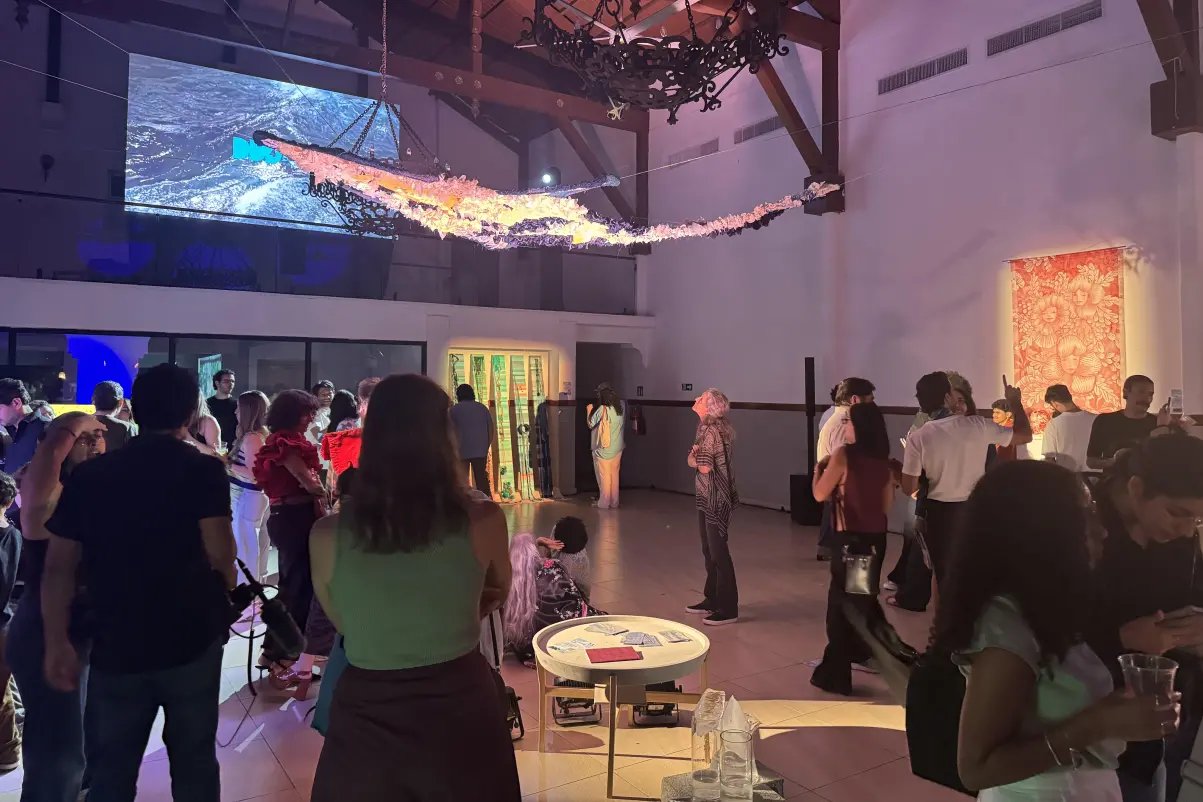
The interdisciplinary collaboration platform ‘4 Days of Design’ inaugurated the artistic exhibition of this second edition in style with a gala at the Parque Omar Club House, whose interior was filled with the different visions that the 40 artists participating in this activity have, who presented 17 pieces that this year deal with a highly current topic: water and the particular vision that each participating artist has on a fundamental element to preserve life in all its expressions.
Its founder Javier Chanis explained in the context of its second edition that the range of both professions and knowledge is what strengthens the proposal of an initiative that seeks to use art as a means of expression to bring to the table those issues that deserve the attention of society.
“There are painters, architects, designers, engineers; there is everything in creation. There are performersphotographers and dancers. I love connecting artists and different people who are creating pieces that usually an artist would create alone,” Chanis added about the reason for ‘4 Days of Design’.
The artistic exhibition – which will be seen until this Sunday at 8:00 pm and whose access is free – puts the culmination to a whole week of activities that not only thought about the role of water both for a country and in the lives of its citizens, but also focused on various topics such as community coexistence as well as the consideration of design through different aspects such as the study of history and experimentation through gastronomy.
The agenda of workshops, discussions and talks – launched on September 24 – took place at the Interoceanic Canal Museum, the Museum of Contemporary Art, the City of Knowledge, Omar Park, the Casa del Soldado and the Colectivo bar.
The deputy director of Creative Economy of the Ministry of Culture (MiCultura) Nikole Roquebert ratified the state support for ‘4 Days of Design’, arguing that this initiative lays the foundations for encounter, creation and dialogue. At the same time, he ratified the intention of the Creative Economy Directorate of MiCultura to support all those initiatives that boost the country’s creative ecosystem.
“One of the great values of ‘4 Days of Design’ is its commitment to collaboration: bringing together artists, designers, architects and creators from different areas to generate new ideas and new conversations. As an artist, I also know how important it is to leave our individual space and meet other creatives. In this exchange we evolve, question what we do and find new ways to transform our ideas,” he expressed.
For her part, the director of the Spanish Cultural Center Casa del Soldado Elena González stated that supporting initiatives such as ‘4 Days of Design’ is a great satisfaction, above all, due to the exponential growth it has had since last year as it has been strengthened in various aspects such as the participation of a large number of artists and greater sponsorship by the State and private companies.
“We are always very aware of how culture can contribute to the defense of human rights, gender equality, sustainability and, of course, the issue of cultural industries, and how they can transform our societies is also a fundamental issue,” he said.
With an atmosphere characterized by curiosity and creativity, hundreds of people who were part of the public that attended the inauguration last October 1, witnessed a scheme of artistic experimentation that also provided the opportunity for not only artists, but families to work together on something that united them.
This is the case of the artist Beatriz Cecilia Paredes, who highlighted in an interview with The Star of Panama the experience of working with her daughter, the designer and architect María Alejandra Icaza Paredes, on E-CORAL, an installation made up of three mixed media sculptures and a table lamp that evoke corals and underwater landscapes. The pieces were made with plastic-coated wire and concrete, incorporating cables from past and discarded technologies. The name of the work refers to the term e-wasteused to describe technological waste.
For Paredes, fluid communication, well-defined roles, creative compatibility and work ethic were fundamental to developing the proposal with her daughter.
The use of these materials introduces a reflection on modernity, dehumanization and the environmental impact of technology, as well as on the way in which these phenomena affect both individual and collective consciousness. The installation also incorporates sand castles cast in concrete as a symbol of human intervention on natural landscapes and of an ambition that, according to the artists, can forget the delicate balances of cooperation and interdependence of nature.
One of the central axes of the proposal is the preservation of coral reefs, considered an essential part of Panama’s natural heritage. In a country whose identity is deeply linked to water and the exchange between worlds, the work suggests that protecting marine ecosystems also implies preserving future possibilities. “More than observing a reef as an external landscape, the work invites us to understand it as a living organism of which we are a part,” explained Paredes.
The very structure of the installation seeks to convey that fragility. Its open and ethereal fabric allows light and eyes to pass through the pieces, evoking the vulnerability of reefs and other threatened ecosystems. At the same time, the act of weaving functions as a metaphor for the connection between different forms of life and the care necessary to repair what has been damaged.
For Paredes, collaborative work also represents an opportunity to expand the possibilities of his artistic practice. “Working with a professional from another discipline has given me the opportunity to expand my creative language, to connect with a new audience and to redefine the limits between art and functionality,” he stated. The experience, he assured, shows that the exchange between disciplines can generate new works and have an impact on future professional practice.
That same spirit of collaboration was felt by Gabriel Wong when with his colleague Charlie Sotelo he created a ‘Cloud Dispensing Machine’. It seeks to explore clouds as environmental agents and triggers for recreational experiences. The installation connects phenomena such as humidity and rain with memory, childhood and imagination.
“We want to make people dream. More than anything it is that: that water is also a vehicle for imagination and dreams. (…) Clouds are also that corner where the imagination is deposited, which is given free rein during childhood. It is like a shape that we all see and each one sees what they want to see. Sometimes one sees a cloud and you see the universe; someone sees a dog; someone sees a lion attacking a castle…”, he reflected.
For her part, the artist Chavela Sicz presents a work made together with María José Villacorta, called ‘Water Mapping’ in which sustainability goes through both the materials and the creative process. Its proposal is based on the use of materials discarded by the textile industry and other sectors. “In such a big industry, we are really small, but many little ones can make a big change,” he says.
The artist explained that her work incorporates textile scraps, plastic and metal materials, as well as elements recovered from demolitions. Its commitment to sustainability is also reflected in the way it produces its pieces. Sicz works with manual textile techniques and without machines, a decision that relates to the value of the time and effort behind each object.
The collaboration with María José Villacorta arose from a proposal by Javier Chanis, promoter of ‘4 Days of Design’. Although both did not previously know each other nor belonged to the same creative circles, Sicz considered that the meeting allowed for an enriching exchange. “I find it interesting that we all do collaborative works, because what I’m going to tell you is very cheesy, but life is collaborative,” he said.