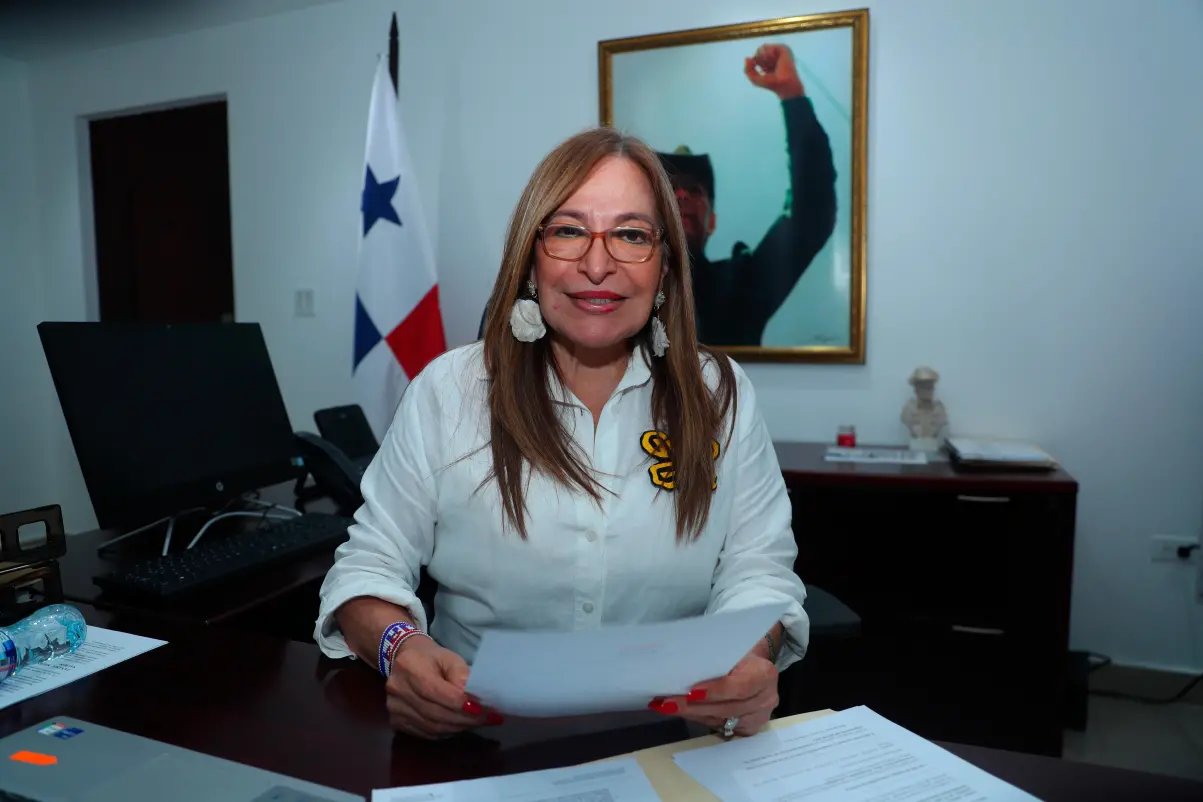
The general secretary of the Democratic Revolutionary Party (PRD), Balbina Herrera, responded to the censure issued by the national leadership of the group and defended the letter she sent to the bench regarding the reforms to the Electoral Code.
Herrera maintains that his actions responded to a specific concern about articles 100 and 101 of the electoral reform project, which, as he explains, directly affect the internal structure of the PRD and the legal representation of the party.
His version contrasts with the resolution approved by the National Executive Committee (CEN) and the National Directing Council (CDN), which disavowed the letter and pointed out that Herrera presented as institutional a position that, according to those organizations, did not have prior approval.
Herrera: “At no time was it discussed”
In his response, Herrera focuses part of his defense on the CEN meeting on September 22.
According to his story, that meeting lasted from 2:00 pm to 6:00 pm and had as its main topic the registration scheduled for October 11. The Secretary General assures that she included other matters in the various topics item, among them a report on meetings with local authorities, a communication from the Comptroller General of the Republic and matters related to the closing of the fifth five-year period and the Electoral Tribunal.
Herrera affirms that articles 100 and 101 of the electoral reform were not discussed or even informed at that meeting.
“At no time was the electoral reform and its articles 100 and 101 discussed,” he said.
His argument seeks to respond directly to the questioning of the PRD leadership about the way in which he raised his objections to the bench.
The center of the dispute is in two provisions incorporated into the draft reforms to the Electoral Code.
Article 100 proposes a change related to the legal representation of political parties. In the case of the PRD, the modification generates a discussion because currently this function corresponds to the General Secretariat, while the proposal establishes that it falls to the Presidency of the party.
Herrera maintains that this modification directly affects the internal structure of the PRD.
The general secretary also questions article 101. According to her explanation, internal lists would be chosen by majority through closed lists, without representation of minorities.
For Herrera, both changes require discussion within the party structures and cannot be defined solely by legal reform.
“The bench has its own autonomy”
Herrera also defends the mechanism he used to raise his concerns.
He explains that he sent a note directly to the PRD bench because, in his opinion, it is a normal procedure in the face of a legislative discussion that affects the internal organization of the group.
The general secretary insists that the bench maintains its autonomy and that her letter sought to warn about the implications of the modifications.
His position coincides with what he stated in the letter of September 28, when he asked the deputies to defend the organizational autonomy and internal structure of the party against the changes introduced to Bill 699.
Another element of his defense is the constitutional argument.
Herrera maintains that the proposed changes could also conflict with article 138 of the Constitution, a provision that establishes principles related to the internal democratic organization of political parties.
Based on this argument, he affirms that modifying by law who exercises the legal representation of a party could affect the autonomy of political organizations.
This is Herrera’s position and it should be presented as such, since the eventual unconstitutionality of the provision corresponds to a legal assessment that is not established solely by his statements.
Herrera also resorts to an internal precedent of the PRD.
According to his story, a similar proposal was discussed in 2015, when Carlos Pérez Herrera held the General Secretary of the group. He states that the proposal then went through the National Directorate and the National Congress and was rejected.
Herrera maintains that the issue was rejected again in the Congress held in 2016.
This precedent, according to his argument, shows that a change in the structure and representation of the party must go through the corresponding internal bodies.
The general secretary also rejected that her actions responded to a personal dispute over the position she holds.
In his explanation, he states that his responsibility consists of defending the structures and bases of the party when he considers that a proposal affects the internal statutes.
“I represent the bases of this party here,” he stated.
His argument seeks to move the debate from a personal difference with other leaders to a discussion about the autonomy of the PRD and the internal mechanisms to modify its structure.