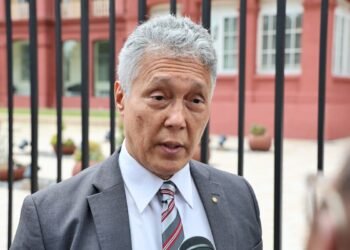

He Constitutional Court (TC) declared a claim for protection filed by the former presidential candidate founded Lourdes Flores Nano. With this, he annulled the criminal proceedings against him for money laundering, for contributions linked to his 2006 presidential campaign with the National Unity Electoral Alliance.
The TC considered that the accusation violated the principles of legality and criminality, because it was attributed a type of money laundering that was incorporated into the law several years after the events investigated.
The ruling, issued on August 31, provides that the preliminary investigation and the preparatory investigation are annulled.
The decision was adopted by majority, with the votes of judges Helder Domínguez Haro, Francisco Morales Saravia, Gustavo Gutiérrez Ticse, César Ochoa Cardich and Pedro Hernández Chávez. Meanwhile, Luz Pacheco Zerga and Judge Manuel Monteagudo Valdez cast singular votes.
The ruling comes after the same court adopted a similar decision in the case of the former president Ollanta Humala and the ruling on Keiko Fujimori. In all three cases, the debate was related to the application of the rules on money laundering to contributions received for electoral campaigns.
Flores Nano turned to the TC to question the tax decision that, in December 2022, formalized and continued a preparatory investigation against him for alleged acts of money laundering related to his 2006 presidential campaign and the Brazilian companies Odebrecht and Camargo Correa.
According to the tax indictment, the former presidential candidate would have received contributions from both companies. In the case of Odebrecht, the prosecution maintained that it was money that would have been given to finance its campaign and that it was not banked or declared before the National Office of Electoral Processes (ONPE). As for Camargo Correa, the accusation referred to a contribution that would have been channeled through third parties.
The ruling maintains that the “property receipt” modality of money laundering was incorporated into the system through Legislative Decree 1249, in force since November 26, 2016. Therefore, according to the majority, this modality could not be used to attribute criminal responsibility for events that occurred during a 2006 electoral campaign.
“Prior to that date, property receipt did not exist in Law 27765,” the ruling states. For the TC, imputing this modality for events from 2006 would mean a retroactive application, incompatible with the principle of legality.
The TC also considered that the investigation did not precisely identify the source crime from which the money supposedly came and that it was not sufficiently substantiated that Flores Nano knew or could presume its illicit origin.