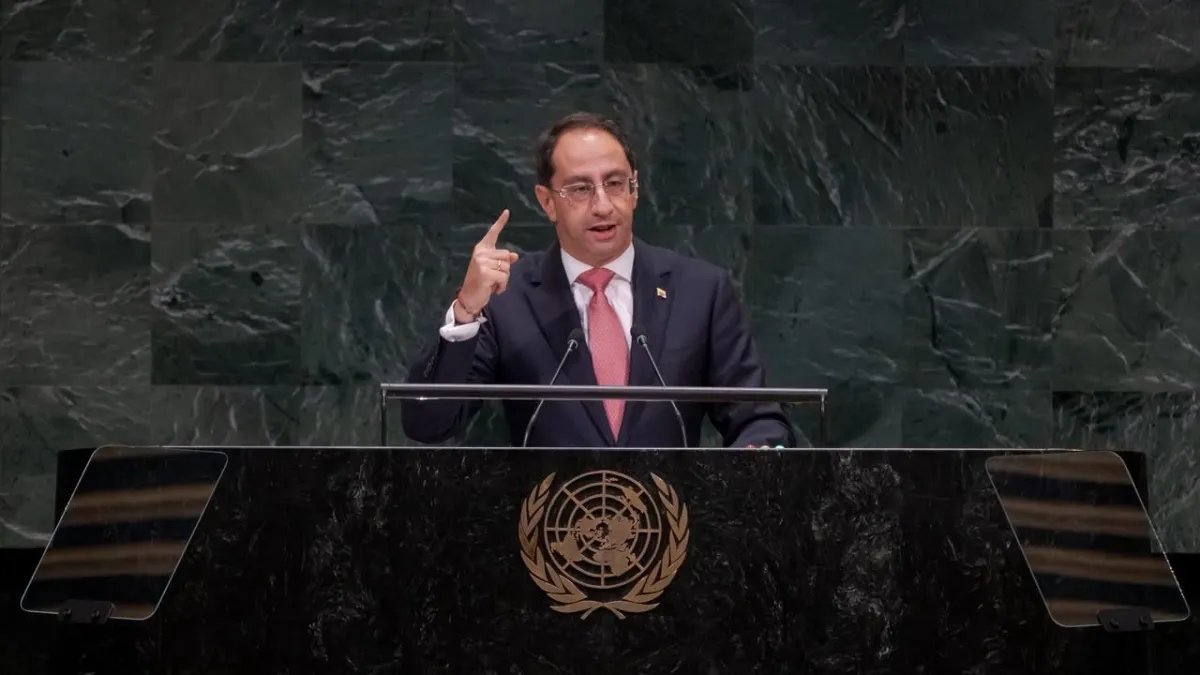
With a speech that went from the defense of his security policy and fight against drug trafficking to questioning the functioning of the United Nations, support for the democratic transition in Venezuela and the call to strengthen investment in Colombia, The government of Abelardo De La Espriella made its formal presentation to the international community, in the auditorium of the UN General Assembly.
Vice President José Manuel Restrepo, who has headed the agenda of the Colombian delegation in New York since Monday, was in charge of reading the head of state’s message.
The intervention, which lasted for 24 minutesbegan with an assessment of the first 47 days of government, marked by the earthquake of August 10 and the challenge of rebuilding the country. The speech then addressed the central issues of the security and foreign policy agenda.
Security, fight against drug trafficking and terrorism
José Manuel Restrepo, vice president. Photo:Vice Presidency
“My Government is determined to leave euphemisms behind. The organizations that they murder, They kidnap, use explosives, recruit minors and deliberately resort to terror to subdue society are terrorist groups. “That’s what we call them and we are confronting them with all the legitimate force of the State, within the Constitution and the law,” he said.
The president also maintained that drug trafficking is a transnational criminal enterprise. and, Although your government will assume its responsibility, the response to this phenomenon also requires the commitment of the international community.
For Angélica Rodríguez, professor of Political Science at the National University of Medellín, Restrepo sought to highlight the current government from a world forum. “They wanted to show it as a strong government, which is recovering the country after what they consider multiple errors of the previous government. Also to give the image of an operational and effective government in the face of challenges such as the August earthquake,” he explained.
Along these lines, De La Espriella called on UN member states to form a common front against terrorism and bring positions together to advance an international legal definition. The Executive stated that this definition must be clear and precise, compatible with international law and fundamental guarantees, and allow for more effective cooperation between countries.
“Terrorism must be condemned no matter who commits it, where it is committed or what cause it invokes,” Restrepo read.
The Government also asked to strengthen information and intelligence exchange mechanisms, expand judicial cooperation, have effective tools to track, freeze and seize resources linked to the financing of terrorism and strengthen coordination against criminal networks that operate simultaneously in different countries.
Criticism of the United Nations
United Nations General Assembly. Photo:Vice Presidency.
Likewise, the intervention was used to question the United Nations bureaucracy and the way in which the organization manages its resources. Although he defended the value of cooperation between countries, he raised the need to review whether their structures and procedures are providing an effective response to the problems that justified their creation.
“My criticisms are not born from a whim or animosity against the United Nations. They have underlying political, institutional and doctrinal reasons.” (…) I have been critical of this organization. I have been so before becoming President and it would be incoherent if, by addressing this Assembly today, I attempted to hide my convictions. I believe in cooperation between nations. Precisely because I believe in it, I consider it legitimate to ask ourselves if the institutions we have built are responding sufficiently effectively to the problems for which they exist,” he said.
Although he recognized that the founding principles of the UN – the maintenance of international peace and security – remain valid, the president called for a review of the organization’s operation and raised questions about the weight of its bureaucracy, the use of resources and the measurement of its results.
“Is the UN fulfilling those purposes with the effectiveness that today’s world demands? Are there bureaucratic structures that have become excessively burdensome? Are we dedicating too many resources and too much energy to managing procedures and too few to solving problems? Are we measuring the results with sufficient rigor?” he questioned.
Along these lines, he asked for an organization less concentrated on the production of documents and the multiplication of procedures, and more focused on concrete results. “That is the multilateralism that Colombia is willing to defend,” he concluded.
Although the president was explicit in his criticism and the need to adjust the multilateral system, the tone of his intervention was more measured than could be anticipated, taking into account that during the campaign he even raised the possibility of Colombia withdrawing from that space.
Venezuela
Delcy Rodriguez Photo:Delcy Rodriguez
One of the most significant moments of the speech came when, in the midst of its questions about what it considers a politicization of human rights, the Government referred to Venezuela for the first time and expressed its support for a democratic transition in the neighboring country.
“My country is consistent and that is why it wants a credible defense of human rights. And in that, as in so many other things, the United Nations can still improve. In this sense, we trust in a prompt, safe and profound democratic transition in Venezuela,” Restrepo said.
The mention of Venezuela was not accompanied by details about the role that Colombia would be willing to play in that process, in a scenario in which the political future of the neighboring country is also linked to Washington’s decisions.
Investment
The speech also had a clear economic focus. De La Espriella indicated in it that his foreign policy will be guided by the search for employment, attracting investment, technology and opening markets. In that sense, invited the international community to invest and contribute to national economic growth. “In the ‘Patria Milagro’ we want an idea to become a company, a company to become employment, and employment to become well-being for people. To those who, from anywhere in the world, are looking for where to invest, I want to invite you to look at Colombia,” he indicated.
“Unlike previous speeches focused on peace, diversity or the environment, this speech was focused on the economic issue and was a permanent call for foreign investment. It was critical of the UN and multilateralism in general. Although it claims to respect these establishments, it harshly questioned its effectiveness,” said Professor Rodríguez.
JUAN PABLO PENAGOS RAMÍREZ
Political Writing