Text Tascha Aveloo
Image Stg. Wi Mato
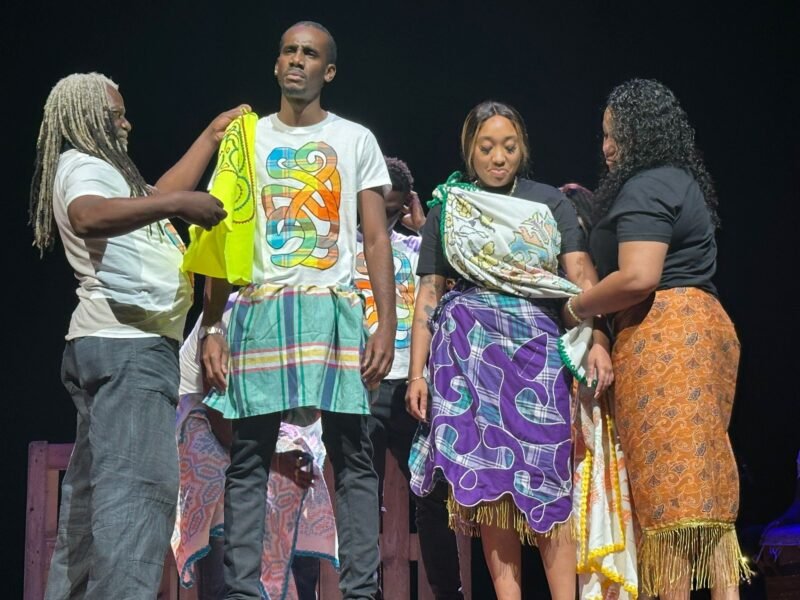
PARAMARIBO – At a time when identity, culture and gender roles are topics of discussion worldwide, the Dutch Wi Mato Foundation brings an interesting music theater performance to Suriname: ‘Manenge’. Under the direction of Maroon culture bearer and theater maker José Tojo, the play will be performed on April 24 and 25 at On Stage Theater in Paramaribo. “Manenge is more than a theater performance. It is a mirror, a confrontation and a search for what it means to be a man in a world that is rapidly changing,” says Tojo.
Scrappy W., known as a rapper and writer of lyrics, makes his debut as a lyricist for the stage. He is supported by an editorial team led by Guus Pengel and Tojo. The singing parts come from the specially flown-in choir Krin A’kra. Kawina singer G-tje – Gerita Sabajo – brings the poetry. And Maroon protest singer Welli Patra makes a special guest appearance. There is a solid drum section. Most drummers were trained by Tojo, but Carlo Hoop (Fra Fra Sound) is also part of the drum section. Actors Tariq Valies and Vernon Sordam (who once started at On Stage) and Mitchell Abionie (Maastricht acting school) are part of the cast.
Masculinity and identity
Tojo says that the idea for the performance arose while working with a group of men who are theater enthusiasts. “I really enjoy working with ‘super hobbyists’, as I call them, because they are men with a permanent job who enjoy making theater.” During rehearsals, in-depth conversations arose about masculinity and identity, especially among men who live ‘between’ the Surinamese and Dutch cultures.
The performance shows how migration not only creates physical distance, but also emotional and cultural distance.
“They talked about masculinity. About how they struggle in Dutch society. And then I thought: there’s a story in this.” Tojo speaks as a Maroon who was raised very traditionally and who then left to live in the Netherlands. “That was an adjustment. In traditional Maroon society, roles were clearly defined.” The community functioned according to matrilineal lines, in which hereditary succession passed through the woman. Men and women each had fixed tasks and responsibilities.
Raising children was a collective task, and respect for each other and for the social structure was central. But in 2026 the world looks different, where cultural mixing has caused shifts in norms and values. Men are increasingly asking themselves: what does it mean to be a ‘real man’ today? “I was raised with women who sleep secluded when they have their period. But modern Western women often want connection and touch during that period. How do you deal with that?” These stimulating thoughts led to collaboration with writer Scrappy W, who further developed the story, mainly based on his personal experiences.
Traditional norms and values
The common thread of ‘Manenge’ is to follow friends who grew up together in the interior of Suriname. They go through the traditional education, the so-called kia – passing on traditional norms and values. When some of them leave for the Netherlands, their world changes. “The main character, Lante, later leaves and is confronted with a reality that is different than he expected. He expected a different attitude from his friends, who have been living in the Netherlands for some time. But he noticed that they have changed. Or perhaps better said: they have adapted to society there.”
The performance shows how migration not only creates physical distance, but also emotional and cultural distance. “This leads to Lante wanting to return to Suriname, because he notices that people live here – in Switi Sranan – while people live in the Netherlands.” An important cultural concept within the piece is kia. “It’s not just about what you say, but especially about how you behave, how you treat others and how you take your place in the community. Tojo emphasizes that this traditional upbringing can be an anchor. “You have something to fall back on if you lose your way.”
Identity and change
Dramaturge Rehana Ganga plays a crucial role in making the story accessible. “I am the first spectator. I ensure that it becomes understandable to a wide audience.” According to Ganga, the piece touches on a global phenomenon. “We see discussions about masculinity everywhere. Think of toxic masculinity and returning to old roles.” She states that what makes ‘Manenge’ special is that it does not try to give simple answers. On the contrary: the piece rubs. “It is the sanding between then and now. Between different cultures. Between male and female.” The audience is challenged to think about identity and change.
Although the piece is deeply rooted in Maroon culture, it is intended for a wide audience
For actor Tariq Valies, participating in the play is a learning process. “I grew up in the city, but through this play I get to know the background of our culture.” He completely agrees that toxic male behavior is certainly spread through social media. “But then you also go back as a man who is used to tradition, to ask, is this my true nature? A moment to reflect on your own values and norms system and how you want to stand towards this new development.”
A special role in the performance is played by Gerita Sabajo. “I play the role of conscience, the voice of nature, your inner self that talks to you.” Her role reminds the characters – and the audience – of their origins. “Always remember who you are, despite the journey you are on.”
School performance
Another social theme addressed in ‘Manenge’ is the way men deal with emotions. According to Tojo, men don’t talk to each other enough: “You swallow your emotion instead of putting it on the table.” The performance wants to break this taboo: “What your husband does not dare to tell you at home, you will hear here.”
Although the piece is deeply rooted in Maroon culture, it is intended for a wide audience. “It must be understandable for everyone: men, women, different ethnic groups, both in Suriname and beyond.” ‘Manenge’ is also performed for secondary school students in Brokopondo. The subject of male emancipation is more important than ever in this age category.
The school presentation was made possible in part by the Dutch embassy and the efforts of the teaching team there.-.