The concern of Saudi Arabia is explained by the recent territorial advances of the Houthis in Yemen. After gaining key positions on the coast of Red Seaincluding the port of Mocharebels backed by Iran They now seek to control the Kahbub Heightsbetween Taiz and Lahij.
From those positions they could isolate government forces from Yemen supported by Saudi Arabia from the coast and consolidate its influence over access to the strategic Strait of Bab el-Mandeba fundamental route for global energy transport and trade, and key for Riyadh now that the Strait of Hormuz has been closed since the start of the war in Iran, on February 28.

A person watches a television broadcast on the latest events of the conflict between Saudi Arabia and the Houthis in Sanaa, Yemen, on September 19, 2026. (EFE/EPA/YAHYA ARHAB).
/ YAHYA ARHAB
According to US officials cited by The New York Times, on Wednesday of last week Trump told his advisors that he was not in favor of launching attacks against the Houthisas the Saudi crown prince had requested days before Mohammed bin Salman in a phone call.
In that first call with the prince, Trump only agreed to help the Saudis with intelligence information and data for locating targets.
But on Thursday, the prince spoke again with trump. After that conversation, the president of USA changed position and ordered the Pentagon prepare airstrikes against Houthi targets in Yemenindicated the NYT.

A US Air Force F-35A stealth fighter jet flies over on a patrol mission in the skies of the Middle East. (Centcom).
That medium reported that The operation reached an advanced stage. Thus, by Sunday the military planning was practically ready: The targets had been selected and approved and the US military was already loading bombs on the planes. chosen for the operation. The attack was close to beginning.
But then Trump changed his mind again and called off the attacks..
The reason? The president hesitated between helping Saudi Arabiaan important ally for Washington, or prevent the US from opening another military front while already involved in the war with Iran. According to the NYT, a good part of the circle of trump was skeptical or directly opposed to entering the war against the Houthis.
At this point, we must take into account what was reported by the Axios portal, which stated that after the first call from the Saudi prince, American diplomats met with officials Houthis and they received assurances that the rebel group would not close the Bab el-Mandeb Strait.
At the time, American officials declared that they would not take military action while the Houthis did not disrupt non-Saudi maritime traffic in the Red Sea, Axios stressed.

The Straits of Hormuz and Bab el Mandeb, two key points for oil transportation in the Middle East. (AFP infographic).
/ JONATHAN WALTER VALENTINA BRESCHI GUILLERMO RIVAS PACHECO
The refusal of trump weekend goes in the same direction: the United States does not want an attack on Houthis ends up causing them to close Bab al-Mandebas it would cause an even greater increase in the prices of oilwhich is already above $100 per barrel as a result of what is happening in Hormuz, a source emphasized to Axios.
The United States has gotten into a difficult situation

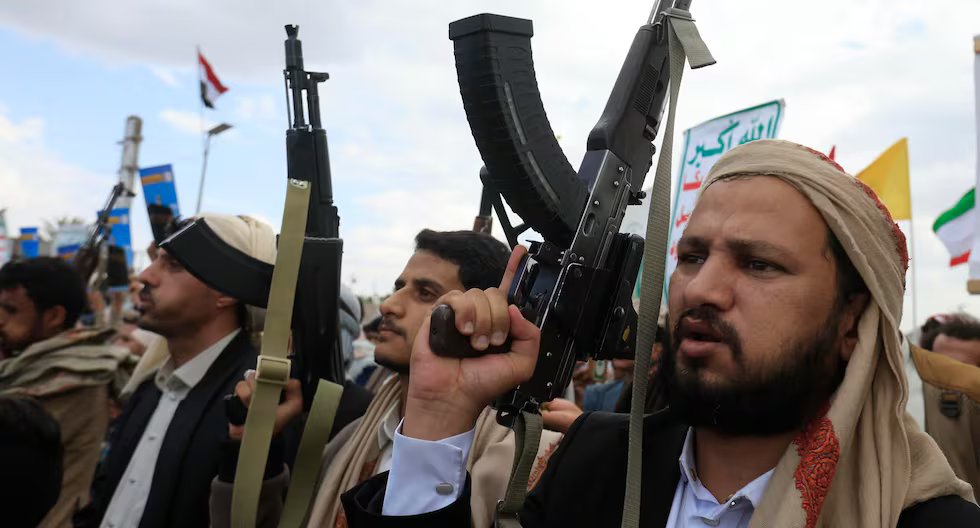
Supporters of the Houthi authorities display their weapons and raise banners with the image of the Kaaba and the legend “For it, we voluntarily offer our souls” during a protest against the Saudi intervention in Yemen. (Mohammed HUWAIS / AFP).
/ MOHAMMED HUWAIS
The international analyst Francisco Belaunde Matossian tells El Comercio that Trump’s retreat reflects the complexity of the scenario facing the United States in the Middle East and the risk that a military intervention against the Houthis will end up aggravating the conflict instead of resolving it.
“The United States has gotten into a difficult situation and does not know how to solve the problem”, Belaunde points out.
For the analyst, one of the reasons for the decision could be the consequences that a US attack would have on maritime traffic and oil prices. “A military attack, to what extent can it resolve the issue or rather aggravate it?“, ask.
Belaunde recalls that the region is already facing the consequences of the crisis in the Strait of Hormuz and that an escalation with the Houthis could add another critical point in Bab el-Mandeb.
“If the price of oil rises even more, it would be disastrous. “It could harm Republicans even more ahead of the November elections in the United States,” warns.
A relationship that loses trust

US President Donald Trump met with the Crown Prince and Prime Minister of the Kingdom of Saudi Arabia, Mohammed bin Salman, in the Oval Office of the White House. (Photo by Brendan Smialowski / AFP).
/ BRENDAN SMIALOWSKI
Belaunde explains that, despite its significant military capabilities, Saudi Arabia seeks the intervention of USA because he fears that a direct attack against Houthis trigger reprisals against its territory and its strategic infrastructures.
But he believes that a US intervention would not necessarily prevent the Houthis from retaliating against Saudi Arabia: “With an attack by the Americans, the Houthis are evidently also going to respond by attacking Saudi Arabia”.
Regarding the relationship between Trump and the Saudi crown prince Mohammed bin SalmanBelaunde believes that the American decision may fuel the perception that Washington is no longer a reliable partner for its allies in the Middle East.
He adds that this perception is leading Middle Eastern countries to seek alternative alliances to reduce their dependence on the United States in terms of security.
Belaunde mentions as an example the rapprochement between Saudi Arabia, Türkiye and Pakistanalthough he warns that this new alliance has not shown until now that it is willing to get involved militarily against the Houthis.