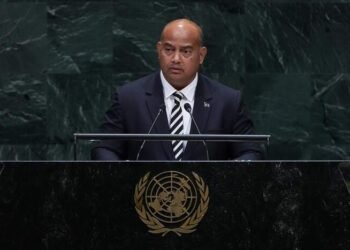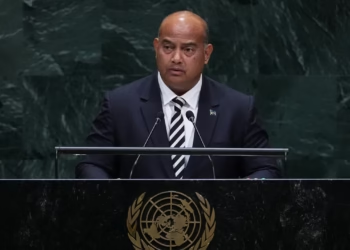
On a global stage crowded with the world’s most powerful leaders, the president of one of its smallest nations made a declaration that reverberated far beyond the walls of the United Nations. On September 22, 2026, President David Adeang of the South Pacific island nation formerly known as Nauru stood before the 81st session of the UN General Assembly in New York and announced a change that, while subtle in spelling, was monumental in meaning: from that day forward, the country would reclaim its ancestral name, Naoero.
“I have traveled far,” Adeang began, his voice carrying a blend of pride and gravity, according to The Independent. In a speech that was both a lesson in history and a call to the future, he explained that what much of the world had long called Nauru was, in fact, a mispronunciation—a label born not of the island’s language, but of foreign tongues struggling to shape the word. “There are moments in the life of a nation when its people are called to remember who they have always been. This is such a moment for us,” he declared to the assembly.
For decades, the country’s name had been rendered as Nauru, pronounced “Now-roo” by outsiders. But among its own people, the name has always been Naoero, spoken as “Now-ero.” The difference, Adeang emphasized, is more than phonetic—it is a matter of identity, heritage, and self-determination. “For many years, the world has known our country as Nauru. Nauru is how our name sounded to those who found it hard to say, and the world kept it. But it is not the name our people used among themselves,” Adeang explained, as reported by India Today.
The change, announced officially in August 2026 after months of signaling intent, is not merely cosmetic. Naoero, an island just eight square miles in size and home to about 12,000 people, is the world’s third-smallest country. It achieved independence in 1968 after enduring colonial rule under the United Kingdom, New Zealand, Australia, and Germany. The new name, Adeang said, is an “affirmation of truth,” a restoration of the island’s ancestral language and national identity, rather than an erasure of its past. “We do not make this choice to erase our past. We make it because we honor it. That name carries the memory of our ancestors, our language, and our identity. It has been there all along. Never lost, never absent. Today, we restore Naoero,” Adeang stated, as quoted by The Associated Press.
The country’s international code is also changing, from NRU to NRO, and its people will now be known as dei-Naoero instead of Nauruan. These changes, though perhaps confusing to some at first, are intended to signal a renewed sense of pride and self-definition for the island’s citizens. “This is not a change but an effort to affirm a truth,” Adeang insisted.
Across the past century, the world has witnessed a wave of similar decisions by countries seeking to reclaim their own narratives and shed the legacies of colonialism or foreign influence. From Eswatini (formerly Swaziland) in 2018, Benin (from Dahomey) in 1975, and Zimbabwe (from Rhodesia) in 1980, to Thailand (from Siam) in 1939, these changes have often been about more than just names—they have been about rewriting history on their own terms. Even in recent years, Turkey requested that the United Nations use the spelling “Turkiye” in English, a move meant to clarify identity and avoid confusion with the bird of the same name. Other examples abound: Persia became Iran, Burma became Myanmar, Upper Volta became Burkina Faso, Gold Coast became Ghana, and Ceylon became Sri Lanka.
For Naoero, the timing of the announcement at the UN was no accident. As climate change threatens low-lying island nations like Naoero with rising seas, and as global economic and political pressures mount, asserting a clear and authentic national identity has taken on new urgency. President Adeang’s speech touched on these challenges, underscoring that the act of renaming was as much for the world as it was for his own people. It was, he suggested, a bid for respect and recognition on the global stage—a way to ensure that Naoero’s voice is heard, and heard correctly.
“There are moments in the life of a nation when its people are called to remember who they have always been,” Adeang said, echoing a sentiment that resonates with many post-colonial states. The name Naoero, he explained, is a living link to the island’s ancestors, its language, and its unique culture. It is a name that has survived centuries of outside influence, and now, finally, it is being restored to its rightful place.
The reaction among international observers has been largely positive, with many recognizing the importance of such symbolic gestures in the broader context of decolonization and cultural revival. The move also serves as a reminder that even the smallest nations can make bold statements about who they are and what they stand for. As The Associated Press noted, “A name, obviously, is a pivotal and intimate expression of a nation’s identity on any stage, domestic or international.”
Of course, not everyone may immediately adjust to the new spelling and pronunciation. Old habits die hard, and it may take time for maps, official documents, and even the international community to fully adopt “Naoero.” But for the island’s people—now officially dei-Naoero—this moment is a powerful affirmation that their heritage matters, and that their voice deserves to be heard in its own language.
President Adeang’s speech concluded with a simple, resonant appeal: “Say our name.” It was a reminder that, for all the complexities of geopolitics and international relations, the act of naming—and of being named correctly—is a fundamental act of dignity and self-respect.
As the world’s third-smallest country steps forward under its restored name, the message from Naoero is clear: identity is not just a matter of history, but of the future. And for those listening at the United Nations and beyond, the call could not have been clearer—or more heartfelt.