EL TIEMPO learned for the first time that aerial fumigation of crops for illicit use with glufosinate ammonium in Putumayo will continue to be suspended, at least temporarily. This was determined by a Mocoa judge, who ordered the authorities to refrain from starting or continuing the authorized activities until it is demonstrated, in a sufficient and verifiable manner, that the constitutional, legal, environmental, health and participation requirements required to execute the pilot are met.
The decision was adopted when resolving several protection actions related to the program. The office temporarily protected the rights to life, health, environmental due process, citizen participation, access to public environmental information, water and the personal integrity of the plaintiffs.
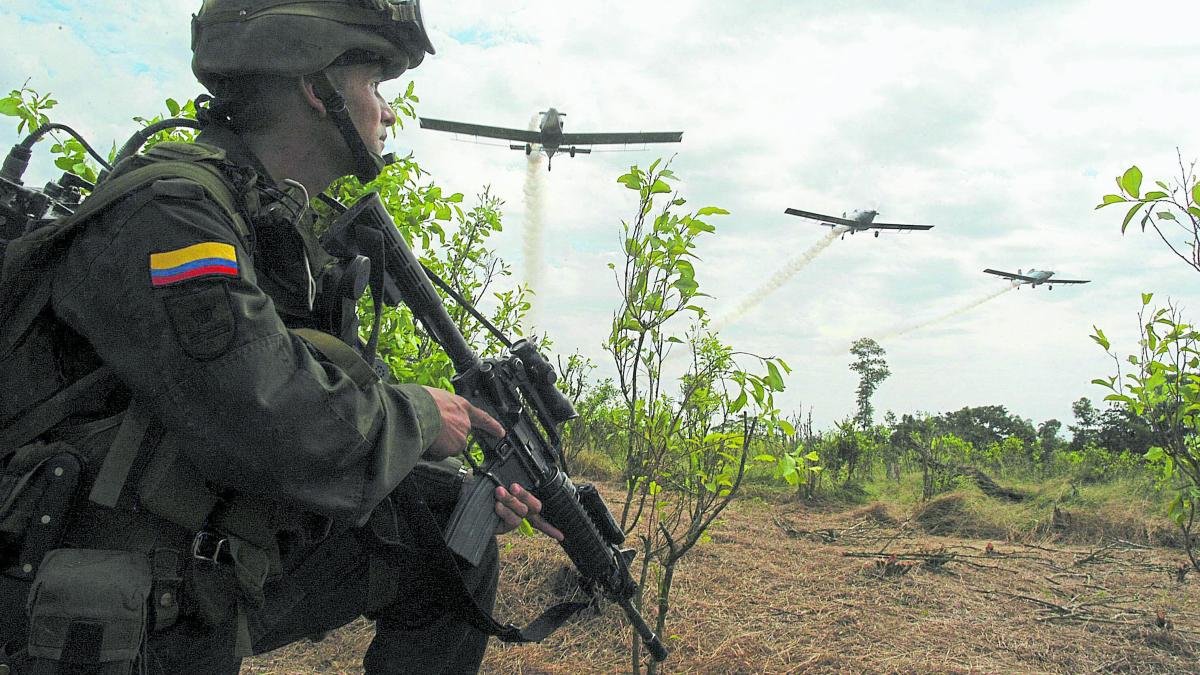
One of the planes that was used to spray ammonium glyphosate. Photo:César Melgarejo/ EL TIEMPO
One of the main points noted by the judge is that it was not fully demonstrated which would be the exact polygons in which the intervention would be carried out or whether these coincide with territories linked to crop substitution programs, such as the Comprehensive National Program for Substitution of Crops for Illicit Use (PNIS)the PISDA either RenWe do.
“Compatibility was not sufficiently proven of the pilot plan with the existing voluntary replacement agreements. The effective participation of potentially affected communities was not fully demonstrated. There is no conclusive proof of comprehensive compliance with the environmental, health and participatory requirements demanded by constitutional jurisprudence. It is applicable the precautionary principle“, reads the sentence.
The ruling also states that was not conclusively proven that there was effective participation of potentially affected communities. According to the ruling, some municipalities did not know precisely the areas of intervention and the implementation of in-person participation spaces in all the territories that could be affected was not demonstrated.
This is how aerial spraying of glyphosate was developed. Photo:EL TIEMPO Archive
Another aspect that was under observation is the environmental component. The ruling indicates that the Resolution 0006 of 2026 recognizes that there is currently no General Environmental Management Plan for the air component. In addition, several authorities reported that procedures and technical verifications were underway before the National Environmental License Authority (ANLA).
“The lawsuit itself proves that Resolution 0006 of 2026 recognizes the lack of a current General Environmental Management Plan.; vSeveral entities report that environmental procedures and technical verifications continue before the ANLA; The National Institute of Health stated that it had not issued a specific technical opinion on the questioned pilot; There is no conclusive evidence in the file of the completion of any prior consultation or environmental participation processes with respect to the specifically impacted territories; The authorities did not fully accredit the public and verifiable identification of the polygons subject to intervention nor the way in which the effective participation of potentially affected communities was guaranteed.“, reads the decision.
Added to this is that, according to the ruling, the National Institute of Health had not issued a specific technical concept about the questioned pilot. Nor did the office find conclusive evidence that all required environmental participation mechanisms had been previously exhausted.
The judge clarified that the decision does not mean that there is a violation of rights already consummated or constitutes a definitive statement on the legality, convenience or constitutionality of the state policy of eradication of illicit crops.
Therefore, the suspension is “strictly temporary and preventive” in nature. The pilot will be able to advance only when the authorities prove compliance with the conditions required in the decision.
“The protection will be granted temporarily and the suspension of the pilot plan will be maintained, until the authorities certify full compliance with the constitutional conditions required for any aerial spraying program with herbicides.or the plaintiffs prove that they have promoted the corresponding popular action, so sad to cease the effects of the transitional protection, says the ruling of the Second Administrative Court of Mocoa.
Spraying with glyphosate. Photo:Archive
The ruling also orders the plaintiffs present a popular action within the term established in the Decree 2591 of 1991. If they do not do so, the temporary protection granted in the guardianship will lose its effects.
Meanwhile, the National Narcotics Councilthe Ministries of Justice and Defense and the Police, through the Anti-Narcotics Directorate, They must refrain from physically carrying out spraying activities. authorized until compliance with the requirements indicated by the judge is demonstrated.
The file must be sent to the Constitutional Court for eventual review if not appealed.
Juan Diego Torres
Justice Editorial