A young girl stands straight on her hands. Her legs slowly bend forward until her feet almost touch her head. A few meters away, another student tries the same move. A trainer watches silently, corrects a posture and lets her start again. Again. And again. What will later seem effortless and almost weightless on stage, here in the acrobat school of Wuqiao, turns out to be mainly the result of discipline, endless practice and a body that has been trained for years to make the seemingly impossible possible.
Text and image Ivan Cairo
Anyone who visits Wuqiao will quickly understand why this place in the northern Chinese province of Hebei convincingly presents itself as the capital of Chinese acrobatics. Here, acrobatics is not a performance that starts in the evening when the curtain opens. She is everywhere: in training rooms, on the street, in theaters and in the museum where it becomes clear how deeply this art form is rooted in Wuqiao’s life.
Conscious choice
A visit to the Hebei Wuqiao Acrobatic Art School shows what lies behind the final spectacle. In large exercise rooms, young people train their flexibility, strength, balance and coordination. Handstands, skips and body positions are repeated endlessly until every muscle seems to know what needs to be done.
The seriousness with which the young people train is striking. For them, this is not a gym class after school. They consciously choose acrobatics as a profession and career. An education can provide access to professional companies, theaters, tourist productions and international performances.
17-year-old Huang Jianqi has consciously chosen to become a professional acrobat. She has been training at Hebei Wuqiao Acrobatic Art School for three years and hopes to join one of China’s top acrobat groups. Laughing, she says she would like to pursue a professional career as an acrobat, but she is still keeping her fingers crossed. “Maybe one day I’ll do something else, but for now it’s acrobatics.”
The international character of the course is also visible. A group of 25 acrobats from Bangladesh are currently training in Wuqiao, in addition to students from other countries. Chinese and foreign young people practice in the same halls and undergo the same intensive training.
Jalal Uddin, trainer of the Bangladeshi acrobats, is very enthusiastic that his pupils have the opportunity to train in Wuqiao. But he thinks the two-month internship is too short. “Every year we send our best acrobats to China for two months, but six months would be better,” Uddin said in conversation with the True Time. He further explains that Bangladesh started professional acrobatics in 1994.

Colours, light and spectacle
After the concentrated atmosphere of the training rooms, the experience changes as soon as you enter Wuqiao Acrobatics World. Here the boundary between amusement park, open-air museum and theater becomes blurred. Something can happen anywhere. Street artists are ready to show their skills in various places. They balance objects, juggle, perform magic tricks and contact the audience. Traditionally designed facades, red lanterns, signboards and streets form the decor. A performer begins his act and within moments a circle of curious onlookers forms.
The visitor gets something of the old Jianghu culture: the world of itinerant artists who showed their skills in markets and squares and depended on their agility and appearance to hold an audience.
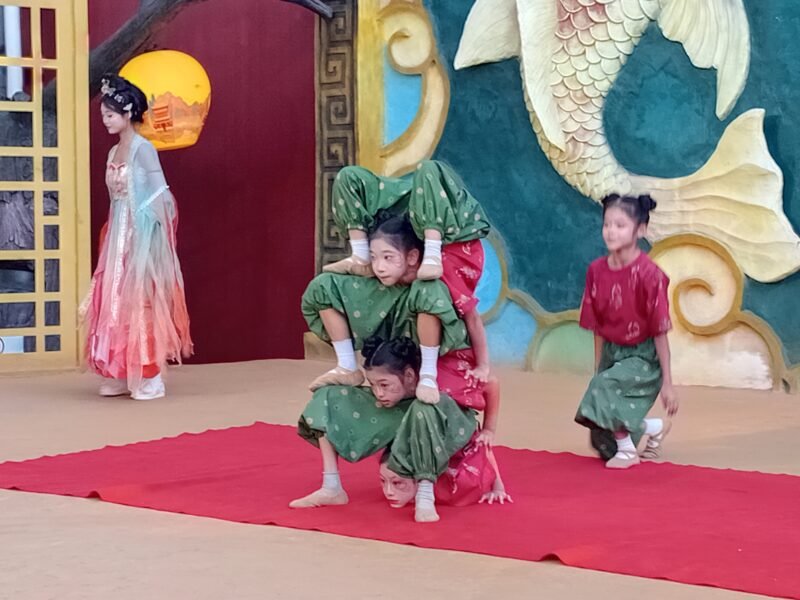
As soon as the big performance begins, the intimacy of the street gives way to choreography, light, music and spectacle. The colors burst from the stage. Bright red and gold alternate with blue, green, yellow and glittering fabrics that catch the theater light.
The richly decorated costumes are an emphatic part of the performance. Sometimes they look traditionally Chinese, other times they are clearly designed for a modern international show. Fabrics move with rotating bodies and bright colors flow into each other during fast group acts.
Bodies spin through the air. Artists build human constructions in which balance seems more important than gravity. Objects are balanced on feet, hands or head. Then follows another fast group act in which timing is everything.
Especially after a visit to the acrobat school, such a performance takes on a different meaning. The visitor has previously seen how much repetition lies behind a movement that is performed here in a few seconds. The audience reacts the way circus audiences around the world react: first quietly when things get dangerous, then with applause and exclamations as soon as a stunt is successful. During some acts it is so quiet that all attention is drawn to one artist. As soon as the movement is successful, the discharge follows.
In the Jianghu Theater the visitor gets to see a different side of Wuqiao. Here too, everything revolves around dexterity and surprise, but the presentation emphatically harkens back to the old world of folk artists, magicians and traveling entertainers.
The artist not only plays with his attributes, but also with his audience. He builds up tension, almost misses a move, waits a fraction longer than feels comfortable and then still completes his stunt. This contact between artist and spectator connects modern theater performance with a much older tradition.
Museum full of stories
Anyone who visits the museum afterwards will see where much of what is shown outside and on stage comes from. Images, utensils, costumes and historical references take the visitor to a time when acrobatics did not require large theaters, bright spotlights or extensive sound systems.
The museum shows how skills were passed on from master to apprentice and within families. What is systematically trained in professional practice rooms today was learned and further developed within communities over generations.
At the end of a day in Wuqiao, images remain. The young student who tries a difficult position again and again. The trainer who corrects with a small gesture. The artist on the street who gathers people around him. The sparkle of gold-colored decorations under theater lights. Bright red costumes that seem to fan across the stage during a rapid movement. The concentrated faces just before a stunt starts and the broad smile as soon as the applause starts.
From poverty to acrobat city
The roots of the acrobatic tradition in Wuqiao go back more than two thousand years. Historical sources mention acrobatic arts in the region, and tomb murals dating from the Jin dynasty, between 265 and 420, depict acrobats. During the Song Dynasty, acrobatics became increasingly popular among the general population, and in later centuries Wuqiao performers traveled throughout China and eventually beyond.
The geographical location helped. The Beijing-Hangzhou Grand Canal ran through this area and was an important traffic artery for centuries. Touring artists could head north to Beijing and Tianjin or south to cities such as Hangzhou and Yangzhou.
There was also dire necessity behind that development. The land around Wuqiao was not everywhere suitable for a good agricultural livelihood. Floods and salinized soil made life difficult. Those who could not earn enough from the land had to develop other skills. Acrobatics therefore became not only art and public entertainment, but also a way to put money on the table.
While young people today can consciously choose a professional education, their predecessors sometimes became acrobats because there were few alternatives. Skills that once earned money on roads, markets and squares would eventually form the basis for an industry that put Wuqiao on the international map.
The old folk tradition has now been transformed into professional training without completely abandoning its historical origins. The Hebei Wuqiao Acrobatic Art School was founded in 1985 and has become increasingly internationally oriented. Foreign students have been trained there since 2002. Hundreds of students from other countries have now followed training here.
The China Wuqiao International Circus Festival was founded in 1987 and has grown into a well-known international meeting place for circus and acrobatics. Wuqiao Acrobatics World followed in the 1990s and today attracts hundreds of thousands of visitors every year.
Acrobatics thus became heritage, education, tourist attraction and economic activity at the same time. In 2006, the tradition received official national recognition when Wuqiao acrobatics was included in China’s first national list of intangible cultural heritage.
World comes to Wuqiao
This has created a development that is almost the opposite of what happened centuries ago. In the past, artists left Wuqiao to show their skills elsewhere and earn an income. Nowadays, people from other parts of China and abroad come to Wuqiao precisely to view the art or to learn for themselves.
The group of 25 acrobats from Bangladesh is a visible example of this. Wuqiao does not export a product that is made in a factory and shipped in a container, but knowledge: body technique, training methods, choreography, discipline and stage experience. Foreign students take these skills with them to their own country, where they can perform or train others themselves.
At the same time, international artists, companies and visitors come to Wuqiao. This has given the city a remarkable position: it preserves a centuries-old local tradition and uses that same tradition to make connections with the rest of the world.

The place does not keep its heritage exclusively behind glass. The past is documented in the museum, while a few streets away young people are re-studying that same heritage. Street artists demonstrate techniques that are reminiscent of the itinerant artists of the past and in the theater the tradition is transformed into a contemporary spectacle with modern lighting, music, choreography and colorful costumes.
In this way, Wuqiao has closed a remarkable circle. What was once a way for residents of a poor agricultural region to earn a living outside their hometown has grown into a cultural industry that draws foreigners to Wuqiao.
Circumstances have changed. The stages have become bigger, the costumes more colorful and the spotlights brighter. The artists now travel by plane instead of with touring companies along the Grand Canal.
But behind all the glitter, one thing has hardly changed: before an acrobat can make the audience believe for a few minutes that gravity does not exist, it takes thousands of hours of learning to control it.