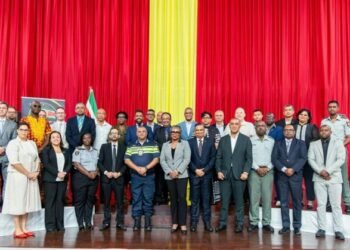
PARAMARIBO — The Surinamese Business Association (VSB) sat down with the EBS to discuss the consequences of the power outages for business continuity. In addition to representatives of the VSB, representatives from other parts of the organized business community also participated in the consultation. This conversation took place on Tuesday.
The VSB has emphasized that a reliable and predictable electricity supply is an essential precondition for production, services and investments. Although it is recognized that load shedding may be technically necessary to protect the stability of the electricity grid, it is especially important for companies to know in a timely manner what they need to take into account.
“Where possible, the character of areas is also taken into account when planning, but the spatial interrelationship of residential and commercial functions makes complete separation difficult”
EBS explained that the available generation capacity is currently insufficient to meet full demand during certain periods. According to EBS, the current situation is partly the result of a backlog in investments in new capacity, while electricity demand has continued to grow. Structural load shedding is therefore applied when the expected supply is insufficient to absorb the load on the grid.
The business community has asked, among other things, how EBS takes economically important activities into account when switching off. EBS indicated that disconnection technically takes place per feeder and not per individual connection. Critical facilities, including hospitals and certain other essential infrastructure, are spared as much as possible. Where possible, the character of areas is also taken into account when planning, but the spatial interrelationship of residential and commercial functions makes complete separation difficult.
Business continuity was also explicitly discussed. Possible measures for companies include emergency power supplies, shifting activities outside of peak hours where possible and investments in solar energy in combination with battery storage. The business community requested attention for practical and affordable solutions, in particular for SMEs, tourism and smaller production companies.
In addition to the acute situation, the structural energy supply was discussed. The necessary expansion of generation capacity, future electricity demand from new investments, adjustment of the legal framework for energy generation by third parties and the follow-up of agreements from the Energy Summit were discussed. EBS indicated that the new legal framework is well advanced, but still needs to go through a final review.
It is important for the VSB that the current problem is not approached solely as a temporary issue. A growing economy requires sufficient generation and reserve capacity and timely investments in energy infrastructure. The VSB therefore continues to focus on structural consultation with EBS, government and other representatives of the business community, whereby the previously made agreements regarding investments, legislation and future energy needs are concretely followed.