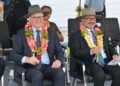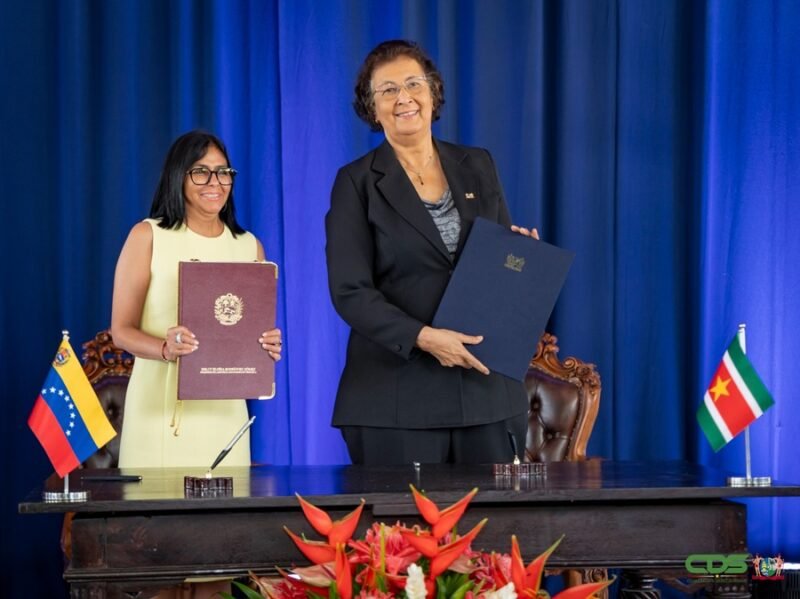
The visit of Venezuelan acting President Delcy Rodríguez to Suriname was dominated by the usual rhetoric, mainly focusing on the words ‘mutual respect’, ‘sovereignty’ and ‘territorial integrity’. She also signed ten on Friday cooperation documents with her Surinamese counterpart Jennifer Geerlings-Simons. The two hundred permits for Venezuelan fishermen were particularly striking. They may cast their fishing gear in an ‘Atlantic corridor’ specially made available by Suriname. The Americans are especially fond of grouper and snapper.
Text Armand Snijders
Image CDS
Since coming to power, Geerlings-Simons has emphatically opted for regional integration and economic cooperation with close neighboring countries. Logistically, an intensive trade corridor with Venezuela (and Brazil) is a logical choice to reduce import dependence and stimulate local markets.
“Delcy Rodríguez acts as a ‘lap dog’ to save her own skin and that of her regime”
Naturally, there is nothing wrong with strengthening ties with Venezuela in that context. After all, good neighborliness never hurts. But the question is to what extent that country is sincere in also being a good ‘neighbor’.
It is currently still completely unclear whether Rodríguez will follow his own course or whether he will mainly do what the United States (read: American President Donald Trump) dictates. To what extent do agreements made with Suriname and other countries serve Washington’s interests?
Trump’s lap dog
After the US military kidnapped incumbent President Nicolás Maduro on January 3 on behalf of Trump, Vice President Rodríguez was put forward as his replacement. Although she too was not democratically elected and even served as a key figure within the old regime, she received – albeit reluctantly – the necessary blessing from Trump.
She was then sworn in as acting president, but was immediately put on the spot by Trump: cooperate and dance to the American tune or be destroyed! She chose the former; in that respect, the threats from the White House were successful. The qualification that she must operate under direct diktat from Washington – thus acting as a ‘lap dog’ to save her own skin and that of her regime – is a frequently heard conclusion in the international world.
Huge oil deal
Proof of this is the gigantic oil deal that Venezuela signed with the Americans at the end of August, which gave the US control over a significant part of Venezuela’s oil reserves, worth a hundred billion US dollars. After all, that was what Trump was all about. Although Rodríguez frantically claimed in TV speeches that Venezuela ‘retains its sovereignty’, it was crystal clear to the outside world that the US is firmly in control in Caracas.
In this light, the question is whether Venezuela can be a reliable and autonomous partner. Geerlings-Simons has concluded many attractive new bilateral agreements with Rodríguez in areas such as aviation, fisheries and education. But while she was drawing this, she must also have realized that she is in an unpleasant dilemma. Because although most agreements can promote the much-desired regional integration from Surinamese perspective, it is completely unclear whether the country will actually benefit from this or whether they should – indirectly or otherwise – serve the interests of the Trump administration.
Fisheries Agreement
The most striking and controversial part of the package is the fisheries agreement. Two hundred Venezuelan fishermen from the states of Nueva Esparta and Sucre are given permission to fish in a specially made available ‘Atlantic corridor’. Everything about this is quite vague, including what benefit Suriname will gain if its neighbors are allowed to empty Surinamese waters.
Rodríguez claimed that this collaboration will also offer Suriname opportunities for the export of sought-after fish species such as grouper and snapper to the United States, among others. By stating this so explicitly, it seems that this construction has been set up to please the American market and therefore Trump, since “the demand for these specific fish species in the US remains as high as ever.”
Who supervises?
In addition, this fishing deal exposes an open nerve within the Surinamese defense and enforcement structure. Suriname has been struggling for decades with a chronic inability to effectively patrol its own exclusive economic zone. The Coast Guard and the Navy lack the necessary budgets, vessels and fuel to combat illegal and unregulated fishing. If the Surinamese authorities are currently unable to effectively keep poachers out of coastal waters, how will they supervise two hundred Venezuelan boats?
The lack of clear, publicly disclosed conditions regarding the exact geographical location of the corridor, catch quotas and on-board controls fuels the suspicion that Surinamese fishing grounds are being strategically used for diplomatic goodwill, without an operational apparatus ready to prevent ecological and economic overexploitation.
The Surinamese side has now emphasized that this is nothing new, but that it is about reviving an agreement that has long expired and that Venezuelan fishermen have been fishing in Surinamese waters for local companies all those years. So it was actually old wine in new bottles, which was blown up to unprecedented proportions due to poor communication.
Risks in the oil and gas sector
The vulnerability of such deals is also becoming visible within the oil and gas sector. Venezuela historically has the largest proven crude oil reserves in the world. Venezuelan institutes such as Intevep and the Universidad Venezolana de los Hidrocarburos undeniably have in-depth theoretical and technological expertise.
The offer to share this knowledge with Suriname, which is on the eve of large-scale offshore oil exploration, seems extremely attractive on paper. However, in practice the Venezuelan energy sector has been seriously neglected technically and infrastructurally due to the years of crisis, the lack of foreign investments and the previous sanctions.
“Suriname simply cannot afford to jeopardize its relationship with the actors who provide the actual capital for the oil economy”
Extreme suspicion
The exploitation of the Surinamese oil fields is entirely in the hands of Western consortia such as TotalEnergies and APA Corporation. These multinationals operate strictly within the Western financial, legal and technological ecosystem. Despite the recent easing of US sanctions on Venezuela, international banks and Western oil multinationals still view direct government intervention from Caracas with extreme suspicion.
Any substantial technological or infrastructural entanglement of the Surinamese oil industry with Venezuelan government authorities could lead to compliance-warnings to international financiers. Suriname simply cannot afford to jeopardize its relationship with the actors who provide the actual capital for the oil economy.
Fiasco PetroCaribe
History also offers Suriname a cautionary precedent when it comes to large-scale agreements with Caracas, especially the Petrocaribe initiative, which was launched by Venezuela at the time as a beacon of regional solidarity, promising cheap energy supplies and flexible credit constructions. At the time, Suriname became highly dependent on this politically driven oil flow. When the Venezuelan economy imploded under pressure from internal frictions and US economic warfare, Petrocaribe collapsed abruptly. Countries in the region were left with debts and unfinished projects.
From this, Suriname can learn that strategic cooperation and economic resilience cannot be built on the foundations of a neighboring country whose stability is still precarious. And that mainly depends on the whims of the extremely unreliable and capricious American President Donald Trump.