Highlights/updates since the last map was sent on PacNet on 08 September 2026:
Acute watery diarrhoea
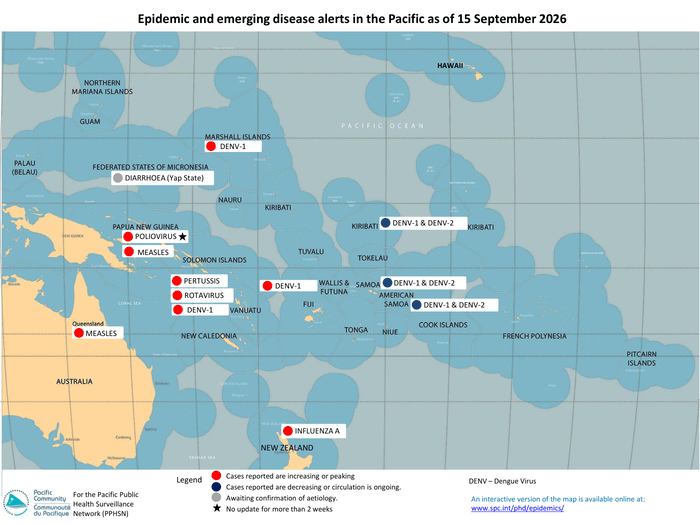
• Federated States of Micronesia: Situation Report #9 on the diarrhoeal outbreak in Yap State, with data as at 13 September 2026, reports no new cases, after five new cases on each of 11 and 12 September, and a cumulative total of 169 clinically diagnosed cases. Children account for 77% of cases. Ten patients have been admitted to date, eight of them children, and all have now been discharged. No deaths have been reported. Additional cases from Elato and Satawal are still being verified and are not yet included in the total. The Yap State Communicable Disease Report for EpiWeek 36 (31 August–6 September 2026) laboratory results for 3 August to 6 September show Escherichia coli specimens, rotavirus, Giardia lamblia, Sapovirus and Salmonella, often as co-infections. Rotavirus A was detected in 18 of 22 stools tested in EpiWeek 36. The aetiology of the overall increase is not yet established. The grey alert for diarrhoea remains in effect for the Federated States of Micronesia (Yap State), awaiting confirmation of aetiology. – Sources: Yap State Diarrhoeal Outbreak Situation Reports #6 to #9, the latest with data as at 13 September 2026, shared with the PPHSN Coordinating Body Focal point on 11 and 15 September 2026, and Yap State Communicable Disease Report, EpiWeek 36, shared with the PPHSN Coordinating Body Focal point on 10 September 2026.
Dengue
• Marshall Islands: The Outbreak Situation Report on dengue in Majuro dated 5 September 2026, covering 15 August to 5 September, records 153 specimens tested at Majuro Hospital Laboratory, 66 confirmed positive by NS1 antigen rapid test, 87 negative and no deaths. That is 20 more confirmed cases than the 46 reported on 1st September, four days earlier. The attack rate for Majuro Atoll (population 23,158) has risen to 6.6 per 1,000 for suspected cases and 2.9 per 1,000 for confirmed cases, from 4.7 and 2.0 in the previous report. Serotyping still identifies DENV-1 only. Confirmed cases are most frequent among people aged 10–19 years (21 cases) and 0–9 years (17). The commonest symptoms were fever (79%), headache (65%) and muscle ache (55%). Residual spraying continues around all confirmed cases, and thermal fogging, approved on 29 August, is now under way. The red alert for dengue (DENV-1) remains in effect. – Source: RMI Ministry of Health and Human Services, Outbreak Situation Report on Dengue Fever in Majuro, 5 September 2026 accessed on 15 September 2026.
Measles and rubella
• Papua New Guinea: The National Department of Health weekly bulletin for EpiWeek 36 reports eight laboratory-confirmed measles cases year to date, up from five, with the most recent onset on 28 August 2026. Confirmed cases are in East Sepik, the National Capital District, Western Highlands, New Ireland and the Autonomous Region of Bougainville. Laboratory-confirmed rubella cases rose from 15 to 16 year to date, with the latest onset on 29 August 2026. The measles-rubella vaccination campaign for children under seven years in affected districts continues through opportunistic routine immunisation. The red alert for measles remains in effect for Papua New Guinea. – Source: Papua New Guinea National Department of Health, Public Health Events Weekly Bulletin, EpiWeek 36, shared with the PPHSN Coordinating Body Focal point on 10 September 2026.
Respiratory diseases
• New Zealand: For the week ending 6 September 2026, the weekly all-cause hospitalisation rate for severe acute respiratory infection (SARI) in the Auckland region decreased but remains in the very high activity band for a fourth consecutive week, higher than at this time in recent years, and the influenza-positive SARI rate is also in the very high band for a fourth week. Influenza was the most commonly detected virus, with test positivity among SARI patients at 52.1%, down from 57.8%. Both A/H1 and A/H3 are circulating, A/H3 predominating, and antigenic typing shows the circulating viruses match the 2026 Southern Hemisphere vaccine. In the community, influenza positivity among sentinel general practice samples rose from 35.6% to 40.4% (19 of 47 samples). Eighteen respiratory illness outbreaks were reported, up from 14: twelve in aged residential care facilities, four in early childhood education centres and two in schools, across nine districts. Pacific peoples have experienced the highest cumulative rates of influenza-, RSV- and SARS-CoV-2-positive SARI hospitalisation and the highest rates of influenza- and RSV-positive intensive care admission of any ethnic group in 2026. Children aged 0–4 years have the highest SARI hospitalisation rate, which increased this week while it decreased in every other age group. The red alert for influenza A remains in effect for New Zealand. – Source: New Zealand acute respiratory illness dashboard, week ending 6 September 2026, PHF Science, accessed on 15 September 2026.
Other Information:
Dengue
• New Zealand: PHF Science reports four confirmed dengue cases notified in New Zealand during surveillance week 36 (5–11 September 2026), all acquired overseas: the cases had been to Bangladesh, Indonesia, the Maldives and Vietnam during the incubation period. Year to date, 361 confirmed, 26 probable and one under-investigation dengue cases have been notified. Multiple arboviruses circulate in the Pacific Island region, serological cross-reactivity means some cases reported as dengue may be due to other flaviviruses, and that data may change as cases are investigated. – Source: NZ Arbovirus Notifications by Country, surveillance week 36, New Zealand Institute for Public Health and Forensic Science (PHF Science) shared with the PPHSN Coordinating Body Focal point on 14 September 2026.
Highly pathogenic avian influenza
• Australia: The national H5 bird flu dashboard records 521 confirmed positive events in wildlife as at 11 September 2026, against 484 on 4 September: South Australia 286, Victoria 162, Tasmania 36, New South Wales 25, Western Australia 10 and Queensland 2, with none in the Australian Capital Territory or the Northern Territory. Authorities no longer test every species in known transmission areas, so event counts increasingly understate spread. New South Wales reported two further events in greater crested terns at Woy Woy and Bulli on 12 September, bringing the state count to 32; state and national figures can differ with reporting timing. H5N1 has been detected in a red fox in metropolitan Adelaide, the first detection of H5 in a land mammal in Australia, followed by a second fox death in Torquay, Victoria. On 13 September South Australian authorities confirmed the first detection in an Australian sea lion, an endangered species, at Seal Bay on Kangaroo Island. There has been no detection in commercial poultry or captive birds and no human case in Australia. H5 has not been detected in any Pacific Island country or territory to date. – Sources: Australian Government H5 bird flu events in wildlife dashboard, New South Wales Department of Primary Industries and Regional Development media release of 12 September 2026, BEACON report of 8 September 2026 and PerthNow (AAP) of 13 September 2026, accessed on 14 September 2026.
Mpox
• Australia: Victoria’s Department of Health issued a health advisory on 14 September 2026 stating that mpox cases are rising in the state, with 52 cases reported since 1 August 2026, and that several strains of the virus are circulating in many parts of the world. In Australia, men who have sex with men and their sexual partners are most at risk, particularly people with multiple or casual partners, while people with a weakened immune system, children and pregnant women are at greater risk of severe illness. – Source: Victorian Department of Health, health advisory “Mpox continues to spread in the community”, 14 September 2026, accessed on 15 September 2026.
Respiratory diseases
• Australia: The Australian Respiratory Surveillance Report for 24 August to 6 September 2026 records 31,650 notified influenza cases in the fortnight, up 27.2% from 24,883, although growth has slowed and the national peak may not yet have been reached. The timing matches pre-pandemic seasons, which peaked in late August to early September. There have been 130,355 cases so far in 2026, 62.6% fewer than at the same point of 2025. Influenza A accounted for 30,074 cases in the fortnight and influenza B for 1,443. Among subtyped influenza A, 491 were A(H3N2) and 226 A(H1N1). The largest fortnightly counts were in New South Wales (14,256), Victoria (7,039) and Queensland (6,625). Influenza admissions to sentinel hospitals rose by 35% (183 to 247) in the fortnight to 23 August, and two children and 12 adults admitted with influenza to sentinel hospitals have died this year. Interim vaccine effectiveness against hospitalisation is 35.0%, with vaccine coverage at 30.2%. – Source: Australian Respiratory Surveillance Report, Australian Centre for Disease Control, 24 August to 6 September 2026 accessed on 15 September 2026.
• Solomon Islands: The Ministry of Health and Medical Services reports that routine surveillance for the reporting week of 24–30 August 2026 shows an increase in influenza-like illness cases from surveillance sites in Honiara and Western Province, and that routine laboratory testing detected influenza A in the majority of samples tested in August. Additional samples collected the following week are pending testing. The Ministry advises hand hygiene, covering coughs and sneezes, staying home when unwell and seeking medical attention if symptoms become severe, particularly for young children, older people, pregnant women and people with underlying health conditions. – Source: Solomon Islands Ministry of Health and Medical Services statement on flu-like illness accessed on 15 September 2026.
Many thanks again for your continuous contributions. Please note that the alerts displayed on the map are based on information available to us as of the date of this report.
As usual, please do not hesitate to contact us for corrections, additions, or comments.
With our best regards,
Thibaut Demaneuf
Surveillance and Research Officer, SPC
on behalf of The Focal Point of the PPHSN Coordinating Body Team
Email: FocalPointPPHSN-CB@spc.int