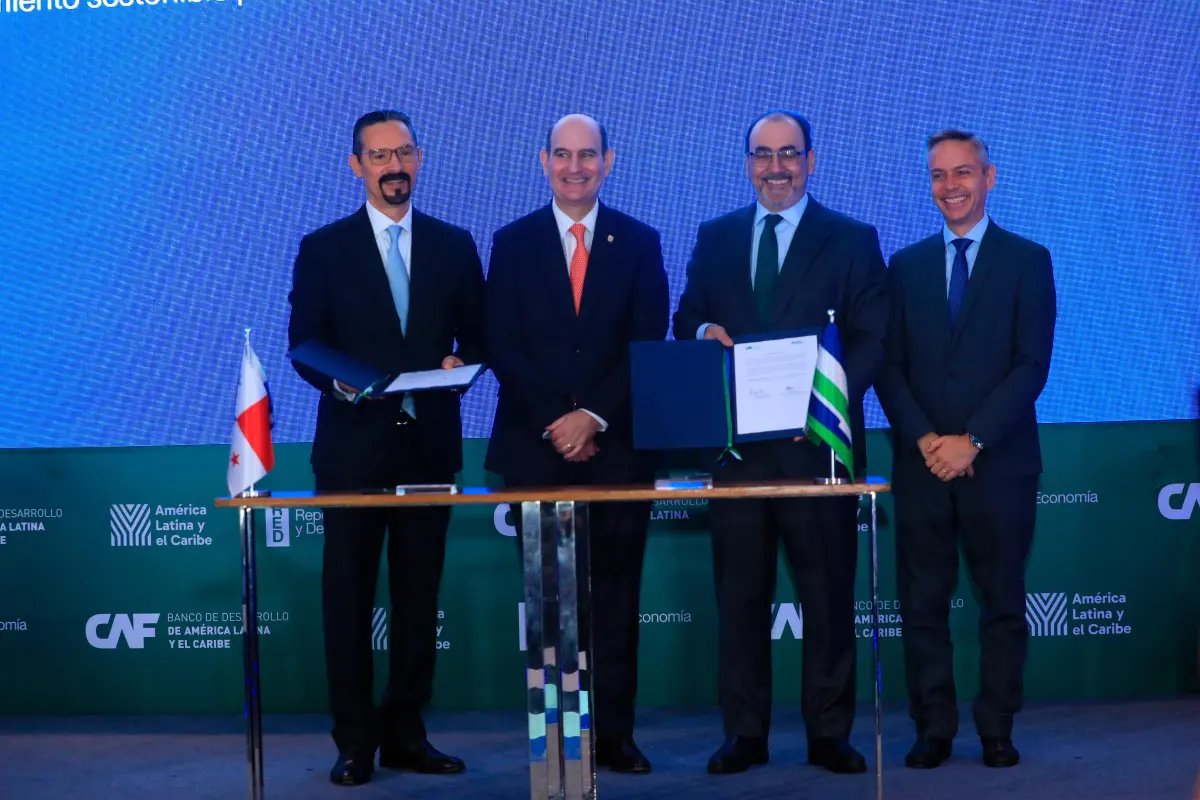
Within the framework of the presentation of the CAF Economy and Development report, entitled “Roots of the future: The new rural world of Latin America and the Caribbean”, the National Bank of Panama (Banconal), the Development Bank of Latin America and the Caribbean (CAF) and the Ministry of Economy and Finance (MEF) completed a historic financing for an amount of $500 million.
The initiative reaches more than 3,300 small and medium-sized companies (SMEs) and the agricultural and agro-industrial sectors. In addition, it is planned to allocate 50% of the resources to rural areas, with the purpose of facilitating access to capital so that small producers can invest, incorporate technology, increase their productivity and generate more opportunities in their communities.
According to the CAF, the transaction stands out for constituting the largest-scale non-sovereign window credit operation carried out by the bank in Panamanian territory.
The financial package was structured under the A/B credit modality and had the participation of seven banking entities and international commercial institutions, highlighting BBVA as Lead Arranger, Lafinanz and Commerzbank as Arrangers, along with the support of Banco de Occidente, Bradesco, Bancaribe and Blue Orchard as participants.
The deputy general manager of Finance and Treasury of Banconal, Milciades Denis, highlighted that the operation integrates an international technical cooperation strategy.
“This initiative will provide public banks with modern methodological tools for structuring agricultural credits, improve the comprehensive management of risks specific to the agricultural sector and guarantee close support to the producer through training in financial education and management skills,” he commented.
According to Denis, this action demonstrates the evolution of the banking business, linking the granting of capital with the measurement of impact and the strengthening of environmental, social and governance (ESG) criteria.
The executive president of CAF, Sergio Díaz-Granados, contextualized the signing of this credit facility within the strategic vision of the multilateral organization on the rural area.
Díaz-Granados argued that the countryside in Latin America should not be conceived as a problem to be solved, but as a frontier of strategic opportunities where the three main global agendas of the future will be played out: food security, the energy transition and environmental sustainability.
He emphasized the enormous potential for economic diversification that Panama has thanks to its advantageous logistical position and connectivity, also recalling that the agricultural sector contributes almost 15% of the country’s exports and that 68% of the national surface has forest cover.
The Minister of the MEF, Felipe Chapman, complemented the importance of the credit by pointing out the government investments that accompany this productive transformation, including more than $600 million allocated for road connectivity projects during 2026, the opening of the Center for Agricultural Specialties (Ceagro) and the Talento Panamá program of technological scholarships.
Chapman explained that one of the region’s main challenges is to increase agricultural productivity and close existing gaps, so that producing in the countryside is an activity capable of generating better income and opportunities for families.
He highlighted that current rurality includes activities that go beyond agricultural production, including agribusiness, tourism, fishing and aquaculture, forestry activities, energy and a growing diversity of services and productive activities capable of generating new employment and income opportunities.
The initiative reaches more than 3,300 SMEs and contemplates allocating 50% of the resources to rural areas, with the purpose of facilitating access to capital so that small producers can invest, incorporate technology, increase their productivity and generate more opportunities in their communities.
The minister emphasized that these actions seek to close socioeconomic gaps, recalling that between 2022 and 2025 Panama managed to reduce its multidimensional poverty from 14.7% to 12.4%, removing 84,000 people from this condition.