Alberta separatists think they’re going to win a referendum that surveys suggest they are poised to lose by a wide margin, according to exclusive new polling.
And that mismatch of expectations has consequences for what comes next — including the likelihood that Albertans shouldn’t expect this issue to be put to rest with this one vote, say the pollster and a political scientist.
Abacus Data CEO David Coletto presented the results of the new poll, done during the first week of September, to CBC’s West of Centre on Friday.
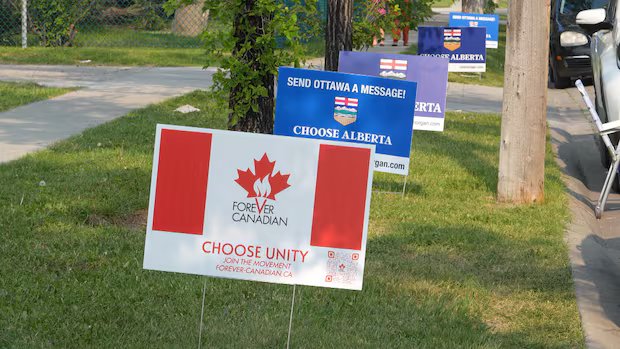
On Oct. 19, Albertans will vote on a question with two choices: Option 1 is to stay in Canada, while Option 2 supports commencing the legal process to hold a binding referendum on Alberta separation.
That ballot question will be in addition to nine others that focus on constitutional and immigration issues.
Coletto’s poll found 64 per cent of respondents would vote to remain a province in Canada and 24 per cent would vote to start the separation process. Nine per cent were undecided and three per cent said they would skip the question.
But the poll also found that Option 2 supporters have surprisingly high expectations, believing that the separatist option will garner a winning 57 per cent of votes.
Coletto chalks it up to the political bubbles people live in and the natural hopefulness that comes with their strong support of the separatist camp.
Lisa Young, a political science professor at the University of Calgary, says that inflated expectation is worth noting — especially in the context of post-referendum ramifications.
“What he found, I think, should be setting off alarm bells in all of our heads,” Young told West of Centre.
“If you do walk into this with the expectation that Option [2] is going to get 57 per cent and the actual outcome is 28 per cent … the first question is going to be, ‘Was this a proper result? Can we trust the outcome?'”
Premier Danielle Smith has said the upcoming referendum will be a gut-check of where Albertans stand, and that the province can hold a vote and move on.
But Young and Coletto don’t see it that way.
In the event that the winning side supports remaining in Canada, the poll found many Option 2 voters expect the separatist movement to keep growing. Only six per cent of them said they expect the issue will be settled.
“There seems to be this assumption in the UCP premier’s office … that if you let this group let off steam, it will make the issue go away,” Young said.
“This does not simply go away afterward. We’re going to live with it one way or another for the next months, if not years.”

Who is the typical Option 2 voter?
According to the polling, the typical Option 2 voter is a conservative partisan, somewhat more likely to be a man and tends to be slightly older than the provincial average.
They are more likely to live in small cities or in bedroom communities around Calgary and Edmonton. While rural Alberta contributes more than its share, the communities ringing Alberta’s main metropolitan centres provide the most voters.
But the group is more distinguishable by its grievances than its demographics, the poll suggests.
It says Option 2 supporters are far more likely to put being an Albertan ahead of being a Canadian, and have a more favourable view of the United States and Donald Trump. That said, the group is split on whether Alberta should become a U.S. state.
The group also shares near-unanimous agreement that Alberta contributes more to Canada than it gets back, the province’s interests are ignored in Ottawa, and the rest of the country does not respect Alberta, the poll suggests.
Young said she wonders if the separatist camp is adequately reflected among people who were polled.
“I did start thinking back to 2016 in the United States,” Young said. “People wouldn’t tell a pollster that they were going to vote for Trump because it was seen as sort of socially unacceptable.”
Coletto said he’s confident his poll factored in as many Option 2 voters as possible, but he also acknowledged this is not a typical election.
“Partisan politics can get divisive. But this is being felt much more deeply and much more emotionally on both sides.”
“Whatever side you’re on, you’ve still got to live together no matter what happens going forward.”
Do they actually want to leave?
What Option 2 voters hope to get out of a favourable result varies significantly. When asked to identify their main motivation for choosing to commence the process for a binding referendum, only 26 per cent said independence.
The rest are voting for leverage, to send a message or on principle, Coletto said.
“For many Albertans who are inclined to look at Option 2, it’s not just a black or white, in and out.”
That result aligns with recent messaging from the separatist camp.
“Independence isn’t actually on the ballot,” Keith Wilson, with independence group Let Alberta Decide, told West of Centre last month.
“Voting Option 2 sends a message that no, we can do better. We want a more respectful and balanced and fair relationship with Ottawa.”
“Others are prepared to vote for Option 2 when they don’t even support independence. And that’s why I have some optimism we’re going to win on Oct. 19.”

Methodology
Abacus Data surveyed 1,000 Alberta adults online from Sept. 4 to 7, 2026, six weeks before the Oct. 19 referendum. Results are weighted by region, age and gender to census data. A probability sample of this size would carry a margin of error of plus or minus 3.1 points, 19 times out of 20. For subsets, the margin of error is larger.