Lead Editor-Politics
As the State of Emergency (SoE) approaches its end, Homeland Security Minister Roger Alexander has announced that the Government will bring the controversial Zones of Special Operations legislation back to Parliament as part of its post-SoE crime-fighting strategy.
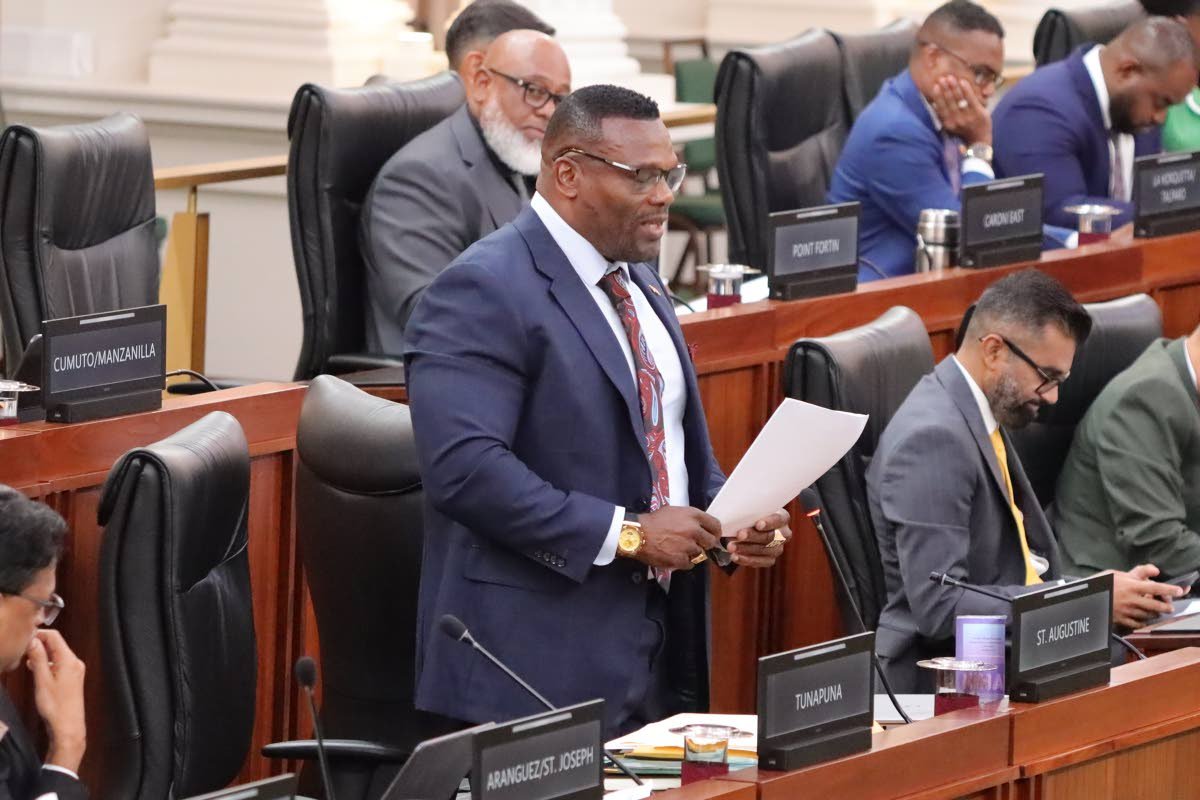
Speaking in the House of Representatives yesterday, Alexander said the Zones of Special Operations and Community Development Measure Bill will return to Parliament, arguing that the legislation is intended to combine targeted security operations with social intervention in vulnerable communities.
He said the legislation is intended to provide “special measures to uphold the rule of law, public order, citizens’ security and public safety” within geographically defined areas.
Alexander, however, sought to emphasise the community-development component of the legislation, insisting it should not be viewed simply as another law-enforcement tool.
“The Zones of Special Operations is not simply about sending law enforcement into a community. It is about security and community development working together,” he said.
He pointed to initiatives being undertaken through his Tunapuna constituency office as an example of the type of intervention he envisaged, including engaging young men, helping elderly residents learn to use computers and bringing medical assistance to people who are ill.
“That is what the Zones of Special Operations is. Where someone is sick in the area, we bring the doctor to them,” Alexander said.
The Law Reform (Zones of Special Operations) Bill, 2026 failed in the Senate in January after the Government was unable to secure the required three-fifths special majority in the Senate.
The legislation faced strong criticism over human rights concerns and safeguards, while the Government declined to accept nearly 50 proposed amendments during the committee stage.
The bill sought to empower the Prime Minister to declare high-crime communities Zones of Special Operations, allowing joint police and military operations, including warrantless searches, curfews of up to 72 hours and detention powers.
It also proposed the establishment of a Social Committee to coordinate housing, healthcare, infrastructure and other interventions in designated communities.
Alexander: 240 PDO detainees charged
Alexander also defended the Government’s use of the SoE, pointing to arrests, firearms seizures, Preventive Detention Orders (PDOs) and falling crime figures as evidence that the emergency measures worked.
As of day 191 of the SoE, Alexander said the protective services had conducted 13,108 operations and arrested 5,767 people.
He said 702 PDOs had been approved, of which 573 were executed, while law enforcement recovered 318 firearms and 6,414 rounds of ammunition.
Significantly, Alexander said 240 people detained under PDOs had subsequently been charged.
“As of day 191, 240 persons held under preventive detention orders have been charged,” he said, adding that investigations into others were continuing.
Alexander also pointed to reductions in serious crime.
A T&T Prison source told Guardian Media yesterday that they had been instructed to release 563 of the people detained under PDOs. That process started on Thursday and will continue for six days.
Between January 1 and September 10, he said total serious crimes declined from 8,014 in 2025 to 6,884 this year, a 14.1 per cent reduction. Compared with the 8,492 serious crimes recorded over the corresponding period in 2024, he said the reduction was 18.9 per cent.
He said murders declined from 438 over the period in 2024 to 262 in 2025 and 252 this year, while woundings and shootings fell from 542 in 2024 to 402 last year and 313 in 2026.
Alexander added that robberies also declined from 1,723 in 2024 to 1,325 last year and 901 this year, a 32 per cent reduction compared with 2025 and 47.7 per cent compared with 2024.
‘SoE ending because the law says it must’
Despite those figures, Alexander warned that the expiration of the SoE should not be interpreted as an indication that the security threat has disappeared.
“The state of emergency is ending because the law says that it must. It is not ending because the threat has disappeared,” Alexander told Parliament.
He said it was also not ending because the police had finished their work, criminal gangs had been given a reprieve or the Government had lost its resolve.
“The emergency powers will end, the fight against crime will continue,” he said.
Alexander also sent a warning to people being released from detention as the emergency powers expire, insisting that release should not be interpreted as vindication.
“Release is not exoneration,” he said.
“The expiration of the state of emergency detention powers does not ease or erase evidence. It does not close an investigation and it does not destroy intelligence.”
He said the expiration of the SoE also does not close police files or prevent charges from being laid later if investigators obtain sufficient admissible evidence.
The TTPS, he said, will continue investigating people and criminal networks of interest and bring matters before the courts once the evidential threshold is met.
Alexander said the SoE was only “one weapon” in the State’s arsenal and argued that the Government’s wider national security strategy will continue after the emergency powers disappear.
He said the TTPS will continue targeted operations, lawful surveillance, warrant execution, gun-suppression exercises, firearm recovery, high-visibility patrols and joint operations with other agencies.
The Government is also seeking to strengthen police manpower, with 233 recruits currently in training and another 800 Special Reserve Police officers expected to be absorbed into the TTPS.
Alexander said 500 Prison Service recruits are also undergoing training, with another 300 expected by April next year.
Six joint police and Defence Force mobile units are expected to become operational shortly, while Tobago is to receive three units. A further 24 units are expected to be strategically positioned across the country.
The strategy also includes new TTPS vehicles, school-oriented policing, parenting programmes and youth intervention initiatives.
Alexander argued that the Government has no intention of reducing its security presence because the crime figures are moving downwards.
“Crime is falling while pressure is being applied,” he said.
“We will not make a foolish mistake of reducing the pressure because the strategy is beginning to work.”
Earlier, Alexander made the Government’s central argument even more pointedly.
“Pressure works. Sustained law enforcement works. Intelligence-led policing works. Disrupting gangs works. Taking guns and ammunition off the street works.”
While acknowledging that no responsible government could attribute every reduction in crime to a single measure, Alexander said the evidence showed the country was moving in the right direction.
He said the Government would therefore intensify rather than abandon its strategy after the SoE ends.
“You do not abandon success,” Alexander said. “You improve on it.”
SoE (March 3 to present)— By the Numbers
Operations conducted: 13,108
People arrested: 5,767
PDOs approved: 702
PDOs executed: 573
PDO detainees charged: 240
Firearms recovered: 318
Ammunition recovered: 6,414 rounds
Serious crime reduction vs 2025: 14.1%
Murders in 2026: 252
Robbery reduction vs 2025: 32%