
Cairo/The rapid advance of Yemen’s Houthi rebels along the Red Sea coast and their arrival in positions near the Bab al Mandeb Strait is changing the balance of the conflict and threatens to have its consequences on maritime traffic and international trade.
The Houthi advances (a largely Shiite group backed by Iran) come amid the most serious escalation of rebel fighting against government forces, backed by Saudi Arabia, since the UN-brokered truce in 2022, and raise the risk of widespread war and greater involvement by Riyadh.
The rebels have chained conquests on the western coast of Yemen after completing control of the entire province of Al Hodeida this Thursday and taking the district of Hays and the coastal area of Al Jauja, in addition to the strategic port city of Mocha and the islands of Zuqar, Greater Hanish and Lesser Hanish.
Today, Friday, they extended their offensive to the Dhubab district, near Bab al Mandeb, while advancing towards the island of Mayun.
It is a vital international waterway and one of the world’s most important maritime choke points.
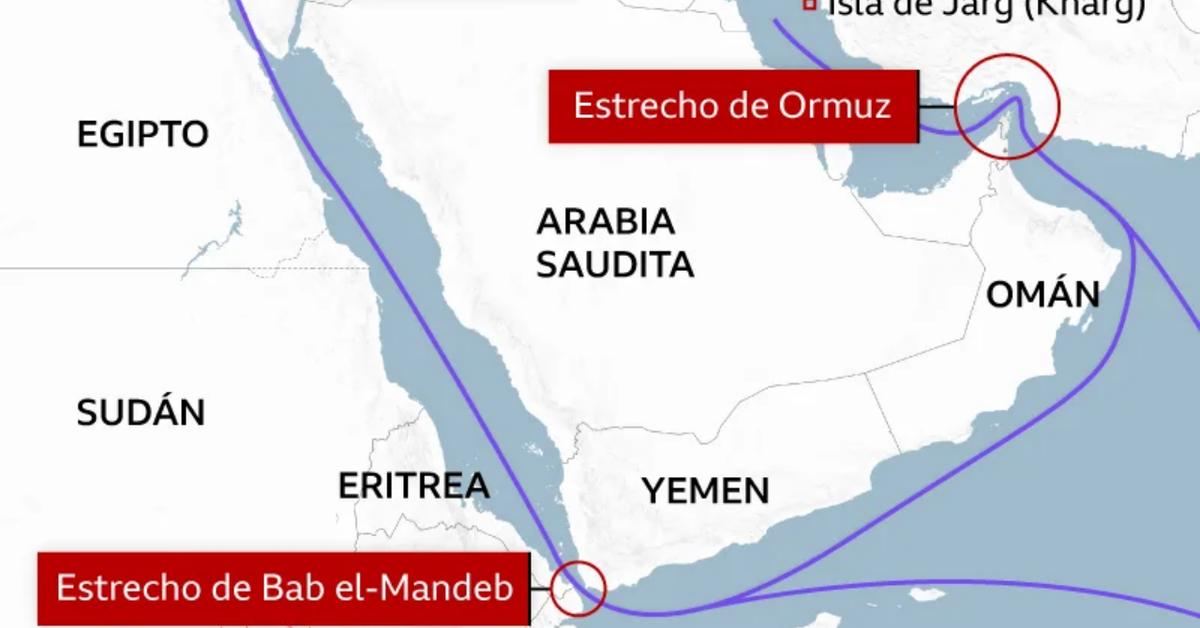
Bab al Mandeb is a strait that connects the Red Sea with the Gulf of Aden, and by extension with the Indian Ocean. It is therefore a vital international waterway and one of the most important maritime choke points in the world.
It is part of a key trade route between Europe and Asia, so any threat can impact traffic in the Red Sea, the Suez Canal and international trade.
The Houthi presence makes control of this strip a vital strategic issue for Saudi Arabia and the region, especially when the war between the United States and Iran has increased the importance of alternative routes to the Strait of Hormuz.
Although the insurgents claim that navigation through the Red Sea and Bab al Mandeb is “safe” for all shipping companies except Saudi vessels, experience in recent years shows that the Houthis do not need to close the strait or completely disrupt traffic to cause an international impact.
Sana Center for Strategic Studies researcher Majed al Madhaji argued in a report this Thursday that “the Houthis do not need to completely close Bab al Mandeb.”
“It is enough for them to become the party whose authorization must be requested, or whose threat must be taken into account, every time a ship passes through the area,” he noted, in addition to pointing out that the rebels are “creating a new model by which they decide” who passes and who does not.
“The Houthis do not need to completely close Bab al Mandeb. They simply need to become the party whose authorization must be requested, or whose threat must be taken into account, every time a ship passes through the area”
In fact, attacks on ships in the Red Sea resulting from Israel’s conflict in the Palestinian territories led many companies to avoid the route and choose to go around Africa, and a new deterioration in security could reproduce that dynamic, making insurance and fuel more expensive and lengthening supply chains.
Furthermore, this situation coincides with the crisis in the Strait of Hormuz, a passage through which approximately 20% of the world’s oil and gas supply transited and which continues to be a point of friction.
If supplies were restricted from passing through another key strait, that could further drive up oil prices, which already exceed $100 a barrel for Brent, during the week due to the exchange of attacks between the US and Iran.
Iran is the Houthis’ main ally, although Tehran insists the Yemeni group operates independently and does not take orders from it.
The Yemeni government, for its part, accuses Iran of supporting the rebels with political, military, financial and technological support.
The advance towards Bab al Mandeb thus also has a regional dimension because a possible Houthi control of navigation in the strait could strengthen Iran’s position in its confrontation with the United States and allow it to exert pressure on another strategic point, after the growing tension in Hormuz.
The decisive question will be whether Saudi Arabia chooses to increase its involvement to stop the advance or remains cautious to avoid a new escalation.
Some analysts believe that Tehran and the Houthis have been preparing for this possibility for some time by strengthening the group’s military capabilities and deploying weapons along the Red Sea coast.
For Saudi Arabia, the Houthi advance poses a particularly complex dilemma. Riyadh maintains its support for the Yemeni government and the forces fighting the rebels, but a new large-scale military intervention would mean reopening a front that the kingdom had tried to contain in recent years.
The Persian Gulf country is especially exposed because, after the almost complete closure of Hormuz, it has increased its dependence on the Red Sea route for its exports.
The decisive question will be whether Saudi Arabia chooses to increase its involvement to stop the advance or remains cautious to avoid a new escalation.
Whether the Houthi advance becomes a new phase of the Yemen war or the beginning of a crisis with much greater regional repercussions will largely depend on that decision.