
All views and claims in this letter belong solely to the author and do not necessarily reflect the views of Dominica News Online.
Dear Editor:
The Caribbean has the highest abortion rate in the world. https://www.guttmacher.org/sites/default/files/factsheet/ib_aww-latin-america.pdf
Yet, for generations we have been a region characterized by severely restrictive criminal abortion laws.
It should be abundantly clear that criminalising abortion has been a catastrophic failure. Our criminal law has not prevented abortions, and therefore it has not safeguarded the sanctity of life.
Any reasonable person who truly valued the sanctity of life would say, “It’s time to try a different approach.” But no, our conservative religious leaders cling to our criminal law. They contend that “legalizing abortion would send the wrong moral signal.”
Apparently, that moral signal is more highly valued than the sanctity of life. For legalizing abortion reduces the number of abortions. This has been the documented experience in Barbados and Guyana, and across the world.
We challenged the constitutionality of the law in Dominica and the High Court ruled in our favour. Justice Zainab Jawara-Alami took the standard, prudent, judicious approach: she used a laser rather than an axe. We applaud her incremental legal caution.
We asked her to declare the law unconstitutional, full stop. That would have decriminalized abortion and left the Government to legislate. She chose not to apply the axe.
Instead, she threaded the needle. Rather than declare sections 56 and 57 bluntly unconstitutional (para 198), she held that they “cannot constitutionally continue to operate in their present form” (para 197). She then ordered that the Government must modify those clauses “to the extent necessary to remove the constitutional inconsistency” (same para). And she identified those conditions in which the continuation of pregnancy ran afoul of women’s constitutional rights as rape, incest, and severe foetal anomaly (para 197), and for the protection of women’s health (para 195).
Justice Jawara-Alami’s ruling is richly buttressed by legal precedent and anchored in the fine tradition of legal incrementalism. On that plane, there is no fault. She stayed in her lane.
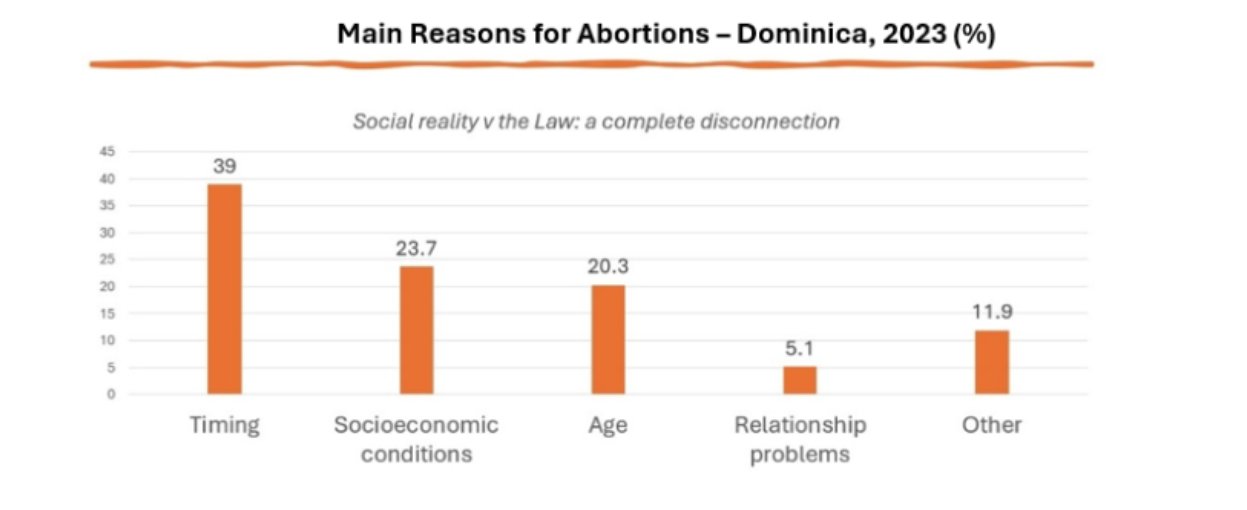
But as advocates, that legal wisdom falls short of addressing the ugly state of abortion in Dominica. Despite data presented to the court, there is no attention to this wretched social reality. Her fine legal judgment is disconnected from the cruel environment outside of the courthouse.
Our data show that at least 83% of the reasons women in Dominica give for having abortions will remain untouched by this decision and so will stay criminalised. Almost 40% have abortions for reasons of timing – I just had a child, I cannot have another now; I must first complete my education, etc. Another 24% because their social and economic situation puts having a child at this time, beyond their capacity. And a further 20% because of their age, whether they are too old or too young.
While addressing this wider issue is not the business of the court, it is not one the court should ignore. We are now left in the peculiar contradiction in which the court has “invited” the Government that opposed the law, and which resists any dialogue about the law, to modify the law. Really? What do we expect?
Sincerely,
ASPIRE
ASPIRE is a pro-motherhood, pro-family, pro-choice, non-governmental advocacy group registered in Dominica and five other Caribbean countries. It promotes research and dialogue with civil society and governments to advance fairness and justice in reproductive health.