ANI |
Updated: Sep 08, 2026 15:51 IST

Hong Kong, September 8 (ANI): China attempted to throw its weight around at the 55th iteration of the Pacific Islands Forum Leaders Meeting, held in Palau from 31 August to 3 September 2026. Beijing started in a huff after the host country invited Taiwan to attend.
Taiwan is a development partner to the forum, and its Foreign Minister Lin Chia-lung was present for this annual gathering. Qian Bo, China’s Pacific envoy, spoke to the media at the opening ceremony and threatened “consequences’ because of Taiwan’s presence.
Indeed, just a few days earlier, China’s Ministry of Culture and Tourism laughably issued a formal warning telling Chinese travellers to be wary of visiting the tourism-dependent nation of Palau because of the risk of robbery. This was none other than a blatant tit-for-tat by Beijing.
Qian bombastically pledged to vocalise strong Chinese objections at the forum’s session with dialogue partners. However, he backed down and did not even mention Taiwan during his brief statement.
This was presumably due to the immediate response from Pacific leaders, who pushed back against Qian’s threats. For instance, New Zealand Foreign Minister Winston Peters said the group did not take instructions from countries outside it. Because of Beijing’s bellicosity, many increasingly see China as a bully rather than a friend – and most Pacific Island nations feel there is no place for Beijing’s “wolf warrior diplomacy” within the region.
Of course, the location for the Pacific Islands Forum Leaders Meeting was significant, for Palau is one of the few nations in the world that still maintains diplomatic relations with Taiwan instead of with China. This helps explain the speech of Palau President Surangel Whipps Jr, the new chairman of the forum, who invited all Pacific partners to “sail with them” but underscored that the Pacific Islands are the captain of the ship. This was a veiled reference warning China not to be so caustic.
China has whittled down the number of Pacific Island countries with formal ties to Taipei to just three: the Marshall Islands, Palau and Tuvalu. Worldwide, just twelve nations still formally recognise Taiwan rather than China. Beijing would love to reduce that total to zero.
China is believed to have also exerted pressure on other Pacific leaders not to attend the forum. The heads of Fiji, Vanuatu, Samoa, Solomon Islands and Kiribati were all absent for one reason or another.
Pacific Islands Forum members, comprising 16 nations plus Australia and New Zealand, are particularly vulnerable to global events and to climate change. China for one is attempting to take advantage of these vulnerabilities, especially when large states like Australia and the USA ignore or do not give the region the attention it deserves.
In its final communique, the Pacific Islands Forum acknowledged that “the Blue Pacific continues to face a period of growing uncertainty, marked by intensifying geopolitical competition, economic volatility, climate threats and rapid technological change. Leaders noted that these global developments increasingly affect Pacific economies, societies and development pathways, reinforcing the importance of a united and strategic regional response. Leaders reaffirmed that regional priorities and aspirations must remain at the centre of the region’s engagement with international partners and institutions.”
One of those competitive threats is China, which lobbed an intercontinental-range ballistic missile, launched from a submerged submarine of the People’s Liberation Army Navy (PLAN), into the South Pacific on 6 July. The flight path of the missile saw it travelling over the northern Philippines and Luzon Strait. After passing near Palau and Guam and flying approximately 7,300km, the unarmed missile splashed down between Nauru and Tonga in the South Pacific Nuclear-Free Zone.
Senior Captain Wang Xuemeng, a PLAN spokesperson, said at the time that China had “successfully launched a strategic missile carrying a dummy warhead toward relevant high seas of the Pacific Ocean at 12:01 p.m., which landed precisely within the designated waters”.
China called it a “routine arrangement of the annual training of the PLA Navy”. This action was upsetting to many, for China failed to give reasonable warning and it transgressed the Blue Pacific Ocean of Peace Declaration agreed at last year’s meeting.
Ironically, the agreement is designed to insulate the Pacific from great-power competition. Furthermore, July’s missile test followed the full-range test of a land-launched intercontinental ballistic missile into the Pacific in 2024. These are indications that such tests are likely to become semi-routine for the PLA.
The communique addressed this latest missile test, registering “concern on the ICBM test which overflew a number of members without adequate notice. Leaders called on all states undertaking ICBM testing to ensure transparency and reassurance, including through the provision of advance notification of at least 24 hours in accordance with international practice.”
Ultimately, that statement failed to finger China as the culprit, and Nauru dissented from it. Nauru and Kiribati are regarded as being close to China. Of the missile splashdown, Whipps Jr asked, “Why does it have to come to the middle of the Pacific when last year we just signed a declaration of Peace for the Pacific? You know we don’t want our backyard, our home, to be threatened and disrespected.”
Even as this final meeting was occurring, China’s Foreign Ministry made known its distaste for Palau and Whipps Jr. It stated, “Palau has repeatedly raised this issue in an ill-intentioned attempt to hijack the position of other member states of the Pacific Islands Forum. It will not have its way.”
But Palau’s leader had the backing of nearly all forum members. New Zealand Prime Minister Christopher Luxon remarked, “Given all the history in our part of the world with nuclear testing…that’s just not something we want to see.” Referring to Nauru, he added, “…We’re not going to not make a statement as a Pacific Island Forum because of the objection of one country, and you’d have to ask them as to what their rationale for that was. Suffice to say, everyone else was fully on board.”
It was encouraging that, when nations banded together and stood up to China’s browbeating, Beijing backed down. This is not to say Beijing will relax efforts to diplomatically isolate Taiwan, or to continue pressurising those who support the beleaguered nation. Palau is obviously one of those facing unrelenting pressure.
Charles Edel and Kathryn Paik, members of the US-based Center for Strategic and International Studies, warned in a recent report that US actions are actually opening doors for China to spread its influence in the Pacific region. They argued, “For years, the United States has declared itself a ‘Pacific power’, yet in reality the United States has treated the Pacific Islands – a vast region stretching from Papua New Guinea east past Hawaii – like a forgotten relative that is remembered only during times of crisis and then quickly overlooked. This neglect is now catching up to the United States as a resurgent and ever-opportunistic China is deftly filling this vacuum.”
The US government proposed a 90% cut to USAID programs globally, and the Center for Global Development reported that these cuts reach 100% of USAID funding for Papua New Guinea, Vanuatu, Palau, Fiji and Solomon Islands. The Palau Red Cross Society, for example, could lose nearly US$600,000 in humanitarian aid. Nearly every Pacific nation was also hit with the irascible President Donald Trump’s “Liberation Day” tariffs ranging from 10-32%. Yet, bilateral Pacific Island-US trade is just a miniscule US$1 billion annually.
The Mariana Islands and Guam are vital to US security interests, yet China is conducting deep-sea surveys in the nearby Mariana Trench. More than 25% of Guam’s land area is occupied by US military bases, and the USA has belatedly realised it needs to beef up its defences. All these seabed surveys help Chinese submarines to navigate and hide in the area, after they have transited through the so-called First Island Chain.
Secretary of War Pete Hegseth has described the USA’s Pacific territories as the “tip of America’s spear” in terms of deterring China. These Compact of Free Association countries offer critical defence access to the USA. However, perceptions of the USA are being undermined at almost every turn by the US government.
Edel and Paik remarked that “the numbers reveal a worrying pattern that shows a lack of US interest, undermining Washington’s ability to forge lasting partnerships and jeopardising US strategic interests in a region becoming increasingly critical to US competition in Asia”.
Strong-arm tactics by Trump may force these small and mostly poor nations to seek help elsewhere. Naturally, lurking in the wings is China. In May this year, Beijing hosted Pacific foreign ministers at a summit for the first time. There, China unveiled plans for more than a hundred projects related to climate change, with the latter topic deemed the greatest threat to the region.
For a long time there was much complacency about China’s presence and influence. Beijing is investing in infrastructure through its Belt and Road Initiative, offering debt relief and financing. Already, Chinese diplomats in Pacific nations outnumber American ones as much as 10:1.
Such “largesse” of course wins China a great deal of influence. As Papua New Guinea Prime Minister James Marape said, “Our trading partners in Asia…have treated Papua New Guinea with respect, honour and fairness … If the US market becomes more difficult…we’ll simply redirect our goods to markets where there is mutual respect.”
Yes, there has been a belated response from the USA, such as reopening diplomatic outposts and reestablishing the USAID mission in Fiji. New US embassies opened in Honiara and Tonga in 2023, in Vanuatu in 2024, and it has announced one for the Cook Islands. However, much of these efforts are being undone by Trump’s approach to diplomacy.
The US Deputy Secretary of State Christopher Landau turned up in Palau with the promise of USD 50 million to upgrade a port on the island of Penrhyn in the northern Cook Islands. It is doing so in conjunction with New Zealand, which will invest USD 10 million. The governments said the “upgraded port facilities will deliver safety and security benefits”.
The Cook Islands signed a comprehensive strategic partnership with China last year, shocking Wellington and causing a diplomatic rift. China is adept at creating long-term dependencies that shift the political orientation of recipients, and this is extremely worrying to Australasia in their own backyards.
For its part, Australia pledged 600 million Australian dollars to fund an anti-drug-smuggling initiative called Waqa Moana. In recent months, Australia signed new security or enhanced partnerships with Papua New Guinea, Fiji and Vanuatu. Oliver Nobetau, Pacific Fellow at the Australian-based Lowy Institute, commented: “Pacific Island countries are still getting better at hedging, you know, playing the major and middle players off each other, and this is a classic case of what we’re seeing right now.”
In other words, Pacific Island nations can gain benefits from both China and their larger Australasian neighbours or the USA. This is resulting in seesawing relations as each side struggles for ascendancy.
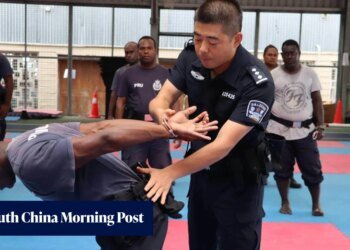
This is similar to the case of the Solomon Islands. Former leader Manasseh Sogavare, who was in China’s pocket, signed a security pact with China in 2022 and allowed Chinese police into the nation. The current leader Matthew Wale, a close ally of Australia, moved rapidly to review that secretive agreement. Wale has proposed a Pacific-wide security pact that would close the door on China, as well as seeking to sign a new comprehensive agreement with Australia by the end of this year.
However, Wale had to pull out of the Pacific Islands Forum after three cabinet ministers resigned and announced a no-confidence motion in his leadership. Many believe China is stirring this unrest to oust Wale, and timed it to coincide with the forum meeting.
This all illustrates the kind of behind-the-scenes arm wrestling that is going on between China and the West for influence in the Pacific. (ANI)