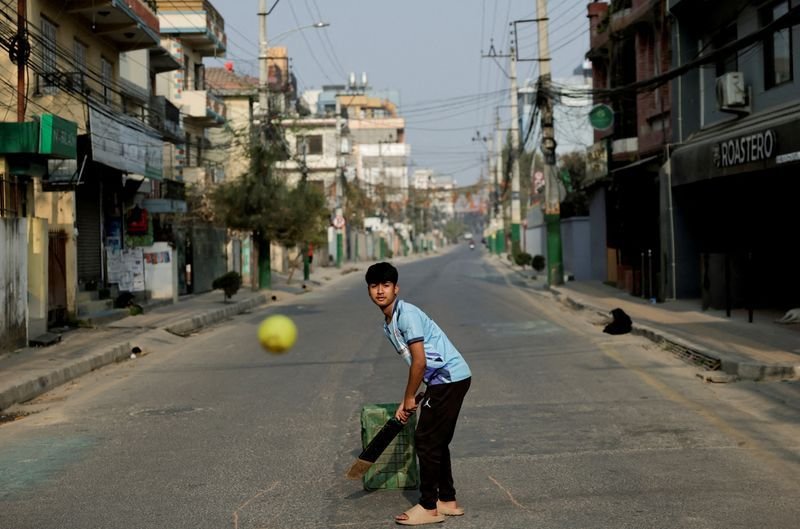
NEW DELHI, Aug 25 (Reuters) – For years, Nepal has been one of cricket’s great stories-in-waiting: a country of extraordinary public passion, flashes of on-field promise and crowds that treat every international as a national event.
Now even the game’s global governing body believes the Himalayan nation of 30 million could be the next Associate member of the International Cricket Council to take their place at the sport’s top table.
“They could be tomorrow’s Afghanistan, or tomorrow’s New Zealand for that matter,” ICC Chief Executive Sanjog Gupta told Reuters.
“They have developed an elite player pool which is consistently breaking through the ICC pathways and not only featuring at our marquee events, but proving that they belong on the global stage.”
The Afghanistan comparison is hard to escape.
From its Associate beginnings, a war-torn Afghanistan fell in love with cricket, impressed in shorter formats and eventually earned test status in 2017.
Like Afghanistan, Nepal may not bring the game huge riches but will be a welcome expansion of the sport, which remains popular in certain pockets and is played by a dozen teams at the elite level.
“Nepal represents enormous potential and opportunity for cricket,” explained Gupta.
“Not because the country is a significant commercial market, but because of their rapidly improving standards of performance and the scale of fandom the sport enjoys in the country.”
PASSIONATE FAN BASE
The ICC has pumped nearly $5 million into Nepal’s cricket development in the last two years and has awarded the country co-hosting rights for next year’s under-19 Women’s World Cup.
“Nepal benefits from the biggest endowment any sport can wish for – a large, deeply passionate fan base,” said Gupta,adding, “Fans today are also the players of tomorrow”.
“One of my personal highlights from the Twenty20 World Cup 2026 was the sea of red at the Wankhede (Stadium), which had turned up to support Nepal against Scotland.”
Nepal beat Scotland by seven wickets to claim their first victory on that world stage since 2014, although both teams had already been eliminated.
Qualifying for the T20 World Cup for the first time in 2014 was the turning point for Nepal.In a region dominated by cricketing heavyweights India, Pakistan and Sri Lanka, Nepal had long watched others and suddenly it had a team of its own.
One-day international status in 2018 helped cricket overtake football as the country’s favourite sport.
“It really skyrocketed this sport into Nepali households,” former captain and secretary of the Cricket Association of Nepal Paras Khadka told Reuters.
“Qualification meant people started to have faith in the team. All of a sudden, it brought out national sentiments, and a sense of pride in Nepalis.”
‘FESTIVAL OF HIMALAYAS’
Two seasons of the Nepal Premier League have added significant revenue to sustain the game’s growth.
“If we are to grow as a cricketing nation, the NPL will be a pivotal part of the growth,” Khadka said of the T20 league, underlining the commercial and entertainment value of the ‘Festival of Himalayas’.
“Whatever money NPL generated has been used in cricket itself. It’s a strong commercial avenue for us now.
“If this keeps growing, we’ll create that cushion for us to start development programmesand build infrastructure, which requires a lot of financial stability.”
The country’s cricket fervour rivals that of India, but Khadka, who captained Nepal for over a decade before stepping down in 2019, says sustained performance remains non-negotiable.
“You could have everything around you, but if you don’t play good cricket, people don’t follow you,” he said.
Nepal showed it can compete in the 20-overs format, nearly pulling off upsets against England and South Africa at the World Cup in India earlier this year.
“You only become a better cricketer when you play against better cricketers, and you become a better team when you play against better teams,” said Khadka.
That need for exposure anchors Nepal’s next phase, with the board planning bilateral cricket against test-playing nations.
“We are in conversations, and hopefully this gets materialised very soon,” Khadka said.
Nepal has also rolled out player contracts for men and women, introduced red-ball cricket and is expanding infrastructure.
For Khadka, Afghanistan’s rise is a model worth emulating.
“There’s a blueprint for sure,” he said. “We definitely would like to follow the same journey.”
(Reporting by Amlan Chakraborty in New Delhi; Editing by Ken Ferris)