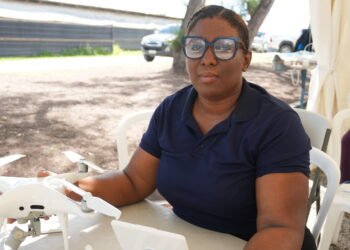
University scientists are preparing to test a new mosquito-control device in Barbados while exploring another biological approach that has significantly reduced dengue infections and hospitalisations in overseas trials, Barbados TODAY can reveal.
Researchers at the Centre for Biosecurity Studies at The University of the West Indies, Cave Hill are hoping to begin field trials of the lethal ovitrap as soon as possible, as they look at alternatives to the heavy reliance on chemicals to control disease-carrying mosquitoes.
The ovitrap is a dark container containing water and fitted with mesh and a surface on which mosquitoes can lay their eggs.
The eggs fall through the mesh into the water, where the larvae hatch and develop into pupae. When adult mosquitoes emerge, they are trapped beneath the mesh and cannot escape.
Ovitraps imitate the preferred breeding sites of container-breeding mosquitoes such as Aedes albopictus and Aedes aegypti.
Dr Kirk Douglas, the centre’s director, described the ovitrap as a mass removal trap for adult mosquitoes. He said it adds to the tools available for vector control and could help reduce the country’s heavy reliance on chemical methods.
“It’s an innovation we have started at the Centre for Biosecurity Studies at UWI Cave Hill,” he told Barbados TODAY in an interview. “That is something we are hoping we can have a field trial launch where we will be looking at controlling the treatment areas and to see how the impact of implementing these mass removal devices can help in terms of reducing the level of transmission of vector-borne diseases, not only dengue, but others.”
The centre is also monitoring the global success of the Wolbachia biological control approach as another possible alternative.
“This is an area we are keen on because of the heavy dependency on the chemical control of vectors. The use of Wolbachia is something that continues to emerge as an early good source as an alternative for vector control,” Douglas said.
“What it really is,” the university scientist added, “is an endosymbiotic [control method] which means it is a bacteria that lives inside the cells of the mosquito that has been deployed to control vectors. It actually blocks viral replication within the mosquito. So it’s a natural bacteria found in several different insects. But it was found that this type of bacteria, when present in mosquitoes, actually blocks the replication of dengue, chikungunya, yellow fever, Zika and all of these other viruses.”
The full name is Wolbachia pipientis.
“What these projects have done is to introduce the bacteria into the insects, and by doing so, they are able to do that. They will rear the adult mosquito carrying the Wolbachia and release them into the targeted areas. The US is undergoing an evaluation to start that in the hotter states like California and Florida where there is a problem with mosquitoes,” he said.
Douglas further explained: “Once the male is released, they would normally mate with the female and when the male mates with an unaffected wild female, the egg generally does not develop because of incompatibility. So they would have to do sequential release of the male mosquitoes. This is biological control.”
He noted that many people were initially sceptical about how the method could be used on a large scale and how effective it would be. However, he said more evidence is now emerging.
The university expert pointed to a cluster trial in Indonesia as providing strong evidence for the effectiveness of the population replacement approach.
“They were able to establish a particular strain of the local Aedes aegypti mosquito population, and this actually led to a significant reduction in systematic confirmed dengue cases – around 77 per cent and also, very high reduction in dengue hospitalisation when compared to the treatment area of mosquitoes which were not in the treatment area. That was an 86 per cent reduction,” Douglas said.
“So we can see with that level of reduction it helped with managing outbreaks a lot better because you are coming at the source, which is really the mosquito and working through biological control to prevent further infections.”
He said research is ongoing globally, and the centre is monitoring developments to determine whether the approach could be a viable strategy for Barbados.
(EJ)